


Part 36. Herbage Vegetables
Description
This section is from the book "Plants And Their Uses - An Introduction To Botany", by Frederick Leroy Sargent. Also available from Amazon: Plants And Their Uses; An Introduction To Botany
Part 36. Herbage Vegetables
36. Herbage-vegetables may be defined as those which yield us nutriment in shoots developed above ground. They include "pot-herbs" and certain "salads." The most nutritive part is in some cases the tender and more or less thickened stem, as with asparagus (Figs. 62 I, II) and kohlrabi (Fig. 66). Sometimes as in kale, borecole, cabbage, and Brussels sprouts (Figs. 63-65, 67-69), watercress (Fig. 71), spinach (Figs. 72-74), and lettuce (Figs. 75-77) the leaves are of most importance. With celery (Figs. 78, 79) the leafstalk is the part employed, while in the cauliflower (Fig. 70) it is the much branched and thickened flower-stalk, together with the innumerable buds which it bears.

Fig. 44.-Turnip. (Brassica campestris, Mustard Family, Cruciferoe). Plants showing fleshy roots, and rosettes of leaves, as they appear at the end of the first year's growth. x 1/5. (Vilmorin.)-Plant a biennial; root varying greatly in form and color under cultivation; leaves bright green; rough-hairy.

Fig. 45.-Turnip. Middle section of second-year stem which bears the flowers. A lower leaf. Flower-cluster with young fruit. Fruit, natural size. (Britton and Brown.)-The plant in its second year becomes about 1 m. tall or less; the lower leaves are hairy, the upper ones smooth; the flowers yellow.

Fig. 46.-Radish. (Raphanus sativus, Mustard Family, Cruciferoe). Part of stem bearing leaves. Flower cluster. Fruit. (Brit-ton and Brown.)-Plant an annual, or in cultivation behaving as a biennial: roots flattened, spherical or long-conical, variously colored, mostly white or red; stem and leaves bright green, more or less covered with stiff hairs; flowers pink or white.

Fig. 47.-Carrot (Daucus Carota, Parsley Family, Umbelliferoe). Plant showing root and rosette of leaves at the close of the first year's growth. (Nicholson.)-The roots vary considerably as regards form and color, being conical, cylindrical, or globular; red, orange, yellow, or white; and from about 5-50 cm. long; leaves bright green, hairy.
In chemical composition, and consequently in food value, herbage-vegetables are found to be a good deal like earth-vegetables. The chief difference is that the former have, on the whole, a somewhat larger percentage of water, and a smaller amount of digestible carbohydrate. As against these deficiencies, however, there is a decidedly larger proportion of proteid in relation to the other nutritious materials. For example in lettuce which has at once the most water and the least proteid of any of the herbage-vegetables given in the table, we find that about one-third of the nutritive material (representing nearly one-quarter of the total weight exclusive of water) is proteid; while in the sweet potato (which of all the earth-vegetables given, has the least water and next to the most proteid) the proportion of proteid to other nutrients is approximately 1 to 12 (being to the total weight of the material dried, nearly as 1 to 18).

Fig. 48.-Carrot. Upper part of plant in flower and fruit. (Baillon.)- Plant a biennial, becoming about 1 m. tall; flowers mostly white, the central one of a cluster being usually dark purple.

Fig. 49.-Carrot. Flower, enlarged. (Baillon.)
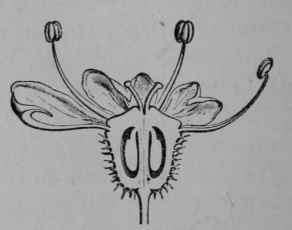
Fig. 50.-Carrot. Flower, cut in half vertically. (Baillon).

Figs. 51-53.-The three upper figures. Carrot. Diagram of flower, showing the arrangement of the parts as they would appear if cut across and viewed from above. Fruit, viewed from the side. Enlarged. Fruit, cut across, showing oil-tubes, at the bases of the long spines. (Baillon.)
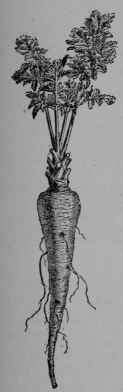
Fig. 54.-Parsnip (Pastinaca sativa, Parsley Family, Umbelliferoe). Plant at close of first year's growth, showing fleshy root and a few of the younger leaves, the older ones having been cut off. (Nicholson.)-The root varies somewhat in form but is commonly conical; the flesh whitish or pale yellow.

Fig. 55.-Parsnip. Part of leaf, reduced. Part of fruit cluster, reduced. Fruit, enlarged. D, half of the same cut across. (Britton and Brown.)- Plant a biennial or sometimes an annual, smooth or somewhat hairy, becoming 0.6-1.5 m. tall; leaves bright green; flowers similar in form to those of the carrot, but somewhat larger and yellow. Many insects are attracted by the clustered flowers.

Fig. 56.-Sweet Potato (Ipomoea Batatas, Morning-Glory Family, Con-volvulaceoe). Stem, leaves and roots. X 1/4. (Redrawn.)-Plant a perennial (i. e. growing more than two years) with creeping stems becoming 2-3 m. long; leaves dark green, glossy; flowers purple, closely resembling those of the common morning-glory; roots becoming fleshy, sweet, and yellow within; fruit dry.
Continue to:


My Books

