


Parts 18 Oats - 19 Barley - 20 Rye
Description
This section is from the book "Plants And Their Uses - An Introduction To Botany", by Frederick Leroy Sargent. Also available from Amazon: Plants And Their Uses; An Introduction To Botany
Parts 18 Oats - 19 Barley - 20 Rye
18. Oats thrive in northern regions where most of the other grains do not flourish. This grain forms one of the chief foods of the Scotch, Icelanders, and Scandinavians. Where other grains are used more largely as human food, it is especially valued as a fodder for horses.

Fig. 19.-Map showing, as in Fig. 16, native home and present range of oats. (Original.)
19. Barley, in spite of its more southerly origin, grows even farther to the north than oats, and thrives equally in subtropical regions. Although anciently of great importance as a breadstuff, it is now used chiefly for malting (see section 29) and as fodder for domestic animals.
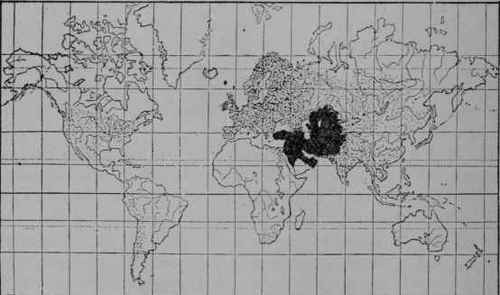
Fig. 17.-Map showing, as in Fig. 16, native home and present range of barley. (Original.)

Fig. 10.-Common barley (Hordeum sativum, var. vulgare, Grass Family, Gramineoe). Plant, flower-cluster, spikelet, flower, and fruit. (Baillon.)
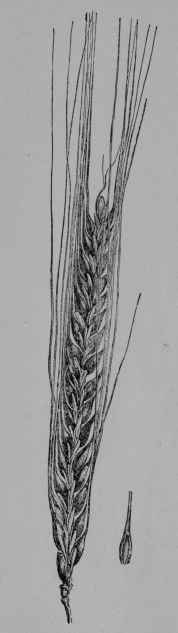
Fig. 11.-Two-rowed barley (H. sativum, var. distichori). Flower-cluster and base of a spikelet, slightly reduced. (Hackel.)
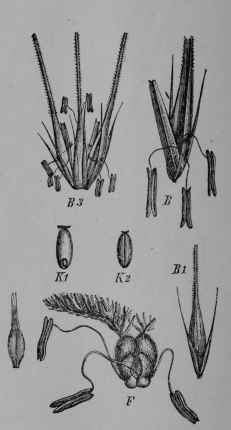
Fig. 12.-Six-rowed barley (H. sativum, var. hexastichon). B3, a group of three spikelets, as they appear together at a joint of the rachis. B, Bl, single spikelets. E, a flower (one stigma partly removed). Kl, K2, back and front views of kernel. All more or less enlarged. (Nees.)
20. Rye will grow in a poorer soil than any other grain. This fact accounts for its importance in regions that are hilly or otherwise difficult of tillage. From it is made a dark-colored bread, largely used by the peasantry of Austria, Germany, and Russia. In Sweden rye is highly valued as a breadstuff by all classes.

Fig. 18.-Map showing, as in Fig. 16, native home and present range of rye. (Original.)
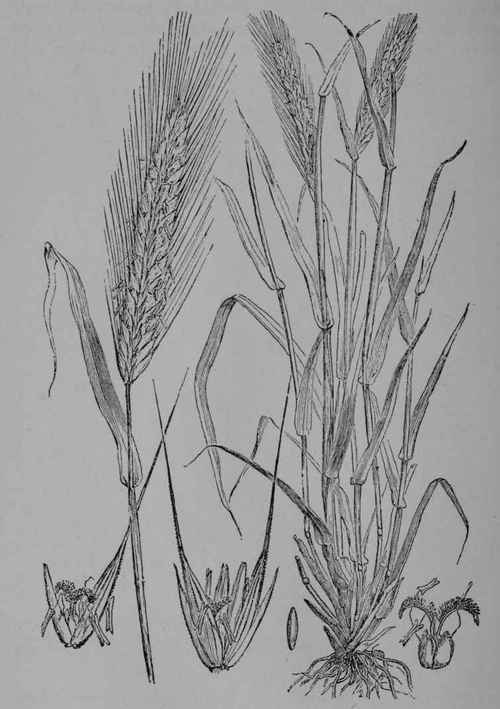
Fig. 7.-Rye (Secale cereale, Grass Family, Gramineoe). A plant, a flower-cluster, two spikelets with bracts spread apart, a flower, and a kernel. (Baillon.)
Continue to:


My Books

