


Part 21. Maize Is One Of The Most Important Of The Grains
Description
This section is from the book "Plants And Their Uses - An Introduction To Botany", by Frederick Leroy Sargent. Also available from Amazon: Plants And Their Uses; An Introduction To Botany
Part 21. Maize Is One Of The Most Important Of The Grains
21. Maize is one of the most important of the grains. The ease with which it may be grown in almost any climate, and the simple way in which the kernels may be prepared for eating, have made it almost as widely used among the savages of the Old World, as formerly among the American Indians. It is less valued as a human food in Europe than with us, but is universally recognized as one of the very best foods for domestic animals, particularly for use in fattening.

Fig. 21.-Map showing, as in Fig. 16, native home and present range of maize. (Original.)
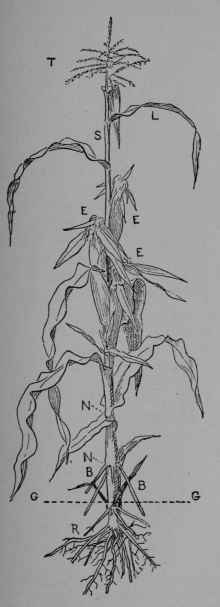
Fig. 13.-Maize (Zea Mays, Grass Family, Gramineoe). A plant in flower. T, the "tassel" (a cluster of flowers having stamens but no pistils); S, stalk; L, leaf; E, E, E, the "ears" (clusters of flowers having pistils but no stamens); N, N, nodes (swollen joints of the stem); B, B, brace roots, which serve as guys helping to hold the stalk upright; R, earth roots; G, G, surface of ground. About one-twelfth natural size. (Original.)
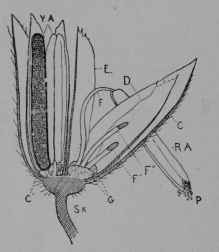
Fig. 14.-Maize. A spikelet from the tassel cut lengthwise to show its two flowers; the one on the right fully open, the other not yet mature. Sk, stalklet; C, C', outer bracts; D, E, inner bracts of the open flower; G, lodicules, which by swelling have spread apart the bracts; F', F", filaments cut across; F, filament bearing ripe anther (R, A) shedding pollen (P); Y, A, young anthers, the left hand one cut to show the pollen. Enlarged. (Original.)
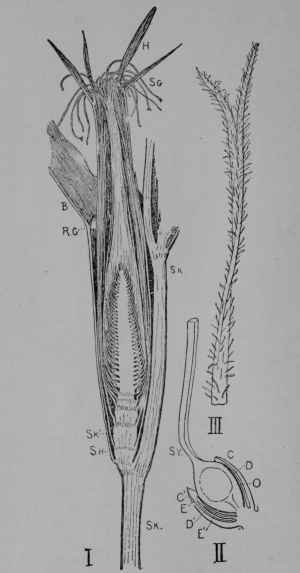
Fig. 15.-Maize. I. A young ear cut through the middle lengthwise. Sk, Sk, the main stalk; Sk', a short branch which bears the ear; Sh, sheathing lower part of the leaf which enfolds the whole ear and its husks; B, blade of the same leaf; R, G, the rain-guard which keeps rain from running into the sheath and promoting decay; H, the "husks" or large, more or less leaf-like bracts around the ear; Sg, stigmas (the "silk") protruding beyond the husks. About one-third natural size. II. A spikelet of the same ear, showing the bracts (C, C', D, D', E, E') and the ovary (O), and the lower part of the style (SY) of the single pistil. Enlarged. III. Upper part of stigma of the same, showing the delicate hairs that cover it. Enlarged. (Original.)
Continue to:


My Books

