


Parts 45. Food Plants In General and Part 46 The Primitive Centres Of Agriculture
Description
This section is from the book "Plants And Their Uses - An Introduction To Botany", by Frederick Leroy Sargent. Also available from Amazon: Plants And Their Uses; An Introduction To Botany
Parts 45. Food Plants In General and Part 46 The Primitive Centres Of Agriculture
Part 45. Food-plants in general. When considering the cereal grains, we found that important facts regarding their special value and present use were explained by the original geographical range and economic history of the species. We have now to conclude our study of food-plants by a comparison, from this point of view, of the other kinds with these, so that we may arrive at some further general ideas concerning them.
Part 46. The primitive centers of agriculture. We have already seen that the three grains, wheat, rice, and maize, which have played a supremely important part in the history of mankind, are each native to a region which is widely separated from the homes of the other two,-wheat being indigenous to Mesopotamia, rice to southeastern Asia, and maize to tropical America.
There is abundant evidence to show that it was in these regions, and in the lands immediately adjacent, that agriculture was first systematically pursued, and thus made possible the development of the great civilizations of antiquity.
It is certainly a fact of profound significance in human history that wheat, the most valuable of the grains, should be native to a region so near the junction of the three continents of the eastern hemisphere. Antiquarian scholars are of the opinion that from the fertile valley of the Tigris and Euphrates as a center, agriculture, with the civilization which it implies, extended to all the great peoples of Africa, Europe, and southern and western Asia. A more restricted civilization of later development and less importance was that which arose in the valley of the Hoangho and Yangtse-Kiang, and formed the beginning of the present Chinese Empire. Still later, although many centuries before the coming of Columbus, an important agricultural center was established on the highlands of tropical America, and formed the basis of those remarkable civilizations of the Nahuas and Incas which the Spanish invaders overthrew.
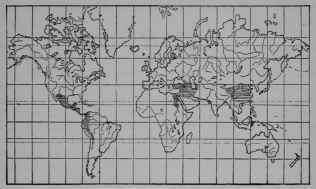
Fig. 121.-Map showing, by shaded areas, the three primitive centers of agriculture.
These three primitive centers of agriculture (Fig. 121) are important for us to remember, since, when taken in connection with what is known of the native homes of cultivated plants, they help us to understand why certain species have been cultivated so much longer than others, and why they have come to be so important.
Continue to:


My Books

