


Part 16. The Importance Of Grains In Ancient Times
Description
This section is from the book "Plants And Their Uses - An Introduction To Botany", by Frederick Leroy Sargent. Also available from Amazon: Plants And Their Uses; An Introduction To Botany
Part 16. The Importance Of Grains In Ancient Times
16. Importance of grains in ancient times. Many facts go to show that cereals must have been among the very first plants raised from seed. The Roman ceremonies, before referred to, were patterned after religious rites which had been practised for centuries by the Greeks, among whom wheat and barley were greatly prized. Passages in the Hebrew Scriptures show that these were the grains cultivated throughout Palestine and in the valley of the Nile; and it is an interesting fact that a grain of wheat has been found embedded in a sun-dried brick from one of the Egyptian Pyramids believed to be over five thousand years old. Certain prehistoric remains of the Lake Dwellers in Switzerland show that wheat, barley, oats, and rye were in use among the ruder peoples of Europe, centuries before the Christian Era. The Chinese have record of the cultivation of rice in their country more than four thousand years ago. Until recent times they observed annually a very ancient custom in which rice grains were planted by the Emperor with appropriate ceremonies in token of its great value to the nation. Finally, in the New World, evidences abound of the cultivation of maize ages before the coming of Columbus. Ears of Indian corn occur along with the most ancient remains in Mexico and Peru. Moreover, the Spanish conquerors found that in Mexico the natives worshiped an agricultural divinity to whom they brought the first-fruits of their maize-harvest, just as the Romans brought their offerings of grain to Ceres.
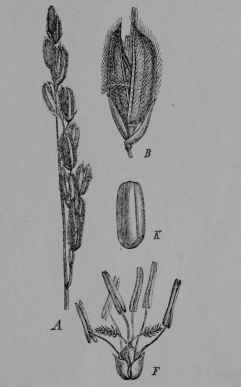
Fig. 6.-Rice. A, part of a flower-cluster of beardless rice, natural size. B, a spikelet of the same. E, a flower showing its six stamens, single pistil (with two styles and stigmas) and two lodicules. K, a ripe kernel. B, E, and K enlarged. (Nees.)
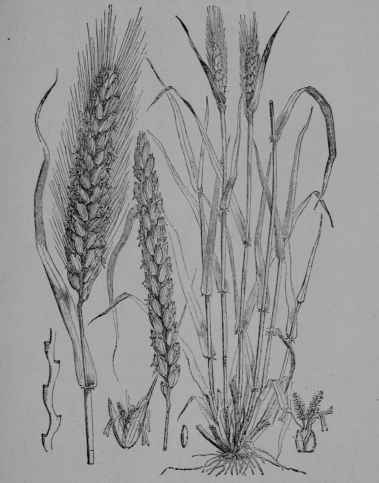
Fig. 8.-Wheat (Triticum sativum, Grass Family, Gramineoe). A plant and flower-cluster of bearded wheat, a flower-cluster of beardless or "club" wheat, a piece of the zig-zag rachis, a spikelet, a flower, and a kernel. (Baillon.)

Fig. 9.-Wheat. A, spikelet of beardless wheat, enlarged. E, flower with bracts spread. C, D, E, bracts. G, pistil with stamens, and a pair of lodicules at base. K1, K2, kernel. R, rachis. (Baillon.)
Continue to:


My Books

