


Part 162. The Vegetable Kingdom - Various Plant Groups
Description
This section is from the book "Plants And Their Uses - An Introduction To Botany", by Frederick Leroy Sargent. Also available from Amazon: Plants And Their Uses; An Introduction To Botany
Part 162. The Vegetable Kingdom - Various Plant Groups
Part 162. The vegetable kingdom (Vegetabilia) which includes all plants is regarded most conveniently as consisting of four main divisions assumed to be equal in rank.1
1 This view differs somewhat from that of Engler and Prantl, but best suits our purpose as being the one most widely adopted at the present day.
The highest division, that of seedworts or spermatophytes, includes most of the forms we have been studying. These agree not only in producing seeds but also in having true roots, stems, and mostly green leaves, all traversed by more or less woody strands, known as fibrovascular bundles, which form a framework or skeleton, and conduct nutrient juices to every part.
True roots, stems, and green leaves, all provided with fibrovascular bundles, occur also in such plants as the male-fern (Aspidium) and the club-moss (Lycopodium); but these plants propagate by spores developed in minute spore-cases, and never produce seeds. Plants thus characterized form the pteridophyte or fernwort division. (Pteridophyta).
Next to these come such plants as peat moss (Sphagnum) which propagate by spores similar to those of fern-worts but contained in more or less urn-like cases commonly much larger than fernwort spore-cases, and usually borne on conspicuous stalks; but these plants have no true roots, stems, or leaves with fibrovascular bundles, although often possessing very simply constructed parts resembling small roots, stems, and leaves. Humble green plants of this description make up the bryophyte or mosswort division (Bryophyta).
Finally come such comparatively simple forms as the so-called Iceland moss (Cetraria), the field mushroom (Agaricus), and the carrageen (Chondrus) which, although commonly propagating by spores that are sometimes in cases, have the cases either stalkless or otherwise plainly different from those of mossworts. True roots, stems, leaves, and fibrovascular bundles are never present, although the plant-body may be so lobed as to resemble somewhat that of higher plants. Hence these lowly organized plants form what is known as the thallophyte or lobewort division (Thallophyta).
Our three examples of the lobewort division each represent one of its three subdivisions. These may usually be distinguished by their different modes of life. The Iceland moss is an air-plant merely resting upon barren soil without having any means of drawing much nutriment from it, and is consequently dependent upon what it can get from the air. This mode of life is made possible by the somewhat spongy nature of the plant-body in which are embedded minute containers of chlorophyll that may become apparent upon wetting. Plants like this so-called "moss" which thrive in barren places such as the surface of rocks, bark, dead wood, and sandy soil are of the lichen subdivision (Lichenes). The field mushroom differs from all lichens in being entirely destitute of chlorophyll because it feeds directly upon animal or vegetable manure in the soil. Lobeworts which can thus dispense with chlorophyll by feeding upon animals or plants or their decaying remains are of the mushroom or fungus subdivision (Fungi). Aquatic lobeworts, whether of fresh or salt water, which like carrageen contain chlorophyll (sometimes more or less obscured by red, brown, or blue coloring matters) form the seaweed or alga subdivision (Algoe).
The following synopses show in tabular view the divisions and subdivisions of the vegetable kingdom, together with one hundred of the more important families of seedworts, and the orders and higher groups to which they belong. The characters given to distinguish them must be understood as being merely those which prevail throughout the group to which they refer, and not as being without possible exceptions besides those noted. The numbers in parenthesis refer to pages where further information regarding the families, or illustrated examples of them, may be found. These synopses show the place in a modern classification of every plant we have studied in the foregoing chapters. Familiarity with the distinctions given, obtained by practical use of the synopses, should enable students to tell at sight, for a large majority of the plants they may see growing wild or in cultivation, the family to which each belongs.
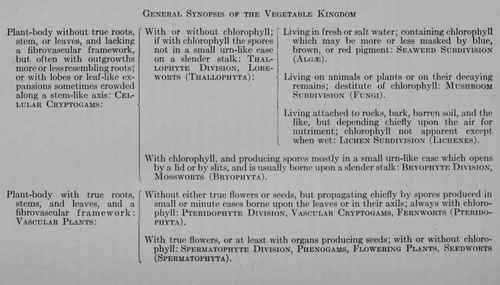
General Synopsis of the Vegetable Kingdom
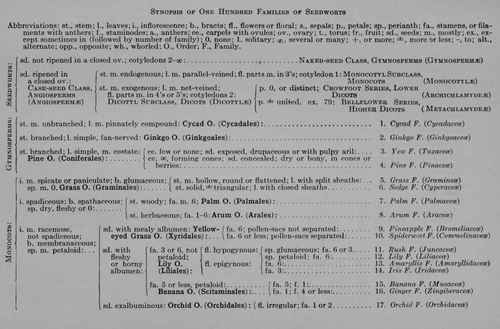
Synopsis of One Hundred Families of Seedworts. Part 1
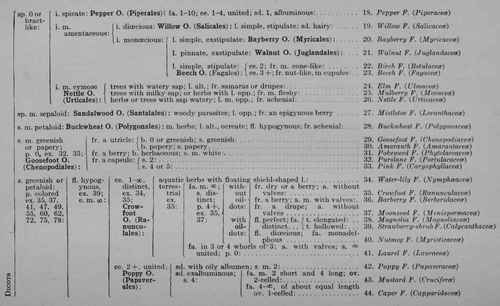
Synopsis of One Hundred Families of Seedworts. Part 2
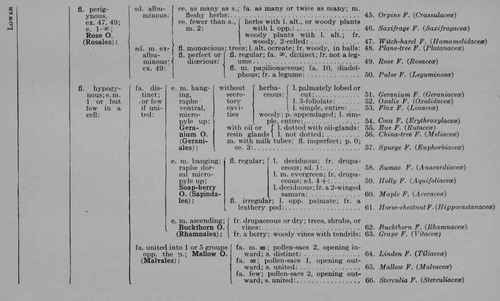
Synopsis of One Hundred Families of Seedworts. Part 3
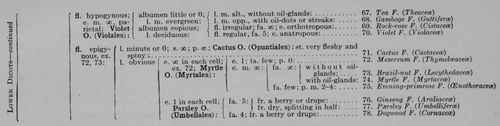
Synopsis of One Hundred Families of Seedworts. Part 4
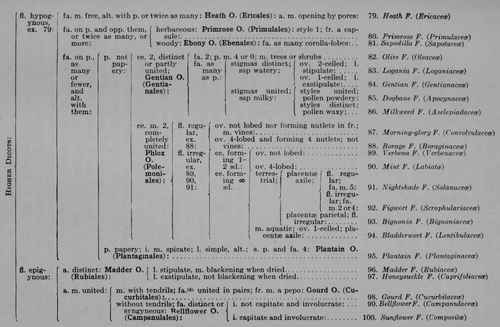
Synopsis of One Hundred Families of Seedworts. Part 5
The student who has learned to know what is typical of the comparatively few orders and families which we have been examining, will be able to tell at sight the family or order in which, or near which, to classify more than half of the flowering plants he is likely to meet; provided, of course, he has observed carefully their structural features. This knowledge, and the acquaintance he has already gained with the most important descriptive terms, will facilitate his use of systematic works in which these and other families are described in more detail.
However far he pursues this line of study-as fascinating as it is exhaustless-the student will continually encounter plants which must be viewed as intermediate links connecting different groups, or as exceptions which make definite limitations practically impossible. These connecting links and exceptional cases seem to defy classification in any consistent arrangement, and have caused endless trouble to botanists in their attempts to construct a natural system. But at the same time it has happened that as botanists have come to study the significance of these exceptions they have found them revealing some very deep truths which have led to more and more satisfactory systems of classification. It behooves us therefore to examine the main beliefs which have been held in regard to the meaning of these connecting links between species, genera, families, and wider groups. As will be observed, the very word "family" implies an idea of kinship. Here, indeed, is a key which if it fits, may unlock for us secrets of great importance. To try this key is the purpose of the chapters which follow.
Continue to:


My Books

