


Part 170. Plant Evolution By Choice - Kinship And Adaptation
Description
This section is from the book "Plants And Their Uses - An Introduction To Botany", by Frederick Leroy Sargent. Also available from Amazon: Plants And Their Uses; An Introduction To Botany
Part 170. Plant Evolution By Choice - Kinship And Adaptation
Part 170. Evolution by choice. To make the foregoing analogy complete we should have to imagine a kaleidoscope with the power of self-movement; for whatever may be the factors which bring about mutations, the process is somehow influenced from within. A living thing is active as well as passive. The idea is thus suggested that organic evolution may have as its controlling factor some power of choice, essentially like our own, residing in all living organisms-a will as truly free, although apparently very different because exercised under very different conditions. This is a hard saying, but perhaps we shall find it to contain important truth.
Doubtless to many readers the idea of plants willing or choosing in any way whatever will appear quite absurd. "How is it possible," they will urge, "to conceive of voluntary action in vegetable life?" Let us try to consider the matter without prejudice. Surely, as we watch plants they seem to act spontaneously, to improve opportunities, and, some of them at least, appear to have gained experience. All observers would agree that a climbing shoot or a root-tip acts almost as if it were intelligent. If the reader will admit that plants in their responses to outside influence are sometimes capable of acting in one way rather than in another way which is equally possible, then all that is essential to what is here meant by choice will be conceded, and he may be willing to entertain an hypothesis which squares well with what we know of all living things. In such a hypothetical view we need not suppose that every action of every creature is an act of will. Many of our own acts are, as we say, mechanical or habitual. We may well suppose that most of the behavior of lower organisms, including the behavior of growth, is of this sort. Nor do we need to suppose that consciousness more than very remotely like our own accompanies any of the actions or reactions of plants. All the hypothesis requires is that sometimes, even with dimmest consciousness, any organism may be free to choose at a critical moment between alternatives profoundly affecting its constitution.
By way of example let us suppose the seeds of a primitive buttercup to be carried near the seashore and to begin to sprout. Such plants are not accustomed to so much salt as would then be in contact with their roots. Here is a change of condition, favorable, as we have seen, to the occurrence of mutations. It has been found by experiment that plants of the same kind placed under the same conditions will absorb different amounts of the same substance, as, for instance, common salt. Thus of several seedlings the same in kind and age, growing with their roots in the same salt solution, some will absorb a larger percentage of the salt than others, and, indeed, may be poisoned while others survive. Sometimes even the same individual may respond differently at different times. Now, what we may suppose to happen, according to our hypothesis, in the case of the buttercup seedlings is that some of them might choose to keep out so much of the salt that they could not get water enough to live; others might let in so much salt as to be poisoned by it; while still others might let in just enough salt to permit their having sufficient water, but not so much salt as would kill them. The survivors, as a consequence of their choice, would have their sap saltish and thus every organ would be affected in an unwonted way. Their seeds would start with some salt in them already, and this might favor the seedlings enduring a larger amount of salt as they grew. Sooner or later the constitutional equilibrium of the plants would be so disturbed that a mutation would result. Several successive mutations might occur as seeds fell into salter and salter localities. At last would appear a form like our seaside crowfoot (Fig. 303) able to thrive where the salt is strong and showing many marks of its effect. The first mutation would give an hereditary salt-preferring type, while a succession of mutations caused by similar responses would produce a distinct species.
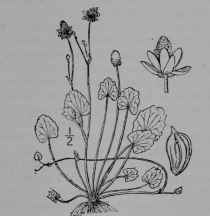
Fig. 303.-Seaside Crowfoot (Ranunculus Cymbalaria, Crowfoot Family, Ranunculaceoe). (Britton and Brown.)-Perennial herb 4-22 cm. tall; leaves fleshy, smooth throughout; flowers yellow; fruit dry. Native home, Northern North America and Eurasia.
The case of our stranded buttercups might be paralleled by an animal which in time of famine, was reduced to the choice of eating or rejecting unaccustomed food, and as a result of eating enough of it to sustain life, being modified in its habits and structure to the point of producing mutations. Whatever share in the final result of such an evolutionary process we may attribute to acquirement or to selection we are still free to believe that it is the choice of individuals confronted by alternatives which ultimately decides whether a given path shall be followed or not. That is to say, external conditions and previous decisions while they restrict the range of choice yet permit of choosing. Of course the reader will not suppose that our imaginary examples afford any real proof of volition in plants or animals. If either do have the power of choice we cannot hope to prove it any more than we can prove that we have such a power ourselves. What has been said is meant merely to show how one who believes that every living thing can choose, may think of evolutionary processes in terms of his belief. With this bare hint of a way of avoiding the pitfalls which await any purely mechanical explanation or any theory of evolution by chance, the reader must be left to make such further applications of the hypothesis as he can. We may call this view, which refuses to regard any living creature as a mere mechanism, Evolution by Choice, since for want of a better name it will serve to emphasize the essence of the belief, which is that a certain measure of self-control is inherent in every organism and that upon this inscrutable power hangs the destiny of the living world.
Continue to:


My Books

