


Part 55. Miscellaneous Condiments
Description
This section is from the book "Plants And Their Uses - An Introduction To Botany", by Frederick Leroy Sargent. Also available from Amazon: Plants And Their Uses; An Introduction To Botany
Part 55. Miscellaneous Condiments
Part 55. Miscellaneous condiments. Horseradish and capers are food-adjuncts which differ so considerably from the others mentioned in this chapter as to require separate treatment. They agree in being used primarily for their sharp taste. Horseradish is the root of a familiar plant (Fig. 144) which owes its pungency to a minute amount of a volatile oil (0.06%) very similar to that of mustard if not identical with it. This oil is so powerful an irritant that it will raise blisters when applied to the skin. Capers are flower-buds of the caper-bush (Fig. 145), preserved in vinegar. They contain a peculiar acid, and a volatile oil similar to that found in garlic.
Under the head of miscellaneous condiments might also be included such sharp tasting vegetables as radish and onion which have already been considered.
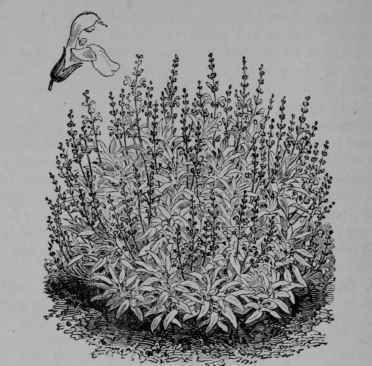
Fig. 132.-Sage (Salvia officinalis, Mint Family, Labiatoe). Plant in flower, 1/8. Flower, 1/1. (Vilmorin.)-A perennial herb with grayish, hairy, aromatic leaves; flowers blue; nutlets brown. Native home, Europe.
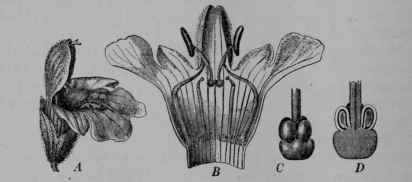
Fig. 133.-Sage. A, flower, enlarged. B, corolla split down the back and spread out to show the attachment and form of the four stamens; one pair is rudimentary, the others have curiously developed anthers, which are remarkably well adapted to secure the transfer of pollen by bees from one flower to another. C, base of pistil, showing the four young nutlets. D, the same cut vertically to show the single ovule in each section of the ovary. (Luerssen.)
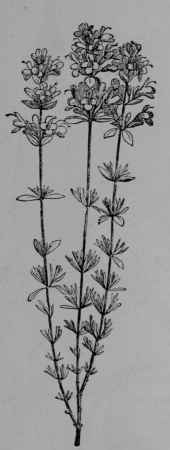
Fig. 134.-Thyme (Thymus vulgaris, Mint Family, Labiatoe). Plant in flower. (Briquet.)-A perennial, low and shrubby with whitish-hairy aromatic stems and leaves; flowers lilac or purplish; nutlets brownish. Native home, southern Europe.
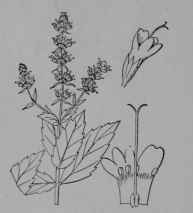
Fig. 135.-Spearmint (Mentha spicata, Mint Family, Labiatoe). Flowering top, reduced. Flower. Corolla, stamens, and pistil. (Britton and Brown.)-A smooth perennial herb; flowers pale purplish; nutlets brown. Native home, Europe.
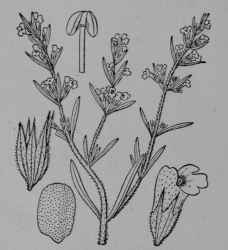
Fig. 136.-Summer Savory (Satureia hortensis, Mint Family, Labiatoe). Flowering top, reduced. Flower. Calyx. Nutlet, enlarged. (Britton and Brown.)-An annual with downy stems and leaves; flowers purple; nutlets brown; finely roughened. Native home, Europe.
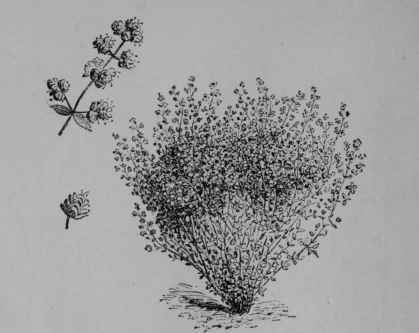
Fig. 137.-Sweet Marjoram (Origanum Majorana, Mint Family, Labiatoe). Flowering plant, 1/12. Flowering branch, 1/1. Flower cluster. (Vilmorin.)-A perennial herb becoming annual in cultivation, leaves downy; flowers whitish or purplish; nutlets brownish. Native home, Eurasia.
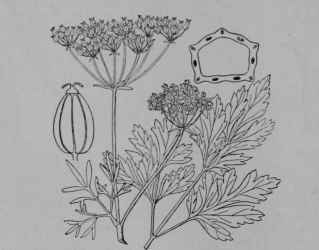
Fig. 138.-Parsley (Petroselinum hortense, Parsley Family, Umbelliferce). Flowering and fruiting top, reduced. Leaf, upper part. Fruit, side view, enlarged. One-half of fruit cut across to show the six volatile oil-tubes in the wall. (Britton and Brown.)-A mostly biennial herb, attaining 1 m. in height, smooth throughout; flowers greenish yellow; fruit brownish, aromatic. Native home, Mediterranean Region.
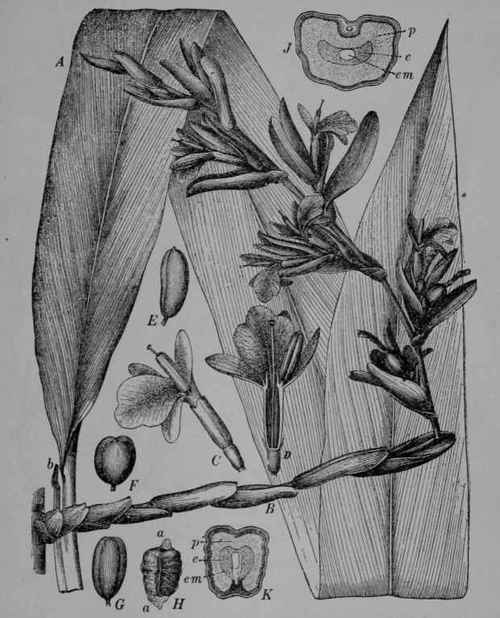
Fig. 139.-Cardamoms (Elettaria cardamomum, Ginger Family, Zingiberaceoe). A, leaf. P, flowering branch. C, flower, 3/4. D, same cut vertically. P, P, G, various forms of pods, 3/4. P, seed, with covering, enlarged. J, K, seed, cut across and vertically, showing the seed-food (p and e) and the embryo (em). (Luerssen.)-A perennial herb with leafy shoots 2-3 m. tall; leaves pale green; flowers whitish, purple-striped; pods pale yellowish; seeds brown. Native home, India to Java.
Continue to:


My Books

