


Part 71. Woody Plant Fibers
Description
This section is from the book "Plants And Their Uses - An Introduction To Botany", by Frederick Leroy Sargent. Also available from Amazon: Plants And Their Uses; An Introduction To Botany
Part 71. Woody Plant Fibers
Part 71. Woody fibers as here understood, are either slender twigs with the bark removed, or timber mechanically reduced to strips or shreds, or else chemically treated so as to separate the ultimate fibrils for paper pulp. Osiers from various species of willow (Fig. 228) afford woody fibers of the first kind which are extensively used for wickerwork. Thin flat strips of willow, poplar (Fig. 253), and other soft woods form the chip of which chip hats are braided. Similar strips of ash (Fig. 245), hickory (Fig. 30), and other hard woods which split easily and evenly make the splint which is woven into large market baskets, chair bottoms and backs, and the like. White pine and spruce, shredded by machinery, yield the familiar packing material known as excelsior. Spruce and poplar are the chief woods used for the wood pulp from which the cheaper grades of paper are made, or as an ingredient in book papers of higher quality. Thus the paper of this book is made of cotton rags mixed with poplar pulp.

Fig. 228, I.-Willow (Salix sp., Willow Family, Salicaceoe). Staminate flowering branch. Pistillate flowering branch. (Baillon.)-Trees with yellowish or greenish flowers, dry fruits, and hairy seeds. Native home, throughout the North Temperate Zone.
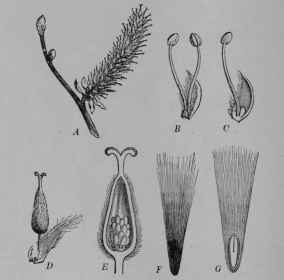
Fig. 228, II.-Willow. A, pistillate flower-cluster. B, staminate flower, enlarged. C, same, cut vertically. D, pistillate flower, enlarged. E, pistil, cut vertically. E, seed, entire. G, same, cut vertically. (Baillon.)
Continue to:


My Books

