


Part 74. Pseudo-woods
Description
This section is from the book "Plants And Their Uses - An Introduction To Botany", by Frederick Leroy Sargent. Also available from Amazon: Plants And Their Uses; An Introduction To Botany
Part 74. Pseudo-woods
Part 74. Pseudo-woods, as we have seen, may be defined as more or less wood-like materials which, however, show no trace of pith rays or annual rings.
Under the name porcupine-wood the outer harder part of the coconut trunk (Fig. 34) is imported for the use of cabinet makers in ornamental work and to some extent for canes. Canes of rather curious appearance are made sometimes also from the mid-rib of the gigantic leaves of the date-palm (Fig. 108). Another curious walking-stick is made from the stalk of an extraordinarily tall variety of cabbage (Fig. 264). The bamboo (Fig. 224) of which there are many species, has, as is well known, a very wide range of uses among which the most familiar to us are for canes and umbrella handles, fishing-rods, articles of furniture, and various ornaments. In tropical and eastern countries where bamboos flourish, the uses to which the light, strong stems are put would require pages to enumerate.
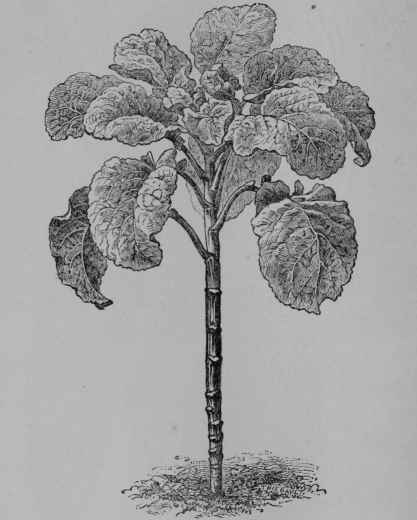
Fig. 264.-Tree-cabbage (Brassica oleracea var. accphala, Mustard Family, Cruciferce). Plant, 1/12. (Vilmorin.)-Perennial herb growing 2 m. tall; leaves, etc., as in other forms of cabbage. Native home, Western Europe.
The hard parts of certain fruits may be considered also as pseudo-woods, and are sometimes put to minor uses of importance. The hard inner shell of the coconut forms the bowl of the familiar coconut dipper. The shells of various gourds (Fig. 265) play a most useful part as vessels for holding liquid or storing food, in the domestic economy of many regions. Finally, may be mentioned the vegetable ivory (Fig. 266) which is a seed-food that takes the form of nearly pure cellulose. Large quantities of these seeds are imported and used in place of ivory or bone for umbrella handles, knobs, buttons, balls, and various other small articles of turnery.
For the most part, pseudo-woods, although sometimes locally important, are of comparatively small use and need not here be further discussed.
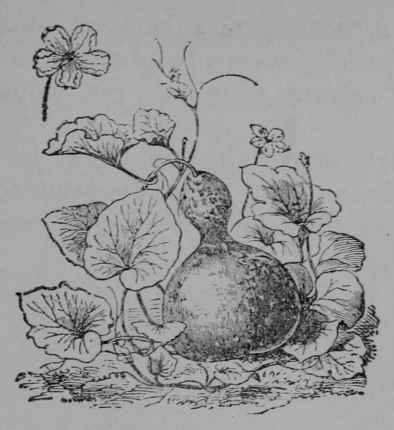
Fig. 265.-Bottle-gourd (Lagenaria vulgaris, Gourd Family, Cucurbitaceoe). Plant in fruit, 15. Flower. (Vilmorin.)-Annual, climbing by tendrils to a length of 10 m. or more; hairy throughout; flowers white; fruit yellowish or orange, very various in form, sometimes 2 m. long. Native home, Old World Tropics.

Fig. 266, I.-Vegetable Ivory (Phytelephas microcarpa, Palm Family, Palmaceoe). Plants, in flower, a staminate plant in front, and a pistillate one behind. (Karsten.)-Shrub with short stem sending up leaves 7-8 m. long; fruit dry. Native home, Tropical America.
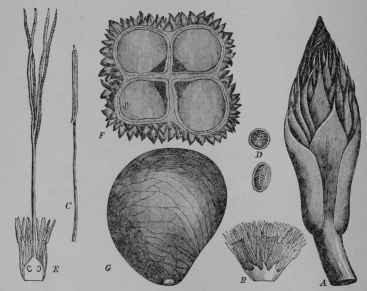
Fig. 266, II.-Vegetable Ivory. A, pistillate flower-cluster in bud. B, staminate flower. C, stamen. D, pollen. E, pistillate flower, cut vertically, showing pistil accompanied by rudimentary stamens. E, fruit, cut across. G, seed. (Karsten.)
Continue to:


My Books

