


142. Eucalyptus Planchoniana
Description
This section is from the book "A Research On The Eucalypts Especially In Regard To Their Essential Oils", by Richard T. Baker, Henry G. Smith. Also available from Amazon: A Research On The Eucalypts And Their Essential Oils.
142. Eucalyptus Planchoniana
(F.v.M., Fragm. xi, 43, Eucalyptographia, Dec. 4.) A Stringybark.
Systematic. - A tall tree, with a fibrous bark, much resembling E. obliqua and E. fastigata. Abnormal leaves large, sometimes 1 foot long and 2 inches broad, lanceolate, drying almost "khaki" colour; venation distinct, spreading, intramarginal vein removed from the edge. Normal leaves rigid, lanceolate, falcate, pale-coloured; venation similar to that of abnormal leaves. Branchlets distinctly quadrangular, almost winged. Peduncles axillary, much flattened, nearly 3 lines broad, with four to six flowers. Calyx tube ribbed, tapering downwards to a short thick pedicel, 4 lines in diameter; operculum ribbed, conical, obtuse, under 6 lines long.
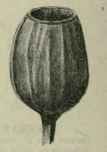
Fruit. - Large, shortly pedicellate, irregularly urceo-late and ribbed, contracted towards the narrow or countersunk rim; valves deeply sunk; slightly over 1 inch long and 9 lines in diameter.
The fruits are not unlike some of the Bloodwoods, such as E. calophylla, a large form of E. eximia or E. intermedia.
Habitat. - Woodburn and Evans River, New South Wales; Queensland. A species very limited in its geographical distribution.
ESSENTIAL OIL. - Leaves were obtained from Woodburn, N.S.W., in August, 1900. The yield of oil was very small, only 1 1/2 oz. being obtained from 675 lbs. of leaves, equal to 0.014 Per cent.
The crude oil was red in colour, and had a somewhat rank odour, difficult to define; the secondary odour was not aromatic. It contained phellandrene in fairly large quantity, and cineol appeared to be absent. From the colour reaction with phosphoric acid and also with bromine, together with the specific gravity of the crude oil, there appeared to be a fair amount of the sesquiterpene present. The specific gravity of the crude oil at 150 C. = 0.9039. Owing to the dark colour of the oil, light did not pass. The saponification number for the esters and free acid was 7.1. Although the oil was insoluble in 10 volumes 70 per cent, alcohol, yet it cleared with 1 volume 80 per cent., thus indicating the presence of alcoholic bodies in the higher-boiling portion.
Continue to:


My Books

