


141. Eucalyptus acmenioides
Description
This section is from the book "A Research On The Eucalypts Especially In Regard To Their Essential Oils", by Richard T. Baker, Henry G. Smith. Also available from Amazon: A Research On The Eucalypts And Their Essential Oils.
141. Eucalyptus acmenioides
(Schau., in Walp. Rep., ii, 924.) White Mahogany.
Systematic. - A tall tree, with a lightish-coloured stringybark. Leaves lanceolate, thin, mostly about 4 inches long and 1 inch wide, dark green on the upper surface, pale underneath, sometimes shining; venation distinct, in relief on the under surface of leaf, lateral veins oblique, parallel or spreading, intra-marginal vein removed from the edges. Flowers axillary, peduncles flattened, about six in each umbel; pedicels about 3 lines long, angled. Calyx tube turbinate, about 2 lines in diameter, and 2 lines long; operculum acuminate, shorter than the calyx.
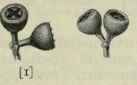
Fruit. - Pedicellate, hemispherical; rim usually thin, slightly sunk; valves not ex-serted, the cells very distinct; 3 lines in diameter.
The nearest fruits in shape to these are (when immature) E. umbra [1], next E. Bosistoana, E. melliodora and E. carnea.
Habitat. - Coast district, New South Wales; Queensland.
REMARKS. - This is a distinct species, but care must be taken in the herbarium not to confuse it with E. carnea and E. umbra, R.T.B., as the early fruits of these species greatly resemble each other. These latter species differ from it in (1) young state leaves, (2) their normal leaves being coarse and thick, and with a uniform greyish colour on both sides, (3) the mature fruits having a thick rim, whilst the timber and oils of all three are also distinct. These species preserve a constancy of specific characters throughout their geographical range.
ESSENTIAL OIL. - Leaves and terminal branchlets for distillation were obtained from Lismore, N.S.W., in August, 1900. The yield of oil was small, only 8 1/2 oz. being obtained from 594 lb. of leaves; equal to 0.09 per cent. The crude oil was dark orange-brown in colour, and had a very rank odour. It contained a large amount of the sesquiterpene. Pinene was present, and phellan-drene also. Only a minute quantity of cineol could be detected in the first fraction. The oil was somewhat viscous, due to the sesquiterpene. It may be mentioned that the viscosity of crude Eucalyptus oils varies much, from that of turpentine to that of olive oil.
The crude oil had specific gravity at 150 C. = 0.9252; refractive index at 200 = 1.5008, and was soluble in 1 volume 80 per cent, alcohol. The saponification number for the esters and free acid was 8.6.
On rectification, 2 per cent, distilled below 1720 C. (corr.). Between 172-1830, 25 per cent, distilled; between 183-2500 18 per cent, came over, and between 250-2900, 43 per cent. distilled. These fractions gave the following results; -
First fraction, sp. gr. at 150 C. | = | 0.8628; | rotation aD | + | 5.5°. | |||
Second | " | " | " | = | 0.8751; | " | + | 1.2°. |
Third | " | " | " | = | 0.9560; | " | not taken. | |
The oil from this species had little resemblance to that of E. carnea
Continue to:


My Books

