


147. Eucalyptus melanophloia
Description
This section is from the book "A Research On The Eucalypts Especially In Regard To Their Essential Oils", by Richard T. Baker, Henry G. Smith. Also available from Amazon: A Research On The Eucalypts And Their Essential Oils.
147. Eucalyptus melanophloia
(F.v.M., in Journ. Linn. Soc., iii, 93.) Silver-leaved Ironbark.
Systematic. - A small tree with a blackish, persistent, sometimes deeply-furrowed bark; with foliage, inflorescence, and fruits all glaucous. Leaves glaucous or olive green, sessile opposite, or petiolate alternate, from cordate-ovate or orbicular to narrow lanceolate, acuminate. Peduncles 1 1/2 to 2 inches long, flowers in axillary cymes or terminal corymbs. Calyx tube slightly angular and of equal diameter; operculum obtusely conical, shorter than the calyx tube.
Fruit. - On a slender pedicel, pear-shaped or globular, contracted at the orifice; rim thin; valves not exserted or only slightly so; up to 3 lines in diameter.
These fruits resemble E. intertexta or a small form of E. caerulea.
Habitat. - Angledool, Narran River, Narrabri, Cassilis and Nyngan, New South Wales; Queensland.

REMARKS. - As this species was originally described from trees from the northern part of the State, when it is easily distinguished by its sessile, opposite, nearly white leaves, the leaf variation of the southern form was not noted. The foliage of this tree is, therefore, not so constant in shape as was originally supposed, for in the far interior of the State, where the trees become stunted, the leaves are small lanceolate, and of a pale brownish or olive-green colour. See paper by R. T. Baker, Proc. Linn. Soc, 1902, p. 225.
ESSENTIAL OIL. - Leaves and terminal branchlets for distillation were obtained from Narrabri, N.S.W., in June, 1901. The yield of oil was 0.11 per cent. The crude oil was reddish in colour, and had an odour strongly indicating cymene. The presence of volatile aldehydes was not marked, but much phellandrene was present, and pinene was also pronounced. Cineol was detected, but in very small amount, not more than 5 to 10 per cent. in the crude oil. The higher boiling portion contained a quantity of the sesquiterpene, and also the liquid form of eudesmol. This is indicated by the dextro-rotation of the fourth fraction. A secondary odour of cinnamon was detected in the portion boiling at about 2400 C.
The crude oil had specific gravity at 150 C. = 0.8959; rotation aD - 23.5°; refractive index at 200 = 1.4893, and was insoluble in 10 volumes 80 per cent, alcohol. The saponification number for the esters and free acid was 11.
On rectification, 2 per cent, distilled below 1620 C. (corr.). Between 162-172°, 25 per cent. distilled; between 172-178°, 33 per cent. distilled; between 178-245°, 6 per cent. came over, and between 245-268°, 30 per cent. distilled, These fractions gave the following results: -
First fraction, sp. gr. at 150 C. | = | 0.8583 | rotation aD | - | 37.5°. | ||||
Second | " | " | " | = | 0.8610 | " | - | 40.7°. | |
Third | " | " | " | = | 0.8954 | " | not taken. | ||
Fourth | " | " | " | = | 0.9352 | " aD | + | 8.0°. | |
That the oil contained alcoholic bodies is shown by the results obtained on acetylating the crude oil, which then gave a saponification number 27.8, an increase in ester value of 10.8. Assuming the alcohol to be eudesmol, the percentage in this constituent exceeded 6 per cent, in the crude oil.
There seems little doubt but that cymene was present, as on boiling a portion of the second fraction in dilute nitric acid for several hours, two acids were
Plate LXX.
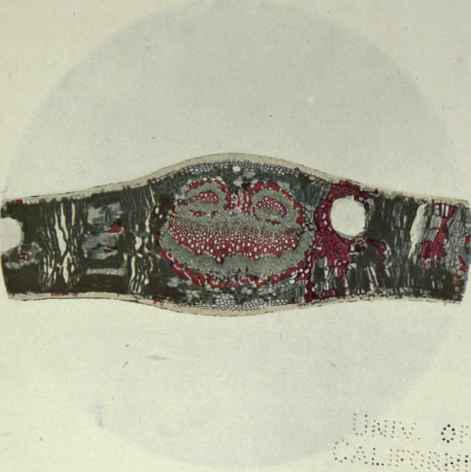
A transverse section of the leaf of this Irobark cut through the mid-rib. Most lronbarks give a low yield of oil, and this species is no exception. The coriaceous character of the leaf is marked by the compact palisade parenchyma, and limited spongy tissue, The supporting tissue to the mid-rib is seen to be restricted, but the woody fibres (red) almost form a complete circle around the bundle, which is bicollateral. On the right of the central vascular bundle is seen an apparent lignification of the palisade tissue, due most probably to pathological afleciion. x 60, eventually obtained; one was insoluble in alcohol and ether and sublimed, the other was soluble in hot water, in alcohol, and in ether, and when purified, melted at 1760 C. The acids thus indicated were p-toluic and terephthalic.
Eucalyptus Fergusoni, r.t.b
The above sample had been stored in the dark, and in October, 1919, was again analysed. Scarcely any alteration had taken place in the character and constituents of the oil during the eighteen years it had been kept, and there was no increase in cineol. 60 per cent, distilled below 190° C.
The crude oil had sp. gr. at 15o C. | = | 0.9004; rotation aD - 20.4°; refractive index at 200 = 1.4897. | |
The rectified portion | " | = | 0.8648; rotation aD - 35.6°; refractive index at 200 = 1.4774. |
The cineol was determined by the resorcinol method in the rectified portion: when calculated for the crude oil, the result was 5 per cent.
Continue to:


My Books

