


146. Eucalyptus siderophloia
Description
This section is from the book "A Research On The Eucalypts Especially In Regard To Their Essential Oils", by Richard T. Baker, Henry G. Smith. Also available from Amazon: A Research On The Eucalypts And Their Essential Oils.
146. Eucalyptus siderophloia
(Benth., in B.FL, iii, 220.) Broad-leaved or Red Ironbark.
Systematic. - A tall tree, with a deeply-furrowed, black bark, which is hard and close in the mature trees, but laminated in the younger ones, and this distinguishes the tree from E. paniculata. Abnormal leaves very broad and coriaceous, with a strongly-marked venation. Normal leaves lanceolate, falcate, variable in size; venation prominent, the intramarginal vein near the edge of the leaf Peduncles axillary or terminal, panicles corymbose. Calyx tube angular, turbinate, about 3 to 4 lines in diameter; operculum long, conical, acuminate or obtuse.
Fruit. - Turbinate, on a rather thick pedicel, angular at the base; rim thick; valves blunt, exserted; under 4 lines in diameter.
Perhaps the nearest approach in shape amongst other species are the larger fruits of E. punctata.
Habitat. - Coast district from south of Port Jackson into Queensland.
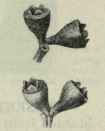
REMARKS. - This "Ironbark" is known by several vernacular names, but "Broad-leaved Ironbark " is the most preferable, as this comparative term distinguishes it at once from the other "Ironbarks." The abnormal leaves are particularly large and leathery, measuring many inches in the length and breadth. The bark has a laminated character not possessed by other "Ironbarks," and is generally not so deeply furrowed. The species is easy of determination both in the field and in the herbarium. The timber sometimes resembles that of E. Fergusoni.
ESSENTIAL OIL. - Leaves and terminal branchlets for distillation were obtained from Canterbury, N.S.W., in June, 1897. The yield of oil was very small, 336 lb. of leaves only giving 3 ounces of oil, equal to 0.06 per cent. The crude oil was lemon-yellow in colour, and had an aromatic odour difficult to define. It contained phellandrene, and pinene was present also. Only a minute quantity of cineol was detected, but the amount of oil at our disposal did not admit of rectification. The presence of an alcohol was shown by acetylating the crude oil. The specific gravity of the crude oil at 150 C. = 0.9067; optical rotation aD + 14.5°; refractive index at 200 = 1.4943. The saponification number for the original ester, together with the free acid, was 4, while that of the esterised oil was 41.9, thus 37.9 represented the saponification number of the esters due to the free alcohols present; if calculated for C10Hl8O, this represents 10.7 per cent. The crude oil did not form a clear solution with 10 volumes 80 per cent. alcohol.
Continue to:


My Books

