


145. Eucalyptus crebra
Description
This section is from the book "A Research On The Eucalypts Especially In Regard To Their Essential Oils", by Richard T. Baker, Henry G. Smith. Also available from Amazon: A Research On The Eucalypts And Their Essential Oils.
145. Eucalyptus crebra
(F.v.M., in Journ. Linn. Soc, iii, 87.) Narrow-leaved Ironbark.
Systematic. - This ironbark often grows to a very large tree, and is the most widely-distributed of all the "Ironbarks," as it occurs on both sides of, and on the Dividing Range, as well as in the interior. Its specific characters are distinct, and it is not easily confounded with other "Ironbarks." The bark is blackish, hard, and deeply furrowed. Leaves narrow, lanceolate, mostly under 6 inches long, and about 3 lines wide, generally of a thin texture, and of equal colour on both sides; lateral veins not well marked, the intramarginal vein not quite close to the edge. Flowers mostly in panicles, appearing to form a terminal corymb. Calyx tube turbinate, about 1 line in diameter; operculum conical, equal in length to the calyx tube.
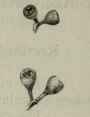
Fruit. - Very small on slender pedicels, semi-ovate, or sometimes attentuate at the base; rim narrow; valves not exserted; under 2 lines in diameter.
This has one of the smallest sized fruits of the Genus, and much resemble those of E. Beyeri, E. polybractea and E. viridis.
Habitat. - New South Wales; Queensland; North Australia.
REMARKS. - The bark of E. crebra is very characteristic, being very deeply furrowed, dark or black, often from 4 to 6 inches thick, and permeated throughout with kino. The leaves are narrower than those of other species of "Ironbarks." It is generally found in poor soil, and has, perhaps, a wider distribution than any other "Ironbark."
ESSENTIAL OIL. - Leaves and terminal branchlets for distillation were obtained from Rylstone, N.S.W., in June, 1900. The yield of oil was 0.16 per cent. The crude oil was of a light orange-brown colour, and had the odour of ordinary crude cineol-terpene Eucalyptus oils. It contained much phellandrene, and thus differed from the oil of E. paniculata; pinene was present, and also a fair amount of cineol. The second fraction consisted largely of phellandrene and cineol, while the third consisted principally of the sesquiterpene. Esters were not pronounced.
The crude oil had specific gravity at 150 C. = 0.8986; rotation aD - 10.8°; refractive index at 200 = 1.4787, and was insoluble in 10 volumes 80 per cent, alcohol. The saponification number for the esters and free acid was 6.2.
On rectification, 2 per cent. distilled below 1650 C. (corr.). Between 165-1830, 64 per cent. distilled; between 183-2550, 11 per cent. came over, and between 255-2800, 19 per cent. distilled. These fractions gave the following results: -
First fraction, sp. great 150 C. | = | 0.8812; | rotation aD | - | 21.70. | |||
Second | " | " | " | = | 0.8925; | " | - | 17.5°. |
Third | " | " | " | = | 0.9330; | " | not taken | |
The cineol, determined by the phosphoric acid method in the first fraction, was 32 per cent., indicating about 22 per cent, in the original oil (O.M.).
Plate LXIX.
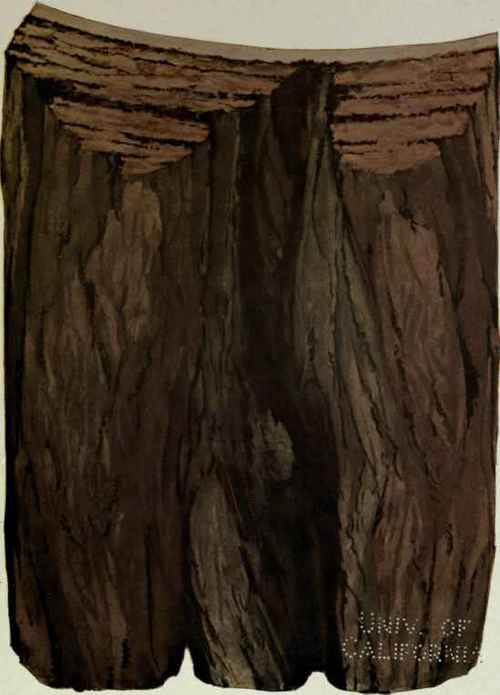
A Tyfical Ironbark
(Eucalyptus crebra, F.v.M.)
A hard, rugged, compact, broadly-latticed pattern, high-ridged bark, either black or grey on the outer surface, and always dark red inside.
The chief oil constituents of Eucalypts with barks of this character are cineol, pinene and phellandrene. In those of a few, however, phellandrene is absent, while the cineol increases considerably. This group is closely associated chemically with the "Stringybarks" and the "peppermints."
Continue to:


My Books

