


144. Eucalyptus obliqua
Description
This section is from the book "A Research On The Eucalypts Especially In Regard To Their Essential Oils", by Richard T. Baker, Henry G. Smith. Also available from Amazon: A Research On The Eucalypts And Their Essential Oils.
144. Eucalyptus obliqua
(L'Her., in Sert. Angl., 18, t. 20.) (Syn. E. gigantea, Hook. f.; E. jalcifolia, Miq.; E. nervosa, F.v.M.)
Systematic. - One of the largest trees on the Australian continent and in Tasmania. Bark stringy, and not to be distinguished from that of other Eucalypts to be found in that cortical class of Eucalypts. Abnormal leaves oblique, oval to ovate-lanceolate, shortly acuminate, petiolate, pale-coloured underneath, shining on the upper surface; venation distinct. Normal leaves lanceolate, falcate, oblique, measuring from 6 to 10 inches long and 1 inch to over 2 inches wide; venation distinct, lateral veins often very oblique, intramarginal veins removed from the edges. Peduncles axillary, about 12 lines long, flattened, bearing numerous flowers. Calyx tube conical, from 1 to 2 lines in diameter, tapering to a short pedicel; operculum hemispherical, acuminate.
Fruit. - Urn-shaped, or pyriform to hemispherical, variable as to size, shortly pedicellate, contracted at the rim, which is thin and countersunk; valves not exserted; sometimes over 6 lines long and 4 lines wide.
The pear-shaped fruit much resembles that of E. Dele-gatcnsis, and. the hemispherical that of E. regnans. Its connection with E. gigantea, Hook. f., is fully dealt with in our paper on Tasmanian Eucalypts and their Essential Oils, Roy. Soc. Tas., 1912.
Habitat.--Tableland from Queensland into Victoria, at high elevations; South Australia; Tasmania.

REMARKS. - This tree was the first Eucalyptus made known to science, and it was on this species that the Genus was founded by L'Heritier. The original specimens came from Tasmania, but it occurs over extensive areas in Victoria and in the New South Wales Coast Ranges. Its botanical and chemical characters are constant throughout this extensive range. It derives its specific name from the unequal halves of its leaves; but this is not a good specific character, as several other Eucalypts have this particular feature well marked. Though much resembling in size, general appearance, and bark, two other species, i.e., E. fastigata, H.P. & J.H.M.. and E. Delegatensis, R.T.B.. with which it is also, associated yet, nevertheless, in the field it is easily distinguished from them by its very broad and rich green abnormal or young state leaves, and by the fact that the persistent bark runs nearly right out to the branchlets, which is not the case in the two other species.
ESSENTIAL OIL. - Leaves and terminal branchlets for distillation were obtained from Monga, N.S.W., in August, 1898. The yield of oil was 0.68 per cent. The crude oil was reddish-brown in colour, and had a rank terpene-like odour, far from pleasant. The principal constituent in the oil was phellandrene, and pinene appeared to be almost absent. Cineol was only present in small amount. A characteristic constituent occurring in the oil of this Eucalypt is the aldehyde aromadendral, and it thus differs from most other phellandrene-bearing oils, obtained from such species as E. dives, E. Sieberiana, etc, in that the peppermint constituent piperitone replaces in these the aromadendral as a distinguishing constituent. The rectified oil had a yellowish tint, due to the influence of the predominating phenol.
The crude oil had specific gravity at 150 C. = 0.8902; rotation not taken; refractive index at 200 = 1.4877; and was soluble in 1 volume 80 per cent. alcohol. The saponification number for the esters and free acid was 8.03.
On rectification, only 1 per cent, came over below 1750 C. (corr.). Between 175-1830, 58 per cent, distilled; between 183-2140, 22 per cent. came over, and between 214-2450, 12 per cent, distilled. The third fraction contained aromadendral. The fractions gave the following results: -
First fraction, sp. gr. at 15o C. | = | 0.8707; | rotation aD | 25.67°. | ||||
Second | " | " | " | = | 0.8810; | " | 24.24°. | |
Third | " | " | " | = | 0.9286; | " | not taken. | |
Later, in July, 1908, material of this species for distillation was collected at Mt. Wellington, Tasmania, at an altitude of about 2,000 feet; and also at about the same time of the year at Williamsford, on the west coast of Tasmania. Both the crude oils were of a reddish-brown colour, due to the action of the iron from the still acting on the phenols, and both contained similar constituents in practically the same amounts, thus being in comparative agreement. The results also agreed with those obtained with the oil of this species from Monga, New South Wales, recorded above. The chief constituent in the oil of this species was phellandrene, and the high-boiling aromatic aldehyde (aromadendral) occurred in some quantity. Cineol was present only in small amount, and both eudesmol and piperitone appeared to be absent. The following tabulated results for the crude oils from the two Tasmanian localities show how closely they agree.
Mt. Wellington. | Williamsford. | |
Yield of oil ............ | 0.66 per cent. | 0.66 per cent. |
Phellandrene ................................. | Abundant | Abundant. |
Aromadendral................................. | Pronounced | Pronounced. |
Specific gravity at 15° C.................................. | =0.8836 | = 0.8854. |
Rotation aD................................. | - 28.1° | - 24.2°. |
Refractive index at 200 C................................. | = 1.4870 | = 1.4861. |
Soluble................................. | In 4 vols. 80 per cent, alcohol. | In 4 vols. 80 per cent, alcohol. |
Saponification number for ester and free acid... | = 8.1 | =7.2. |
These results, together with the botanical characters, indicate that the Tasmanian trees of this species are identical with those growing in Australia.
Plate LXVIII.
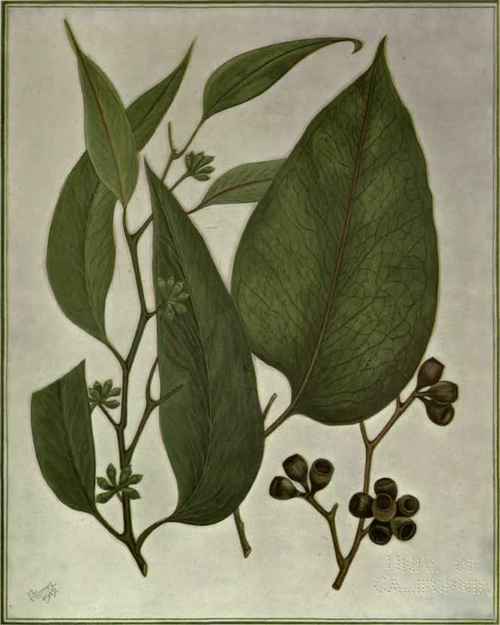
Eucalyptus Obliqua, L'her. A Stringvbark
In August, 1912, leaves for distillation were collected by Mr. L. G. Irby, from trees which, although growing amongst E. obliqua on Mt. Wellington, Tasmania, at an altitude of about 1,000 feet, had a smooth top, the "stringy-bark" supposed to be characteristic for this species only reaching to the, branches. The oil distilled from this material was identical in all respects with that of the typical E. obliqua. The yield of oil was 077 per cent.; specific gravity of crude oil at 150 C. = 0.8845; rotation aD - 28.8; refractive index at 200 = 1.4835, and was soluble in 3 volumes 80 per cent, alcohol.
The presence of aromadendral and absence of piperitone in the oil of E. obliqua, is a distinguishing feature, and enables these trees to be easily separated from all allied forms growing in Tasmania. It is thus seen that the persistence of the outer "stringy-bark" is only relative, and we have noticed with E. pilularis that the outer bark will occasionally only persist a few feet from the ground.
The Monga sample was preserved in the dark, and in November, 1919, was again analysed. Very little alteration had taken place during the twenty-one years it had been stored, and the phellandrene had only altered slightly in optical rotation. 58 per cent, distilled below 1900 C. The crude oil and the rectified portion gave the following results: -
Crude oil, sp. gr. at 150 C. | = | 0.8966; rotation aD - 22o; refractive index at 200 = 1.4882. | |
Rectified portion | " | = | 0.8723; rotation aD - 23.7°; refractive index at 200 = 1.4817. |
The cineol was determined by the resorcinol method in the rectified portion; when calculated for the crude oil, the result was 15 per cent.
The cineol was removed from a portion of the rectified oil by shaking with 50 per cent, resorcinol. The remaining oil had an odour indicating cymene. It had specific gravity at 150 = 0.8621; and refractive index at 20° = 1.4858. These results indicated that both phellandrene and cymene were present, and together with the occurrence of the aromadendral, suggest that this species is more closely related to the members of the "Box" group, than are the other "Stringybarks."
Continue to:


My Books

