


174. Eucalyptus Marsdeni
Description
This section is from the book "A Research On The Eucalypts Especially In Regard To Their Essential Oils", by Richard T. Baker, Henry G. Smith. Also available from Amazon: A Research On The Eucalypts And Their Essential Oils.
174. Eucalyptus Marsdeni
(Cuthbert Hall, in Proc. Linn. Soc, N.S.W., 1918, p. 747.)
Systematic. - A tree 30 feet high in specimen observed, and probably would attain a height of 60 to 80 feet when fully grown. Bark smooch on the upper branches, laminated with an ochreous deposit on the outer surface of each layer, inner bark very hard and compact. Abnormal leaves alternate narrow-lanceolate, falcate, petiolate, acuminate, thin, and shining, up to 6 inches long. Normal leaves lanceolate, acuminate, falcate, thin, usually under 6 inches long; venation less pronounced in older leaves, intramarginal vein fairly close to the edge, looped,
Plate LXXXII.
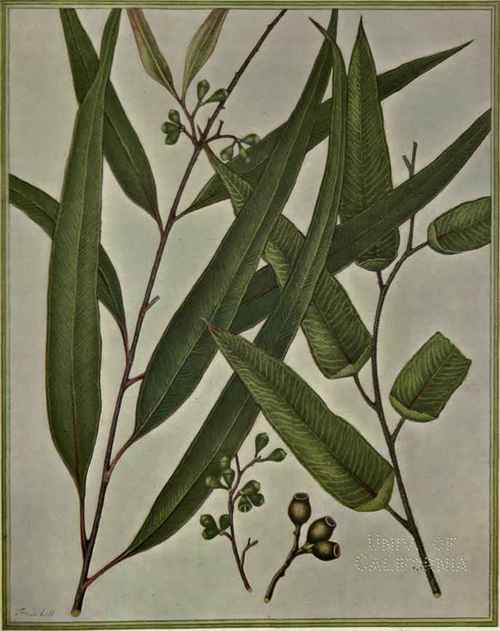
Eucalyptus Citriodora, Hook. Citron Scented Gum
Plate LXXXIII.
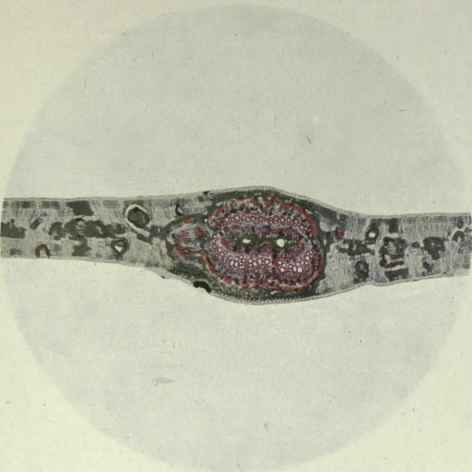
A section showing portions of the leaf blade adjoining the mid-rib, which is of a very compact nature. The woody fibres form almost a complete circle around the bicollateral bundle which has the unusual feature of two ducts in the centre-a character also found in the Blood woods, as shown in E. corymbosa (Plate XV). The reagents used in mounting the section seem to have hardened the contents of the oil glands rather than dissolved them, as in the case of almost all other species. x 60.
Eucalyptus Citriodora, Hook
lateral veins distant, spreading oblique, inclined at an angle of 300 or less to the mid-rib. Peduncles angular, 5 lines long, bearing umbels of six to nine flowers. Calyx tube 2 lines long, turbinate, contracted to a short pedicel; operculum hemispherical, shortly pointed.
Fruit. - Hemispherical on short slender pedicels; rim domed; valves slightly exserted; 2 1/2 lines long and 3 lines in diameter.
E. Rossii or E. maculosa are perhaps the nearest affinities morphologically.
Habitat. - Toongabbie, N.S.W.

ESSENTIAL OIL. - Material of this species was obtained from near Parra-matta, N.S.W., and forwarded for distillation by Dr. Cuthbert Hall. The yield of oil was 0.7 per cent.
The crude oil was almost as viscous as castor oil, and had little resemblance to the ordinary Eucalyptus oils of commerce. It contained a considerable amount of the sesquiterpene, and in this respect resembled the oil of E. nova-anglica and a few others. The oil at our disposal did not permit of complete analysis, but it is possible that the active terpene was dextro-rotatory pinene. Cineoi was practically absent, and phellandrene could not be detected. The oil was but little coloured and had a not unpleasant odour. The phenols gave the reaction for tasmanol, but the crystalline phenol australol appears to be the most abundant.
The crude oil had specific gravity at 150 C. = 0.9469; rotation aD + 4.8°; refractive index at 200 = 1.4989, and was insoluble in 10 volumes 80 per cent. alcohol. The saponification number for the esters and free acid was only 2, so that esters were practically absent. Some of the oil was distilled, but only 2 per cent. came over below 2000 C.; traces of cineol could be detected in this portion, the remainder consisting largely of the sesquiterpene.
Continue to:


My Books

