


149. Eucalyptus piperita
Description
This section is from the book "A Research On The Eucalypts Especially In Regard To Their Essential Oils", by Richard T. Baker, Henry G. Smith. Also available from Amazon: A Research On The Eucalypts And Their Essential Oils.
149. Eucalyptus piperita
(Smith, in Trans. Linn. Soc, iii, 286 partly.) The Sydney Peppermint.
Systematic. - A tall tree, bark fibrous, but not so furrowed as in the "Stringybarks," hoary on the outer surface. Abnormal leaves ovate, ovate-acuminate, lanceolate, almost membraneous, pale-coloured underneath, 2 to 6 inches long; venation faintly marked, lateral veins oblique, spreading, intra-marginal vein slightly removed from the edge. Normal leaves lanceolate, not large, rarely exceed 6 inches, oblique, not coriaceous, very acuminate, not shining; venation not prominent, lateral veins distinct, oblique, spreading, petiole slender. Flowers in axillary peduncles or panicles, or clustered at the base of the branchlets. Buds about 6 lines long. Calyx tube small, a little over 1 line in diameter, hemispherical, or slightly tapering into a pedicel a few lines long; operculum conical, acute.
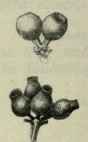
Fruit. - Dimorphous, pilular, shortly pedicellate, sometimes contracted below the rim, when it becomes quite urn-shaped; rim thin; valves not exserted; about 3 lines in diameter.
The fruits cannot well be confounded with any other.
Habitat. - Sydney, Coast District, and Tableland, New South Wales; Victoria; Queensland.
REMARKS. - In this research particular interest pertains to this species, as it was from trees of the "Sydney Peppermint," growing where Sydney now stands, that the first Eucalyptus oil was obtained. It was distilled by Dr. White, Surgeon to the First Fleet, in 1788.
ESSENTIAL OIL. - Leaves and terminal branchlets for distillation were obtained from Gosford, N.S.W., in April, 1897. The yield of oil was 0.8 per cent. The oil was light-coloured, and had a distinct peppermint odour due to the ketone piperitone. Phellandrene was present in some quantity, as was to be expected from the characteristic venation of the mature lanceolate leaves; pinene was also found in small quantity. Cineol occurs to the extent of about 20 per cent. in the crude oil. Crystallised eudesmol was found, and it was in this oil that we discovered that constituent. The higher-boiling portion consisted largely of the sesquiterpene.
The crude oil had specific gravity at 150 C. = 0.0111; rotation aD - 2.7°; refractive index at 200 = 1.4781, and was soluble in 1 volume 80 per cent. alcohol. The saponification number for the esters and free acid was 11.0.
On rectification, 1 per cent, distilled below 1700 C. (corr.). Between 170-183°, 77 per cent, distilled; between 183-198°, 9 per cent, came over; the temperature then rose rapidly to 266°. Between 266-272°, 8 per cent, distilled. The third fraction consisted largely of eudesmol.
Plate LXXI

Cross section of a portion of a leaf showing the large area occupied by each oil gland (four in this case), and all situated in the palisade area of the tipper portion of the leaf, The dorsal epidermis is more heavily cutnised and the palisade layers are more conspicuous towards that surface, x 55.
Eucalyptus Piperita. Sm
The cineol, determined by the phosphoric acid method in the first fraction, was 25 per cent. (O.M.), indicating about 20 per cent. in the original oil.
It was from this species that the first Eucalyptus oil was obtained. This is referred to in White's "Journal of a Voyage to New South Wales, 1790," p. 266.
Material for distillation from trees that are considered to be E. piperita, which have urn-shaped fruits resembling in miniature those characteristic of E. corymbosa, was obtained from Wingello, N.S.W., in January, 1901. These trees grow extensively in that neighbourhood. The oil had resemblances to that of the type, but contained considerably more phellandrene; pinene was present, and eudesmol also detected. Cineol was present to the extent of about 10 to 15 per cent, in the crude oil.
The crude oil had specific gravity at 150 C. = 0.8785; rotation aD - 35.5°; refractive index at 200 = 1.4772, and was insoluble in 10 volumes 80 per cent, alcohol. The saponification number for the esters and free acid was 2.8.
On rectification, 2 per cent. distilled below 1670 C. (corr.). Between 167-1830, 83 per cent, distilled; between 183-2250, 7 per cent. came over, and between 225-260°, 6 per cent. distilled. These fractions gave the following results: -
First fraction, sp. gr. at 150 C. | = | 0.8700; | rotation aD | 39.3°. | ||||
Second | " | " | " | = | 0.8877; | " | 29.4°. | |
Third | " | " | " | = | 0.0208; | " | not taken. | |
The cineol did not appear to exceed 10 or 15 per cent, in the crude oil, consequently the phosphoric acid method was not suitable for quantitative determination.
From the rotation figures it is apparent that the activity was due to the phellandrene present, but the whole results indicate that this form of E. piperita is closely associated with the type.
This sample from Wingello had been stored in the dark, and in September, 1919, was again analysed. Very little alteration had taken place during the eighteen years the oil had been kept. 85 per cent. distilled below 190° C.
The crude oil had sp. gr. at 15o C. | = | 0.8828; rotation aD - 30.4 ; retractive index at,20° = 1.4778. | ||
The rectified portion | " | " | = | 0.8720; rotation aD - 377°; refractive index at 20° = 1.4744. |
The cineol was determined by the resorcmol method in the rectified portion; the result was 27 per cent., but as 5 per cent. of piperitone was also present, that amount had to be deducted, thus 22 per cent. of cineol is the corrected amount.
Continue to:


My Books

