


152. Eucalyptus phellandra, sp. nov
Description
This section is from the book "A Research On The Eucalypts Especially In Regard To Their Essential Oils", by Richard T. Baker, Henry G. Smith. Also available from Amazon: A Research On The Eucalypts And Their Essential Oils.
152. Eucalyptus phellandra, sp. nov
Narrow Leaf Peppermint
Systematic. - A medium-sized tree, with a typical "Peppermint" bark. Abnormal leaves lanceolate, cordate, sessile, usually under 5 inches long and 3/4 inch broad, upper surface darker in colour, branchlets scabrous, particularly so when young. Normal leaves thin, lanceolate, or narrow lanceolate, sometimes falcate, up to 7 inches in length and 1 inch broad, on slender pedicels; venation distinct, intramarginal vein looped and well removed from the edge, a secondary less prominent vein often occurring nearer the margin, lateral veins very oblique, occasionally almost parallel to the mid-rib, distant and spreading. Peduncles usually axillary, 2 to 3 lines long, bearing umbels of ten or more flowers. Buds clavate; calyx tube tapering into a slender pedicel; operculum hemispherical, umbonate.
Fruit. - Pynform, sometimes hemispherical, more or less shining, on a pedicel 1 line in length; rim reddish, truncate, somewhat countersunk or even slightly convex; valves not or only slightly exserted; 3 lines long and under 3 lines in diameter.
E. amygdalina of Tasmania is more likely than any other to be confounded with these fruits, and E. Aus-traliana is its next in resemblance.
Habitat. - Barber's Creek, Batlow, Braidwood, Bundanoon, Bungendore, Burrawang, Crookwell, Hill Top, Laurel Hill, Lochiel, Marulan, Mittagong, Monga, Moss Vale, Tumberumba, Tumut, New South Wales; Warburton, Victoria.
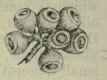
REMARKS. - This species is one of the Eucalypts that has been included in the past under E. amygdalina, and its separation is the result of this research. Morphologically, it is difficult to distinguish from the type E. amygdalina and E. Australiana, both being long regarded as one species. The abnormal leaves are also similar to those of E. viminalis, and the same might be said of the normal leaves of the species above enumerated. The fruits more nearly resemble in shape those of E. Australiana than any other, and show a slight difference between those of that species and E. amygdalina. In the field it is classed as a "Peppermint" from the odour of the leaves and the nature of the bark. It is one of the few species of this research that has been founded almost entirely on the chemical constituents of the oil. The loc?lities (supra) will help in some degree to systematically identify the tree. The economic importance of separating this species from E. Australiana can be judged from the fact that at the present time the value of the oil of the latter species is more than double that of E. phellandra.
ESSENTIAL OIL. - During the last twenty-five years, there have been distilled in Eastern Australia thousands of tons of oil from this Eucalyptus species. In New South Wales and Victoria, it occurs on the mountain ranges, growing in the former State at an altitude of about 1,500 to 3,000 feet. It has a most extensive range, particularly in southern New South Wales, and is especially abundant in the Braidwood district of this State.
The oil derived from this Eucalypt does not reach the standard laid down in the British Pharmacopoeia, being deficient in cineol and containing too much phellandrene. It now finds its chief use in the mining industry for the separation of metallic sulphides by a flotation process. It is employed for this purpose equally with that of E. dives, and as the yield of oil is large it is a profitable species to work. It is also used for other manufacturing processes, mainly on account of its cheapness.
The general characters of the oil of this species are chose recorded by us in the first edition of this work in 1902, under E. amygdalina. The results obtained at that time are reproduced below, and although since that book was published much work has naturally been undertaken with the oil of this species, yet we see no reason why the original statements should be modified, except perhaps that the cineol content might have been a little higher in all cases. The determinations were all made at that time by the phosphoric acid method, when it was considered necessary to press the cake repeatedly until absorption of oil ceased. Cineol determinations as thus made are now known to give too low results.
From the record of investigations with the oil of this Eucalypt, now extending over twenty years, it is evident that the general results are practically always in agreement, a fact which again illustrates the comparative constancy of the oil products of identical species.
The " Peppermint" group appears to be the most recent of the whole Genus, and for that reason might, perhaps, be considered as less stabilised than species belonging to the more ancient groups, yet even with the members of the "Peppermint" group, a similar constancy is observable.
Analysis of the Oil. - Leaves and terminal branchlets for distillation were obtained from Moss Vale, N.S.W., in March, 1899. The yield of oil was 4.2 per cent. The crude oil was but little coloured, and had a peppermint odour, but this was not so marked as was the case with the oil of E. dives. The secondary odour was aromatic, this being due to alcoholic bodies. A small quantity of eudesmol was detected, as it crystallised after the more volatile constituents had evaporated. Phellandrene was a constant constituent, and the amount present appears to be fairly uniform, but is much less abundant than in the oils of E. dives and E. radiata. Cineol was present to the extent of about 20 to 30 per cent. in the crude oil, but by a method of separation during the primary distillation an oil containing 40 to 50 per cent. of cineol can be obtained from this species. Pinene was present, but only in small amount; the physical and chemical properties for that terpene were, however, secured with the fraction obtained on completely rectifying the first distillate. Free alcohols were present in some quantity, as determined by acetylating the crude oil. The esters were very small in amount, and volatile aldehydes not at all pronounced.
Continue to:


My Books

