


157. Eucalyptus Sieberiana
Description
This section is from the book "A Research On The Eucalypts Especially In Regard To Their Essential Oils", by Richard T. Baker, Henry G. Smith. Also available from Amazon: A Research On The Eucalypts And Their Essential Oils.
157. Eucalyptus Sieberiana
(F.v.M., in Eucalyptographia, Dec, ii, 1879.) Mountain Ash.
Systematic - A tall tree with a dark, fibrous, deeply-furrowed bark. Abnormal leaves oblique, ovate, shortly acuminate, and about 3 inches long, or lanceolate-falcate, over 6 inches long; venation distinct, lateral veins very oblique, spreading, distinct, the intramarginal vein removed from the edge. Normal leaves lanceolate, falcate, coriaceous, shining, or lustreless; venation fairly prominent, and similar to that of abnormal leaves. Flowers on axillary, compressed peduncles, 9 lines long, with not many in the umbel. Calyx very short, on a pedicel of about 3 lines long; operculum hemispherical, sometimes with a point.
Fruit. - Pear-shaped, slightly contracted at the edge; rim red, flat, thick; valves compressed; mostly about 6 lines long and 3 lines in diameter.
The fruits of two or three others are difficult to separate from this species, viz.: - E. Consideniana, E. cam-panulata, E. virgata.
Habitat. - Blue Mountains and Coast district of New South Wales; South Australia; Victoria; Tasmania, where it is known as "Ironbark."

REMARKS. - Bcntham (B. Fl., iii, p. 202) evidently includes this Eucalyptus under Sieber's E. virgata, but Mueller, thinking Sieber's name inappropriate for so large a tree, suppresses Sieber's name of E. virgata, and renames his specimens, dedicating the tree to Sieber. The tree, as now understood, is one of the " Mountain Ashes " of the Blue Mountains. The bark is similar to that of an "Ironbark," and extends almost to the branrhlets, which are always of a purple colour. The very greatest care is required in order not to confound this species with a " Mallee " that is found on the Blue Mountains and other localities, and which has exactly identical foliage and fruits, and cannot, therefore, be differentiated from it by dried specimens. We think this latter is E. virgata of Sieber, who would never have applied such a name to so large a tree as E. Sieberiana, and Mueller must have suspected that Sieber referred "to a different species" other than this "Mountain Ash," by a remark of his in his Eucalyptographia, under E. Sieberiana. Morphologically, the two cannot be separated, and hence the confusion of Bentham, Woolls, and others in the matter of these two species. Judged, however, from field observations and chemical results the two arc quite distinct, and are so regarded in this work. (Vide remarks under E. virgata.)
ESSENTIAL OIL.-Leaves and terminal branchlets for distillation were obtained from Barber's Creek, N.S.W., In April, 1898. The yield of oil was 0-5 per cent. The crude oil was but little-coloured, and had a peppermint odour, due to the presence of a small quantity of piperitone. It had a strong resemblance to the other oils of this class, such as E. dives, E. coriacea, E. radiata, etc. The venation of the leaves is also similar to those of the members of this group. Much phellandrene was present, but pinene only in small amount. Cineol could be detected in the first fraction, but not more than 5 to 10 per cent. Crystallised eudesmol was not detected, nor did the oil distilled from this species in September, 1899, contain that constituent. This latter material was obtained specially for the purpose of deciding this point, as we were then investigating the oil of E. virgata. Esters were very small in amount. Cymene probably occurs in this oil.
The crude oil had specific gravity at 150 C. = 0.8880; rotation aD - 43.3°; refractive index at 200 = 1.4829, and was insoluble in 10 volumes 80 per cent. alcohol. The saponification number for the esters and free acid was 2.5.
On rectification, 2 per cent. distilled below 1750 C. (corr.). Between 175-1880, 56 per cent. distilled; between 188-2050, 12 per cent. came over, and between 205-2660, 22 per cent. distilled. The third fraction consisted largely of the sesquiterpene. The fractions gave the following results: -
First fraction, sp. gr. at 15o C. | = | 0.8675; | rotation aD | - | 52.4°. | |||
Second | " | " | " | = | 0.8815; | " aD | - | 39.5°. |
Third | " | " | " | = | 0.9382; | " | not taken. | |
Material of this species for distillation was also obtained from the same locality in September, 1899. With the exception that the yield of oil was lower, and the lævo-rotation a little less (both factors being due to the difference in the time of the year), it was practically identical with the previous sample, and consisted of the same constituents in practically the same amounts.
Plate LXXII
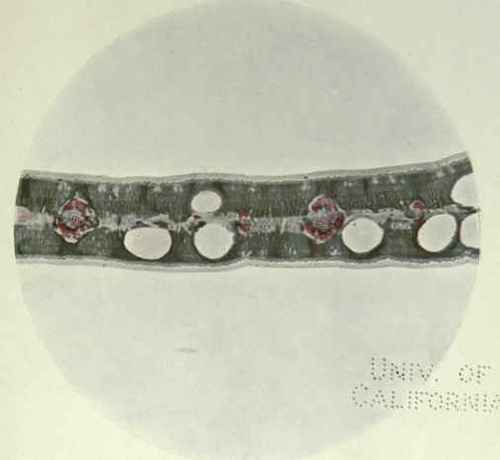
This section shows a rather unusual number of oil glands for a species with a com -paratively low yield of oil. It is, however, a very evenly balanced leaf structurally, the mesophyll in the centre supported top and bottom by equal palisade tissue, and the cuticle particularly well developed towards either surface. The oil glands are very rarely found to run across from side to side, but are confined to either half of the leaf. x 55.
Eucalyptus Sieberiana. F.v.M
The above two samples were mixed and stored in the dark, and in November. 1919, the oil was again analysed. Very little alteration had taken place in the oil during the twenty years it had been kept, with the exception that the optical rotation had been reduced by about 10 degrees. This appears to be due to the alteration of the phellandrene, as the loss was about the same in both the crude oil and in the rectified portion. 53 per cent, distilled below 190° C. The crude oil and the rectified portion gave the following results: -
Crude oil, sp. gr. at 150 C. | = | 0.8970; rotation aD - 33.4°; refractive index at 200 = 1.4827. | |
Rectified portion | " | = | 0.8696; rotation aD, - 43.6°; refractive index at 200 = 1.4753. |
The cineol was determined by the resorcinol method in the rectified portion; when calculated for the crude oil, the result was 17 per cent. As piperitone was present, a ketone determination was made in the rectified portion, with the result that 10 per cent, was absorbed, so that about 11 per cent. of cineol was present in the crude oil.
Continue to:


My Books

