


19. Eucalyptus Iævopinea
Description
This section is from the book "A Research On The Eucalypts Especially In Regard To Their Essential Oils", by Richard T. Baker, Henry G. Smith. Also available from Amazon: A Research On The Eucalypts And Their Essential Oils.
19. Eucalyptus Iævopinea
(R.T.B., Proc. Linn. Soc, N.S.W., 1898, p. 414, t. X.) Silver-top Stringybark.
Systematic. - A very tall tree in favourable situations. Bark fibrous, but brittle, a feature that distinguishes it from that of "Red Stringybark," E. macrorhyncha, F.v.M., and "White Stringybark," E. eugenioides, Sieb.; ultimate branches smooth. Abnormal leaves alternate or scarcely opposite, broad at the base, but not cordate, acuminate, about 3 inches long; the intramarginal vein removed from the edge, the lateral ones very distinct on the under side, but scarcely showing on the upper surface. Normal leaves varying in size and shape, mostly very oblique, of a very dark green colour, and shining on both sides, lanceolate, falcate, acuminate; the intramarginal vein removed from the edge, lateral veins fairly distinct. Petiole varying from 1/2 to 1 inch long. Umbels axillary, bearing about five to seven flowers; stalks flattened, under 1 inch long, stalklet varying from 3 to 8 lines long; operculum hemispherical, shortly acuminate. Calyx not angular. Stamens all fertile, inflexed in the bud; anthers divergent from the very prominent connective which surmounts them.
Fruit. - Hemispherical, pedicellate ; rim either slightly inclined outwards, truncate, or quite domed; incised ring just below the lower edge ; valves exserted; varying in diameter from 3 to 6 lines.
The domed fruit form resembles somewhat that of E. macrorhyncha.
Habitat. - On basaltic outcrops in the Coastal Mountain Ranges; Nulla Mountain, Rylstone, Never Never Mountain, Gulf Road, Black Mountain, Tenterfield, Uralla, Armidale, New South Wales; and Lilydale, Yarra Junction. Victoria.

REMARKS. This tree has always been regarded by local residents of the districts where it occurs as quite distinct from any of the other "Stringybark" trees in the Rylstone district, owing to its peculiar bark and tough wood, and the glinting of the leaves in the sun, which makes them appear glaucous, and hence its vernacular name of " Silver-top Stringybark." When seen growing in its native habitat, it somewhat resembles E. macrorhyncha, F.v.M., and the mature fruits with the domed rim and well-exserted valves might perhaps lead one to diagnose it as that species, from which it differs principally in its hard, durable timber, and nature of the bark, as well as in its operculum, calyx tube, oblique leaves, and in the chemical character of its oil. Except for the domed fruits, there is little to connect it botanically with E. macrorhyncha, F.v.M., a species the leaves of which yield (1) the dye myrticolorin, (2) an oil, rich in the stearoptene eudesmol, and also cineol. These bodies are absent from the leaves of this particular Eucalypt, and the oil is almost entirely composed of lsvo-rotatory pinene. It differs from E. dextropinea, R.T.B., in the shape of its fruits, the superior quality of its timber, and the presence of a lasvo-rotatory pinene in its essential oil. From an economic point of view the confounding of this tree with E. macrorhyncha, F.v.M., would be fatal to the establishment of an industry for the particular products for which each species is suitable.
ESSENTIAL OIL. - Leaves and terminal branchlets for distillation were obtained from Nulla Mountain, Rylstone, N.S.W., in August, 1898. The yield of oil was 0.66 per cent. The crude oil was red in colour and had a turpentinelike odour. Phellandrene was absent, and cineol only present in small amount, about, 8 or 10 per cent. The oil consisted very largely of pinene, which was highly laevo-rotatory, and it contained a smaller amount of esters than were present in the oil of E. dextropinea.
The crude oil had specific gravity at 150 C. = 0.8755; rotation aD - 37.8°; refractive index at 200 = 1.4704, and was scarcely soluble in 10 volumes 80 per cent. alcohol. The saponification number for the esters and free acid was 7.0.
On rectification 1 per cent. distilled below 1570 C. (corr.). Between 157-1640, 60 per cent. distilled; and between 164-1720, 28 per cent. came over. These fractions gave the following results :-
First fraction, sp. gr. at 150 C. | = | 0.8699; | rotation aD | - | 40.66°. | |||
Second | ,, | ,, | ,, | = | 0.8748: | ,, | - | 38.75°. |
The cineol was only present in small amount, and could not be determined quantitatively at that time.
For the further determination of the terpene, see the article in this work on "The Pinenes of Eucalyptus Oils."
This sample of oil had been preserved in the dark, and in October, 1919, twenty-one years afterwards, was again analysed. It had become a little heavier and the optical activity had lessened a little also, otherwise the alteration which had taken place in the oil during all that period was small. Between 157-164°, 53 per cent. distilled; and between 164-178°, 23 per cent. came over. The crude oil and the fractions gave the following results: -
Crude oil, sp. gr. at 150 C | = | 0.9006; rotation aD - 35.8°; refractive index at 20°= 1.4709. | |||
First fraction | ,, | ,, | = | 0.8742; rotation aD - 38.1°; refractive index at 200 = 1.4646. | |
Second | ,, | ,, | ,, | = | 0.8832; rotation aD - 35.6°; refractive index at 200 = 1.4660. |
The cineol was determined by the resorcinol method in the oil boiling below 178°. When calculated for the crude oil the result was 13 per cent. (See also results with the oil of E. dextropinea.)
In the year 1907 the opportunity came for determining the oil of this species from Northern New South Wales. The results of that investigation were published by us in the Proc. Roy. Soc, N.S.W., Nov., 1911.
Leaves and terminal branchlets for distillation were obtained from Armidale in July, 1907, and from Uralla in the same month. The crude oil in both instances was red in colour; this being due to the action of the phenols on the iron derived from the still, was easily removed by aqueous alkali. The oil thus treated, after well washing and drying, was of a light lemon colour, but when rectified was colourless. The crude oil had a turpentine-like odour, this being more pronounced in the rectified oil. Phellandrene does not occur in the oil of this species, so that in this respect it differs from the oil of E. macrorhyncha, and the stearoptene eudesmol, although such a pronounced constituent in the oil of E. macrorhyncha, was not found in that of E. Iævopinea. Cineol was present to a small extent. The following table gives the general results obtained with the crude oils, those previously recorded for this species from Rylstone being given for comparison: -
Rylstone, 1st August, 1898. | Armidale, 1st July, 1907." | Uralla, 13th July, 1907. | |
Yield of oil, per cent. ... | = 0.66 | = 0.59 | = 0.57 |
Specific gravity at 150 C. ............... | = 0.8755 | = 0.8875 | = 0.8871 |
Rotation aD ...... | - 37.8° | - 307° | - 33.3o |
Rotation of portion distilling below 1640 C. ... | - 40.65° | - 36.4° | - 38.6° |
Refractive index at 200 C. | 1.4704 | 1.4686 | 1.4692 |
Solubility in 80 per cent. alcohol, scarcely soluble in | 10 volumes | ditto | ditto |
Cineol | 5 to 10 % | ditto | ditto |
Amount distilling below | 164°C.=6o% | 163°C.=62% | 164° C. =63% |
Saponification number for esters and free acid | 7 | 11.06 | 10.27 |
The trees of this species growing in the New England District of New South Wales, thus gave an oil in agreement with that from Rylstone, although the two localities are very far apart.
Plate XVIII.
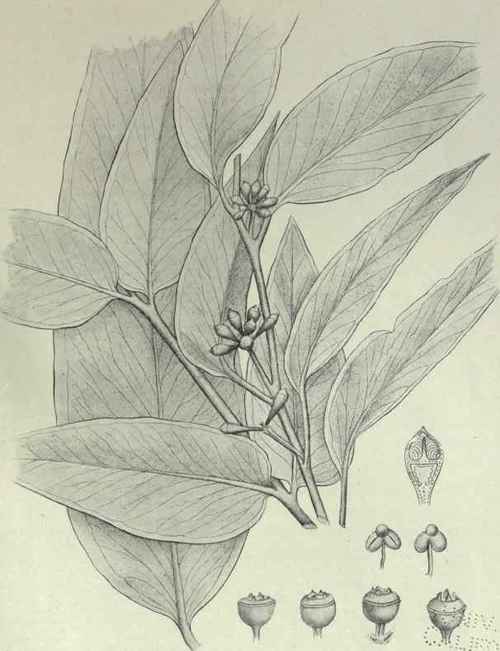
Eucalyptus Laevopinea. R T.B
Silver Top Stringybark
200 c.c. of the Armidale sample were rectified, using rod and disc still head. The oil commenced to distil at 155° C. (corr.). Between 155-158o, 100 c.c. came over; and between 158-170o, 50 c.c. more, or 75 per cent, below 170o C. These two fractions were again distilled, when 100 c.c. came over below 156o, and 20 c.c. more between that temperature and 159° C.
The oil distilling below 156.5° had specific gravity at 15o C. = 0.8682; rotation aD - 38.9°; refractive index at 20o C. = 1.4651. The second fraction had almost the same specific gravity and refractive index, but the rotation was a little less, an - 36.0°. The terpene was definitely shown to be laevo-rotatory pinene.
The odour of the distillate resembled that of commercial turpentine. The oil was water-white, and had properties closely approaching those for pure pinene, although a little cineol still remained. (For the corresponding dextro-rotatory pinene see under E. dextropinea.)
Continue to:


My Books

