


23. Eucalyptus eugenioides
Description
This section is from the book "A Research On The Eucalypts Especially In Regard To Their Essential Oils", by Richard T. Baker, Henry G. Smith. Also available from Amazon: A Research On The Eucalypts And Their Essential Oils.
23. Eucalyptus eugenioides
(Sieb., in Pl. Exs.; p. 479, and Fl. Mixt, p. 603; DC. Prod., iii, 218.) White Stringybark.
Systematic. - A tall tree. Bark thick, stringy, of a clean, reddish colour, or hoary on the external fibres. Abnormal leaves ovate, lanceolate, with crenulate edges, scabrous, oblique, acuminate, on, a petiole of about 1/4 inch long; venation fine, lateral veins oblique, parallel, intramarginal vein removed from the edge. Leaves of mature trees falcate, lanceolate, oblique, medium size, often shining; venation similar to that of the early leaves. Peduncles axillary, very numerous at the base of the branchlets, compressed, with many flowers. Calyx 2 to 3 lines long, tapering into a short pedicel; operculum conical, obtuse, about as long as the calyx.
Fruit. Hemispherical, very shortly pedicellate or sessile; rim wide, red coloured; valves not exserted, or only slightly so; about 1/4 inch in diameter.
In shape nearest to E. capttellata, but smaller, and only rarely eompressed, as obtains in that species. They are also not unlike E. Wilkinsoniana. Rim often a little wider than shown in the figure.
Habitat. - Probably the most widely distributed species on the coast and tableland of New South Wales, Victoria, and Queensland.

REMARKS.-A tree very rarely known by any other vernacular name than that of " White Stringy-bark." The buds and fruits are smaller than those of the other " Stringybarks," and these, together with the timber, form the chief botanical distinctions. Timber-getters and bushmen distinguish it from its congeners by its timber, which has a great reputation for durability in the ground, and being fissile is in much request for posts and rails.
ESSENTIAL OIL. - Leaves and terminal branchlets for distillation were obtained from Canterbury, near Sydney, in June, 1898. The yield of oil was 0.7 per cent. The crude oil was almost colourless, of a lightdemon colour, and had rather a pleasant odour, somewhat aromatic. Pinene was the principal low-boiling terpene, and phellandrene was absent. Cineol was present in fair amount at time of distillation. The sesquiterpene was a pronounced constituent.
The crude oil had specific gravity at 15o = 0.9132; rotation aD + 3.41°, refractive index at 20o = 1.4694, and was soluble in 6 volumes 70 per cent. alcohol. The saponification number for the esters and free acid was 6.9.
On rectification, 2 per cent. distilled below 172o C. (corr.). Between 172.174o, 21 per cent. distilled; and between 174-193, 59 per cent. distilled; the remainder consisted largely of the sesquiterpene. The fractions gave the following results: -
First fraction, sp. gr. at 15o C. | = | 0.9042; | rotation aD | + | 4.16o | |||
Second | " | " | " | = | 0.9092; | " | + | 2.63°. |
The cineol, determined by the phosphoric acid method in the crude oil, was 31 per cent. (O.M.).*
Material of this species was also obtained at Canterbury, N.S.W., in July, 1897. The colour, odour, constituents, and physical properties of the crude oil were practically identical with those of the previous sample. The yield of oil was 0.8 per cent. The crude oil had specific gravity at 15o C. = 0.9122 ; rotation aD + 4.8°, and was soluble in 7 volumes 70 per cent. alcohol.
The cineol, determined by the phosphoric acid method, was 28 per cent. (O.M.). The solubility in alcohol of the crude oil of this species increased as it became richer in cineol, and at the end of three and a half years it was soluble in 1 1/2 volumes 70 per cent. alcohol.
The above samples were mixed together and stored in the dark, and in August, 1919, the oil was again analysed. The increase in cineol was quite pronounced. This was noticed before the first edition of this work was published, and a note was added at the time recording this peculiarity.
The crude oil and the rectified portion gave the following results. 86 per cent, distilled below 100° C.: -
Crude oil, sp. gr. at 15° C. | = | 0.9393; rotation aD + 3-8°; refractive index at 20o = 1.4707. | ||
Fraction, | " | " | = | 0.9158; rotation aD + 2.5°; refractive index at 20o = 1.4636. |
The cineol was determined by the resorcinol method in the fractionated oil, and calculated for the crude oil; the result was 72 per cent. By the rapid phosphoric acid method it was 58 per cent., when calculated for the crude oil. The saponification number for the esters in the rectified portion was 11.7, and after acetylation 24.7. It is thus evident that bodies other than cineol, alcohols and esters, were absorbed by resorcinol.
* (O.M.) denotes original determination by phosphoric acid for the first edition of this work. See also the article on cineol (or eucalyptol).
Plate XIX.
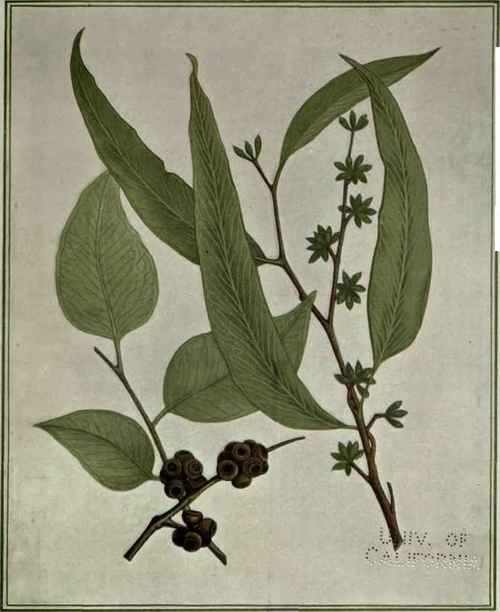
Eucalyptus Eugenioides. Sleb. White Stringybark
Plate XX.

A Typical Stringy Bark
Eucalyptus eugenioides, Sieb.
These barks are characterised by the long fibres which intertwine and cross lattice-like, forming ridges and depressions, and are reddish-brown or grey in colour.
The oils of Eucalypts with barks of this character usually consist of pinene with cineol, although occasionally phellandrene occurs in those of some species. The " Stringybarks "
seem to be the connecting group between the " Boxes " and the " Peppermints."
Plate XXI.

The species of the Stringybark Group are all and yielders of oil, and in this cross-section, taken near the mid-rib. three medium-sized oil glands are seen. Those nearest the mid-rib are not cut through the centre but the one to the right gives about the average size for this class of Eucalyptus. The mesophyll is of small dimensions, the leaf structure being composed mostly of palisade tissue, the cells towards the upper side being the larger. X 55.
Eucalyptus Eugenioides, Sieb
Continue to:


My Books

