


5. Eucalyptus terminalis
Description
This section is from the book "A Research On The Eucalypts Especially In Regard To Their Essential Oils", by Richard T. Baker, Henry G. Smith. Also available from Amazon: A Research On The Eucalypts And Their Essential Oils.
5. Eucalyptus terminalis
(F.v.M., in Jour. Linn. Soc, iii, 89.) A Bloodwood.
Systematic. - A fair-sized tree, with a brick-red, flaky bark. Leaves lanceolate mostly under 4 inches long, light yellow in colour, coriaceous; intra-marginal vein close to the edge,; lateral veins numerous, fine, almost transverse, parallel. Oil glands appear to be quite absent. Umbels in a broad, terminal corymb. Calyx 3 lines long and 3 lines in diameter, bell-shaped, pedicels 3 lines long ; operculum hemispherical, shortly acuminate.
Fruit. - Urn-shaped; rim countersunk; under 1 inch long, and up to 8 lines in diameter.
Care is required, in some instances, not to confound the fruits uith those of E. eximia and E. intermedia.
Habitat. - The Northern interior of New South Wales; West Australia; South Australia; Queensland.
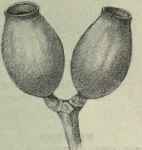
REMARKS. This Eucalyptus tree closely resembles E. eximia, Schau., and E. intermedia, R.T.B., in the shape of the fruits and the nature of the timber and bark but has paler and smaller leaves. Mueller and Bentham were inclined to regard it as a variety of E. corymbosa, Sm., but it differs from that species in fruit, timber and leaves. The scarcity of oil glands is a distinguishing festure in this, as in most of the "Bloodwoods." The leaves are thick and of a yellowish colour, probably being rich in the dye myrticolorin.
ESSENTIAL OIL. A quantity of leaves (60 lb.) was received from the far interior of New South Wales, but as the leaves showed an entire absence of oil glands, and other indications for oil were so unsatisfactory, no distillation was made. It is evident that several hundreds of pounds of material would be necessary in order to obtain sufficient oil to enable an investigation to be undertaken,
Continue to:


My Books

