


62. Eucalyptus resinifera
Description
This section is from the book "A Research On The Eucalypts Especially In Regard To Their Essential Oils", by Richard T. Baker, Henry G. Smith. Also available from Amazon: A Research On The Eucalypts And Their Essential Oils.
62. Eucalyptus resinifera
(Sm. in White's Voy., 231; in Trans. Linn. Soc, iii, 284.) Red or Forest Mahogany.
Systematic. - A tall forest tree extending throughout nearly the whole range of the coast district of New South Wales into Southern Queensland. Leaves lanceolate, rather large and broad, thick, drying a light green colour on both sides; venation faint, the lateral veins almost transverse and parallel, the intra-marginal vein close to the edge. Umbels axillary, stalk compressed, number of flowers varying up to twelve in an umbel. Buds pedicellate. Calyx hemispherical; operculum conical (sometimes several lines long), or hemispherical and acuminate.
Fruit. - Hemispherical; rim flat or slightly round; valves acutely acuminate, well exserted; usually about 3 lines in diameter.
The truncate rim and the sharp exsertei valves are characteristic, and are the best guides in identifying the tree. E. dealbata is much the same shape, but smaller.
Habitat. - The Coast district of New South Wales and Queensland.

REMARKS. - One of the largest forest trees of N.S.W. The common name has been given to it in allusion to the timber somewhat resembling the Honduras Mahogany. On a cortical classification, it would be placed in the " Stringybarks," as its bark is much more stringy than many Eucalypts known by that name. The fruits are characteristic, the hemispherical shape and flat rim being constant. The variety grandiflora, of Bentham (B.F1. iii, 246), is, in this work, raised to its original specific rank of E. hemilampra, F.v.M. We find that E. resinifera presents little or no variation of form throughout its geographical distribution, and the present supposed varieties will no doubt be found to be good species under the original names of E. spectabilis, F.v.M., and E. pellita, F.v.M.
ESSENTIAL OIL. - Leaves and terminal branchlets for distillation were obtained from Gosford, New South Wales, in May, 1897. The yield of oil was 0.42 per cent. The crude oil was dark lemon in colour, and had an odour resembling those of the cineol-pinene class. The oil was rich in cineol, but did not contain phellandrene; the low-boiling terpene was pinene. Only a small quantity of high-boiling constituents was present, consequently the specific gravity was somewhat low.
The crude oil had specific gravity at 150 C. = 0.9098; rotation aD + 2.25°; refractive index at 200 = 1.4698, and was soluble in 1 3/4 volumes 70 per cent, alcohol. The saponification number for the esters and free acid was 9.2.
On rectification the usual amount of acid water with rather an excess of aldehydes came over below 1700 C. Between 170-1830, 87 per cent, distilled; and 7 per cent, between 183-2450. These fractions gave the following: -
First fraction sp. gr. at 15° C. | = | 0.9072; | rotation aD | + | 2.45°. | ||
Second | " | " | = | 0.9168; | " | not taken. | |
The cineol determined in the crude oil by the phosphoric acid method was 50 per cent. (O.M.). A precipitate formed in the crude oil on keeping, as do many of the oils belonging to this class. (See the article on this deposit.)
Plate XXIX.
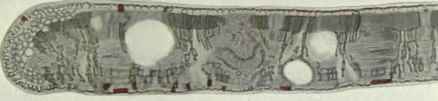
Section near the edge of the leaf, three glands are seen. The palisade tissue is developed below the thickened edge of the upper surface of the leaf, and clearly demarcated from the spongy tissue. The edge of the leaf is backed by strengthening tissue stomata hypogenous. x 55.
Eucalyptus Resinifera. Sm
The above sample had been preserved in the dark, and in August, 1919, was again analysed. The alteration that had taken place in the oil during the 22 years it had been kept was not very pronounced; the specific gravity had increased somewhat, and a precipitate had formed; perhaps the cineol had also increased as indicated from the results with the fractionated oil.
On rectification go per cent, distilled below 1900 C. The results with the crude and rectified oils were as follow: -
Crude oil, sp. gr. at 150 C. | = | 0.9249; rotation aD + 3.0°; refractive index at 200 = 1.4699. | ||
Fraction | " | " | = | 0.9133; rotation aD + 2.4°; retractive index at 200 = 1.4651. |
The cineol, determined by the resorcinol method in portion distilling below 1900 and calculated for the crude oil, was 69 per cent. By the rapid phosphoric acid method it was 56 per cent, when calculated for the crude oil.
Continue to:


My Books

