


61. Eucalyptus dealbata
Description
This section is from the book "A Research On The Eucalypts Especially In Regard To Their Essential Oils", by Richard T. Baker, Henry G. Smith. Also available from Amazon: A Research On The Eucalypts And Their Essential Oils.
61. Eucalyptus dealbata
(A. Cunn., Schau. in Walp. Rep., ii, 924.) Cabbage, White Gum, or Mountain Gum.
Systematic. - A fair-sized tree, from 60 to 80 feet high, with a smooth bark, which is occasionally rough at the base. Abnormal leaves lanceolate, acuminate, or shortly so, 4 to 6 inches long, and under 2 inches broad, pale bluish; intramarginal vein well removed from the edge, especially in the short broader leaves. Normal leaves lanceolate, generally under 6 inches long, not shining; venation well marked, lateral veins oblique, spreading, intramarginal vein removed from the edge. Peduncles axillary, short, 4 lines long, with four to six flowers in the umbel. Calyx conical, about 2 lines long; pedicel short or long, occasionally angular- operculum conical, obtuse, equal to or longer than the calyx.
Fruit. Hemispherical; rim flat, or slightly convex; valves acuminate, exserted, often resembling those of E. oleosa, F.v.M.; 2 lines long and 2 1/2 lines in diameter.
The fruits are constant in shape, not unlike those of K. resinifera with the truncate rim, butsomwehat smaller.
Habitat. - Condobolin to Manildra, Cowra, Grenfell, Tenter-field, Murrumbo, Rylstone, New South Wales; Victoria; Queensland.

Plate XXVIII.
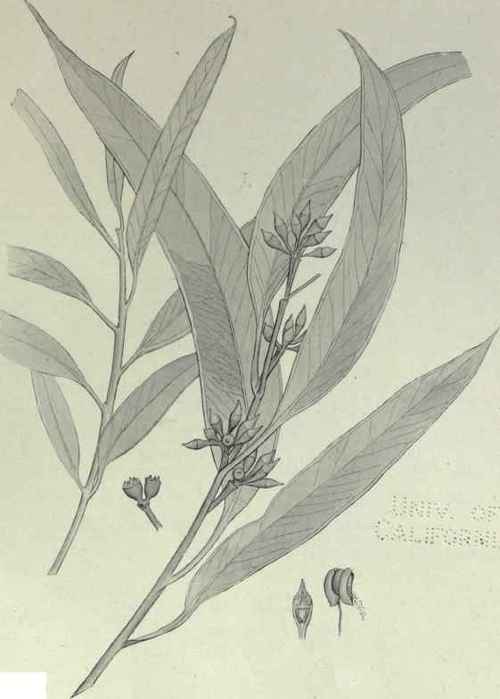
R.T.B., del.
Eucalyptus Dealbata, A Cunn. A Mountain Gum
REMARKS. - A good-sized, straight-stemmed tree; except for the greyish tinge of the foliage, it resembles in appearance E. punctata, DC, the trunks having the same general grey colour, but with lighter coloured patches on them. There has been some doubt in the past whether this tree should not be placed with E. tereticornis, Sm., but timber, bark, and fruits, as well as the oil differ from those of that species, and as these characters are constant throughout its extensive distribution, i.e., east and west of the Great Dividing Range, it has been decided to retain Cunningham's naming. A feature of the inflorescence is the very small, brown-coloured, second operculum, which comes off early in the bud stage.
ESSENTIAL OIL.- Leaves and terminal branchlets for distillation were obtained from Condobolin, New South Wales, in March, 1901. The yield of oil was 0.85 per cent. The crude oil was the colour of olive oil, and had an odour resembling those of the cineol-pinene class. It was rich in cineol, contained some pinene, but phellandrene was absent. The higher boiling portion consisted largely of the sesquiterpene, together with a high boiling dextro-rotatory alcohol. The rectified oil had a yellowish tint, resembling, in this respect, those belonging to this class. The oil is a good one for pharmaceutical purposes.
The crude oil had specific gravity at 150 C. = 0.9261; rotation aD + 3.8°, refractive index at 200 = 1.4648, and was soluble in 1 3/4 vols. 70 per cent, alcohol. The saponification number for the esters and free acid was 2.1.
On rectification a small amount of acid water and volatile aldehydes came over below 1660 C. (corr.). Between 166-1830, 88 per cent, distilled; between 183-2550, only 2 per cent, came over, and between 255-2680, 5 per cent, distilled. These fractions gave the following results: -
First fraction, sp. gr. at 15o C. | = | 0.9193; | rotation aD | + | 2.6°. | |||
Third | " | " | = | 0.9460; | " | not taken. | ||
The cineol determined by the phosphoric acid method in the large traction was 58 per cent. (O.M.), indicating about 52 per cent, in the crude oil.
This sample of oil had been stored in the dark, and in September, 1919, eighteen years afterwards, was again analysed. Very little alteration had taken place in the oil during all that period, except that it was richer in cineol, in fact, the rectified oil consisted principally of cineol and pinene.
On redistilling, 90 per cent, came over below 1900 C. The crude oil and large fraction gave the following results: -
Crude oil, sp. gr. at 150 C. | = | 0.9290; rotation aD + 3.6°; refractive index at 200 = 1.4649. | ||
Large fraction | " | " | = | 0.9228; rotation aD + 2.5°; refractive index at 20°= 1.4594. |
The cineol was determined by the resorcinol method in the portion distilling below 1900; when calculated for the crude oil the result was 87 per cent. By the rapid phosphoric acid method it was 73 per cent., when calculated for the crude oil.
Continue to:


My Books

