


60. Eucalyptus cinerea
Description
This section is from the book "A Research On The Eucalypts Especially In Regard To Their Essential Oils", by Richard T. Baker, Henry G. Smith. Also available from Amazon: A Research On The Eucalypts And Their Essential Oils.
60. Eucalyptus cinerea
(F.v.M., in B. Fl., iii, p. 239.) Argyle Apple.
Systematic. A picturesque tree, from 40 to 50 feet high., having a foliage covered with a whitish bloom. Bark whitish brown or reddish, fibrous, thick, extending almost to the branchlets. Leaves opposite, sessile, cordate, ovate, ovate-lanceolate, or lanceolate, on a short petiole; venation generally well marked, oblique, intramarginal vein removed from the edge. Peduncles axillary, flattened or terete, very short, bearing mostly three flowers, sessile or nearly so; calyx obconical, 2 to 3 lines long; operculum hemispherical, shortly acuminate.
Fruit. - Sessile and hemispherical, or pyriform; rim thick, domed; valves short, rarely exserted; 2 to -5 lines in diameter.
Fruits are not unlike (hose of E. pulverulenta.
Habitat.- Counties of Camden and Argyle, Lake George, New South Wales; Toongabbie to Walhalla, Victoria.

REMARKS. - Baron von Mueller in his "Eucalyptographia" unites this species with Sim's E. pulverulenta. but it is only under a much restricted classification that this would hold, for when seen in their native habitat, no two trees could be more unlike each other than are these two. Bentham, however, agrees with the original author, and separates the species (B.F1. iii, pp. 224, 239). Unfortunately for recent botanical workers, Mueller erroneously figures this particular species (E. cinerea) when illustrating what he considered to be E. pulverulenta (loc. cit.); this has led to much confusion, and we ourselves did not discover this fact till late in the research for the first edition. In Mueller's numerous references to E. pulverulenta in his "Eucalyptographia," it is undoubtedly E. cinerea that is meant, as it is that tree, the "Argyle Apple "which has a reddish, stringy-bark, and a reddish-coloured timber similar to E. Stuartiana, the "Apple" of Victoria, and Mueller often states that he was inclined to consider these two latter identical. We are of the opinion, from our examination of the material of E. Stuartiana, E. pulverulenta, E. cinerea, and E. Bridgesiana, that they are all good and distinct species. Unfortunately, most of the Eucalyptus vernacular names are misleading, one name being applied to several distinct species, but E. cinerea is an example in which one common name is applied to the one species, and not to several others, so that in this particular instance there can be no mistaking the tree locally, however much the botany may be in doubt.
ESSENTIAL OIL. - Leaves and terminal branchlets for distillation were obtained from Barber's Creek, New South Wales, in January, 1900. The yield of oil was 1.2 per cent. The crude oil was red in colour, and had a pronounced odour of volatile aldehydes. A rather large amount of esters appear always to be present in the oil of this species, consequently it had a tendency to become acid, particularly if rectified by direct distillation under atmospheric pressure. Pinene was always present, varying slightly in amount at different times of the year; but phellandrene was absent. The oil was rich in cineol, and when properly rectified, of good quality for pharmaceutical purposes. The crude oil had usually a high specific gravity, but contained a minimum of high-boiling constituents for an oil of this class, although the ester content was considerable. During the summer the specific gravity of the oil was usually lower than in the winter, as the terpenes of low boiling point are then present in a maximum amount.
The crude oil had specific gravity at 150 C. = 0.9113; rotation aD + 3.05°; refractive index at 200 = 14649, and was soluble in 1 1/4 volumes 70 per cent, alcohol. The saponification number for the esters and free acid was 24.
On rectification 2 per cent, distilled below 1680 C. (corr.). This portion consisted largely of the two aldehydes, butaldehyde and valeraldehyde. Between 168-188°, 89 per cent, distilled. The distillation was not carried further.
This fraction had sp. gr. at 150 C. = 09094; rotation aD + 3.2°.
Plate XXVII
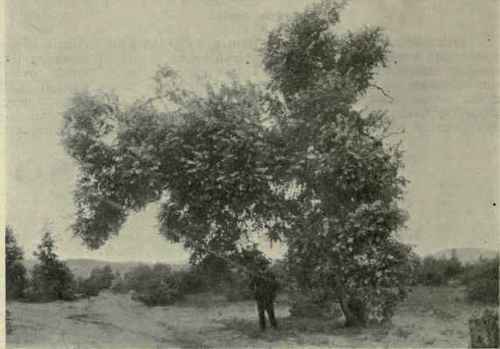
[M. F. Connelly, Photo.]
Eucalyptus Cinerea. F V.M. "Argyle Apple."
This photograph shows the foliaceous character of this species.
Towrang, N.S.W.
The cineol, determined by the phosphoric acid method in the rectified portion, was 59 per cent. (O.M.), indicating about 54 per cent. in the crude oil.
The rectified oil was yellow in tint, as is usual with the oils of this class. This colour is traceable to the influence of the phenol australol.
Leaves and branchlets of this species for distillation were also obtained from the following localities: - Barber's Creek, New South Wales, in September, 1899; Towrang, in August, 1900; Barber's Creek, in November, 1896; Barber's Creek, in September, 1897. The oils from all this material were found to be fairly constant in general characters; and the percentages of esters, cineol content, optical rotations, and yields of oil were all practically in agreement, only varying in the amounts usual with the oil of a particular species, distilled at varying times of the year.
The following tabulated results obtained with the crude oils will show the range of differences between the several samples: -
Date and Locality. | Specific gravity at 15o. C | Optical Rotation | Saponification number for esters and free acid. | Pencntage yield of oil. |
E. cinerea, Barber's Creek, Nov., 1896 | 0.9186 | + 4.1° | 15.9 | 1.2 |
E. cinerea, Barber's Creek, Sept., 1897 | 0.9157 | + 3.5° | 16.5 | 1.3 |
E. cinerea, Barber's Creek, Sept., 1899 | 0.9225 | + 2.5° | 14.4 | 1.0 |
E. cinerea, Barber's Creek, Jan., 1900 | 0.9113 | + 3.05° | 24.0 | 1.2 |
E. cinerea, Towrang, Aug., 1900 | 0.9168 | + 3.6° | 21.1 | 1.3 |
Considerable quantities of oil were commercially distilled from this species at one time in the Towrang district of New South Wales, particularly by the Australian Eucalyptus Oil Company, and we were thus able to test numerous samples of this commercially distilled oil. It was not found to differ in constituents or general characters at any time, beyond what might be expected with the oil from any one species. The specific gravity of the crude oil varies between 0.91 to 0.9225, the rectified oil being in agreement. The saponification number of the esters and free acid in the crude oil usually ranges between 14 and 24. As the trees are somewhat gregarious, with plenty of foliage, which yields a fair percentage of a good oil, this species may be considered of value for Eucalyptus oil distillation.
The above oils were mixed together and stored in the dark, and in August, 1919, the sample was again analysed; it had increased a little in specific gravity, as was to be expected from the formation of the insoluble deposit, and for the same reason had increased in cineol content. 86 per cent. distilled below 1900 C. The crude oil and the rectified portion gave the following results: -
Crude oil, sp. gr. at 15o C. | = | 0.9230; rotation aD + 4.0o; retractive index at 200 = 1.4627. | |
Rectified portion | " | = | 0.9170; rotation aD + 4.5°; refractive index at 20°= 1.4604. |
The saponification number was 18.5 and after acetylation 55.4, equal to 1.-5 per cent, of free alcohol, with a C10Hl8O molecule.
The cineol was determined by the resorcinol method in the rectified portion and calculated for the crude oil; the result was 72 per cent. By the rapid phosphoric acid method it was 60 per cent, when calculated for the crude oil. Terpineol was detected in the rectified portion, which gave an alcohol value equal to 8 per cent.
The red colour of the cineol-pinene crude Eucalyptus oils is traceable to the free acid attacking the iron of the stills, the iron reacting on the phenols, consequently the colour may be removed by agitating with a solution of sodium hydrate. In commercial distillation of the leaves, copper still-heads were at one time generally used, but it was soon found that copper fittings for this purpose were unnecessary and objectionable, because the free acid in many of the oils readily dissolved the copper, so that the crude oil became of a greenish colour in consequence. This was particularly the case with the oil of E. cinerea, and it was found that if care were not taken in the rectification., copper could be detected in the distillate. When iron alone was present in the oil this did not occur, so that eventually copper fittings were in most cases discarded.
As an illustration of the amount of copper likely to occur in oils of this class, if copper fittings are used, the following is given: - When crude Eucalyptus oils are rectified by direct distillation, a portion of the water absorbed in the oil comes over in the first distillate, and this contains practically the whole of the free volatile acid occurring in the oil. Our thanks are due to the Australian Eucalyptus Oil Company for supplying us with about two litres of this water, which they had collected when rectifying the crude oil of Eucalyptus cinerea. This water was strongly acid, and of a bright green colour, due to the presence of the copper in solution. The water had also a strong odour of the volatile aldehydes. It was made alkaline by the addition of sodium hydrate, the precipitated copper filtered off., and the precipitate dried and ignited. The copper was then dissolved out, and finally precipitated as metal on a platinum dish. The amount of metallic copper thus obtained from 2 litres of water was 0.8772 gram., equal to 0.0438 per cent. It must be remembered, too, that this result only represented that portion of the copper which came over on redistillation.
The amount of free acetic acid in the water was determined by titrating 10 grams, with semi-normal soda. The amount of NaOH used was 0.140 grams., equal to 2.1 per cent, acetic acid. (See also the article on "The Free Volatile Acid of Eucalyptus Oils.")
Continue to:


My Books

