


Illustrations
Description
This section is from the book "A Research On The Eucalypts Especially In Regard To Their Essential Oils", by Richard T. Baker, Henry G. Smith. Also available from Amazon: A Research On The Eucalypts And Their Essential Oils.
Illustrations
The following series of plates will serve to illustrate the various forms of Eucalyptus oil stills in operation in Australia; from the single tank, where direct firing is employed, to the larger installations worked with boiler and separate digesters. In many of the more modern and larger plants the digesters are sunk in the ground, and are constructed either of wood or of iron. This method allows of easy loading and unloading, and works quite satisfactorily.
We are indebted to the proprietors of these distilleries for much information concerning their construction.
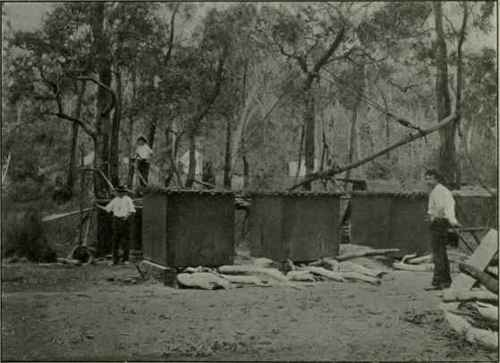
Plate No. 106. Single tank Eucalyptus oil still at Springgrove, near Braidwood, New South Wales. It is of double size, and fired directly. Three men were working this plant, mutually performing the necessary duties such as cutting the leaves, carting, and distilling. The species being worked were the "Narrow-leaf" and " Broad-leaf Peppermints," E. phcllandra and E. dives, and from 75 to 8o pounds of oil were obtained at each distillation. The value of this crude oil at the stills in November, 1919, was 71/4d. per pound, so that good wages can be secured with a simple plant of this description. The tank shows the stirrup form of fastening on the lid, and two straight pipes, laid in water, for condensing the steam. (Mr. A. J. Bedwell.) Plate No. 107. The more common type of still in which two tanks are coupled together and fired directly. The condensing arrangement is usually the long straight 2-inch iron pipe, and the cover is fastened with steel clips. These stills are usually employed in New South Wales for working the "Peppermint" species. (Mr. McGrath.) Plate No. 108. The arrangement of three directly fired tanks linked together. In this plant either one, two, or three tanks could be worked at the same time. The condenser was fixed in a similar tank at the rear, into which the water was pumped from a creek running near the tree.* (Australian Eucalyptus Oil Co.) Plate No. 109. Four square tanks linked together and worked with a boiler. This plant was in operation at Wyalong, New South Wales, distilling E. polybractea. The yield of oil from this species is less than from either the "Narrow" or "Broad-leaf Peppermint," consequently the value of the oil at the stills is greater than that of the crude phellandrene-bearing "Peppermint" oils. (Wattle Brand Eucalyptus Oil Co.) Plate No. no. A plant in operation on the Cygnet River, Kangaroo Island, South Australia. The species being worked were E. cneori-folia and E. odorata. The distillation was carried out by direct firing, the tank being a large one, holding about 4,000 pounds of partly dried leaves, or 5,000 pounds of green leaves with terminal branchlets. The bottom part was set in bricks, the upper part framed with wood. The distillation was continued for three hours, and during the spring and summer months about 112 pounds of oil were obtained from each charge. In the winter months the yield was only about half that amount. By the mechanical means adopted the whole of the spent leaves could be lifted out under six minutes from the time the lid was removed. (Mr. E. Burgess.)
* The tree close to where the man and boy are standing is E. Macarthuri, the species from which the oil so rich in geranyl-acetate is obtained.
Plate No. hi. A crude adaptation of the principle of distillation, where the steam is produced outside the digester. The whole plant consisted of three 400-gallon iron tanks; one of these was used as a boiler, another as the digester, while the third was the condenser. The worm for condensing the steam was of copper and the large still-head was also of copper. This plant was working at Macedon, Victoria, distilling the "Peppermint" species. (Mr. Saddington.)
Plate No. 112. Another plant working at Macedon, Victoria, also distilling the "Peppermint" species. The steam was produced by a small boiler and the digesters were two 400-gallon tanks, worked alternately, so that by preparing one tank while the other was being distilled the process could be made continuous. The water was supplied to the- condenser by the aid of the windmill. (Mr. Tovey.)
Plate No. 113 A plant at Huntley North, Victoria. The species being worked was E. polybractea. The digester was constructed of wood and was 8 feet by 5 feet 9 inches. The condenser was made of copper. (Mr. Moyles.)
Plate No. 114. A plant at Wyalong, New South Wales, employed in distilling E. polybractea. The three digesters were of iron, sunk in the ground, one holding about 2,500 pounds of leaf material, the others a little smaller. A large Cornish boiler supplied the steam, the working pressure being 30 to 35 pounds, and the time of distillation two hours. The spent leaves were removed by mechanical means. (Gillard Gordon, Ltd.)
Plate No. 115. A plant working E. polybractea, at Wyalong, New South Wales. There were two digesters sunk in the ground, the larger holding about 3,000 pounds of leaf material. When in full working order six digesters were distilled each day, the time for each being two hours. (Gillard Gordon, Ltd.)
Plate No. 116. A large plant at Whirrakee, near Bendigo, Victoria. The two large digesters were built of wood, bound with iron, and sunk in the ground. The lid was of wood also, with an outlet in the centre made of copper. The digesters were 12 feet deep with a diameter of 6 feet 6 inches, and held about 8,000 pounds of leaf material. The best yield of oil was about 160 pounds for each digester, although in the winter the yield was only about half that amount. The condenser was laid in a concrete trench with about 260 feet of piping, from 3 inches in diameter, diminishing to 1 1/4 inches. The boiler was a large Cornish one, 22 feet long, and much of the spent leaf material was burnt in it. The crude oil was refined by steam distillation in the ordinary way. The chief species worked was E. polybractea, (The Hardinge Smith Co-operation Ltd.)
Plate No. 117. A large plant at Huntley North, Victoria, for distilling the "Mallee" species. The two digesters, built of wood, were 7 feet 6 inches deep, by 5 feet 6 inches in diameter, and sunk in the ground. A large tubular boiler supplied the steam, the pressure being 15 to 20 pounds. The oil was rectified by steam. (Mr. J. M. Hodgson.)
Plate No. 118. A Victorian distilling plant for the production of Eucalyptus oil. Each of the four digesters was of 2,000 gallons capacity. Messrs. J. Bosisto & Co.)
Plate No. 119. A distilling plant at one time working at Punyelroo, on the River Murray in South Australia. The digesters, one of which is shown in the picture, had a capacity of between 4,000 and 5,000 gallons. One of them was a brewer's fermenting vat, and the other built of pine, with the fittings of copper. (Messrs. Faulding & Co.)
We have selected this series of plates as they give a very good summary of the several methods employed in the production of Eucalyptus oil in Australia. In an undertaking of this character, where some hundreds of stills of one kind or another are in operation, it is to be expected that a considerable diversity in general ideas will be evident, but we think the range of stills here illustrated is sufficiently comprehensive to cover the majority of those employed in the industry.
Plate CVI.
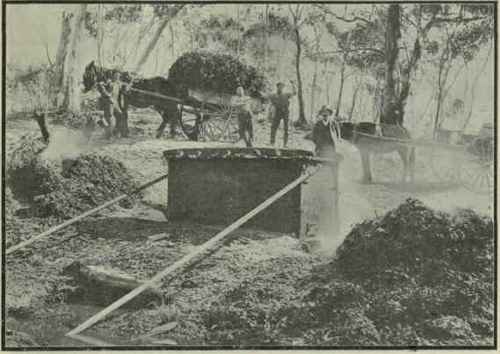
Single Tank, Eucalyptus Oil Still, Direct Firing Spring Grove, near Braidwood, N.S.W. (M. A. J. Bedwell.)
Plate CVII.
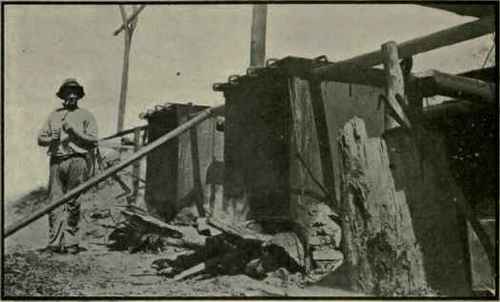
Two-tank Eucalyptus Oil Still, Direct Firing. Youri, N.S.W. (Mr. McGrath.)
Plate CVIII.
[Photo.]
M. F. Connelly,
Three-tank Eucalyptus Oil Still, Direct Firing. Wingello, N.S.W. (Australian Eucalyptus Oil Co.)
Plate CIX.
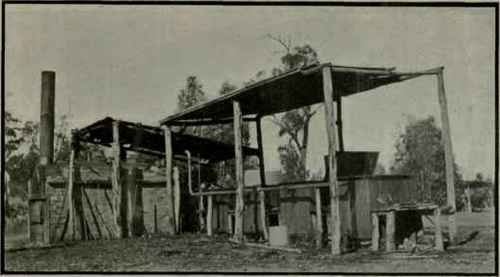
Four-tank Eucalyptus Oil Still, Steam from Boiler. Wyalong, N.S.W. (Wattle Brand Eucalyptus Oil Co.)
Plate CX.
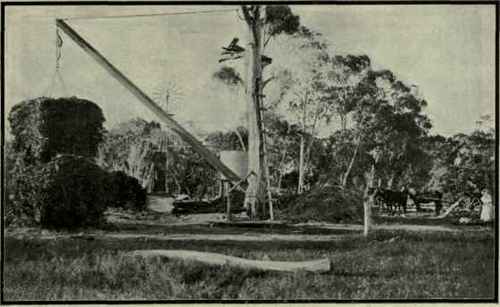
Eucalyptus Oil Still, Direct Firing. Kangaroo Island, South Australia, (Mr. E. Burgess.)
Plate CXI.
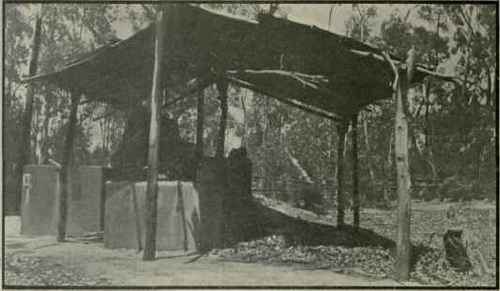
COMPOSITE Eucalyptus Oil Still, Using Three Tanks. Macedon, Victoria. (Mr. Saddington.)
Plate CXII.
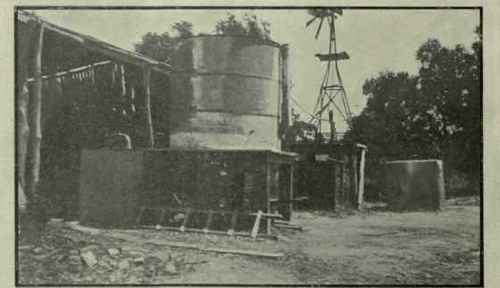
Eucalpytus Oil Still. WITH Square Tank Digesters, Steam from a Boiler. Macedon, Victoria. (Mr. Tovey.)
Plate CXIII.
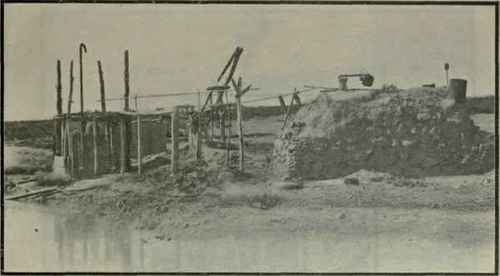
Eucalyptus Oil Still, With Wooden Disaster Huntley North, Victoria. (mr. Moyles.)
Plate CXIV.
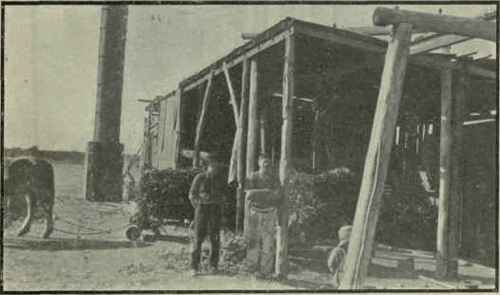
Eucalyptus Oil Still, with Three Iron Digesters Sunk in the Ground. Wyalong, N.S.W. (Messrs. Gillard Cordon. Ltd.)
Plate CXV.
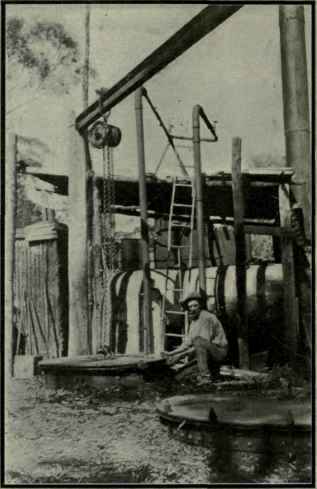
Eucalyptus Oil Still, with Two Iron Digesters Sunk in the Ground. Wyalong, N.S.W. (Messrs. Gillard Gordon, Ltd.)
Plate CXVI.
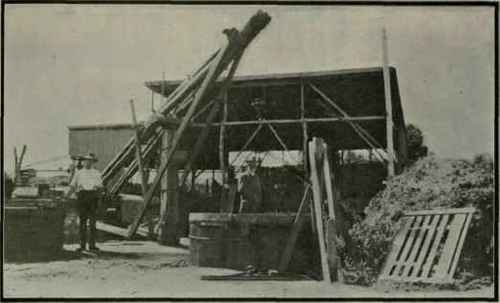
Eucalyptus On. Still, with Two Large Wooden Digesters Sunk in the Ground. Whirrakee, Victoria. (Hardinge Smith Co-operation.)
Plate CXVII
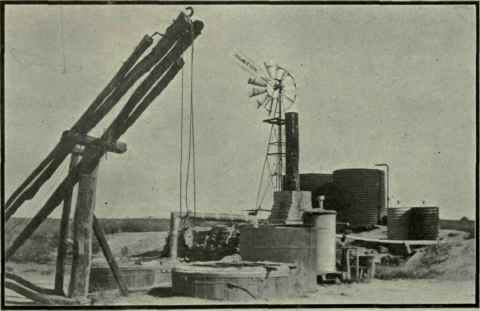
Eucalyptus Oil Still, with Two Large Wooden Digesters Sunk in the Ground. Huntley North, Victoria. (Mr. J. M. Hodgson.)
Plate CXVIll.
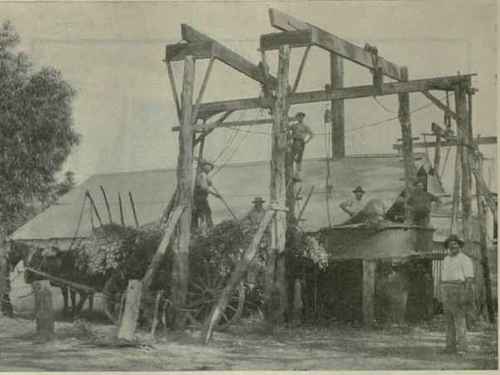
EUCALYPTUS OIL STILL. Victoria. (Messrs. J. Bosisto & Co..)
Plate CXIX
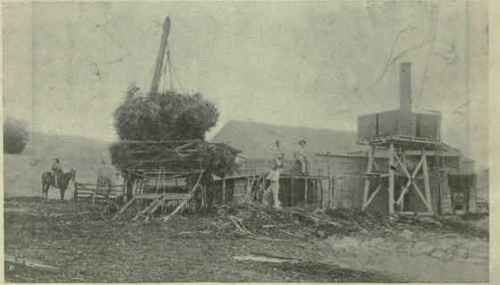
Eucalyptus Oil Still. South Australia. (Messrs. Faulding & Co.)
Plate CXX
A
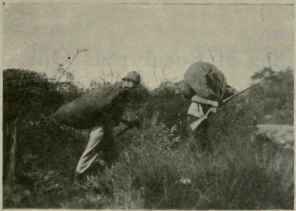
A
E. vernicosa 4000 Feet above Sea Level On The hartz Mountains Leaves Carried 2 MILES.
B The Leaves were then "Packed" 12 MILES Geeveston, thenCE boat to hobart and Sydney.
2 CWT. TO THE LOAD.
B
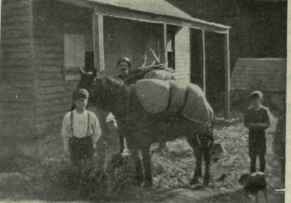
C
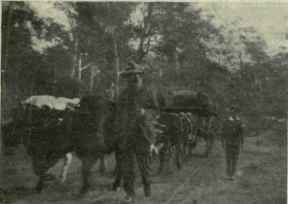
c E. Perriniana.
Leaves being Drawn 12 Miles to Ouse Bridge, then 25 Miles by Horse-team to Mac-cjuarie Plains, thence by Train to Hobart and Boat to Sydney
Collecting Eucalyptus Leaves In Tasmania. Supervised by Mr. L. G. Irby. Conservator of Forests, famania.
Continue to:


My Books

