


79. Eucalyptus pulverulenta
Description
This section is from the book "A Research On The Eucalypts Especially In Regard To Their Essential Oils", by Richard T. Baker, Henry G. Smith. Also available from Amazon: A Research On The Eucalypts And Their Essential Oils.
79. Eucalyptus pulverulenta
(Sims, in Bot. Mag., t. 2087.) (Syn. E. pulvigera, A. Cunn.)
Systematic - A tall shrub, with a "weak green stem hardly able to support itself " (Sims), the bark on the thicker stems is smooth, flaking off near the base, where only specimens of the wood can be obtained. The lower parts of the green stems have the appearance of rattans or palms by the scars left by the base of the old deciduous leaves, which produce an effect somewhat similar to the nodes of the bamboo. To our knowledge no other Eucalypt has this character. Leaves sessile, ovate, cordate, orbicular or broadly ovate, obtuse, or very shortly acuminate, not crenulate, or hardly perceptible, yellowish-green and slightly shining, or mealy white, rigid, coriaceous; venation distinct, lateral veins spreading, intramarginal vein removed from the edge. Peduncles axillary, opposite, terete, under 3 lines long, bearing three comparatively large flowers, glaucous. Calyx campanulate, 3 lines long and 3 lines in diameter; operculum conical, shorter than the calyx.
Fruit. - Sessile, hemispherical or inclined to bell-shape; rim thick, truncate, slightly rounded or countersunk, with a narrow edge; valves slightly exserted; 3 to 4 lines in diameter.
These fruits are distinctive from those of other species except E. cinerea.
Habitat. - Cox's River, Cow Flat, New South Wales.

REMARKS. - At the time of the publishing of the first edition, the systematic recognition of this species by us was very much challenged, and so the remarks in that edition were given rather fully in order to support our contention that it is not E. cordata of Tasmania or E. cinerea of New South Wales.
As its specific rank is now firmly established, those remarks (loc. cil.) are omitted from this edition.
ESSENTIAL OIL. - Leaves and terminal branchlets for distillation were obtained from Bathurst, N.S.W., in February, 1901. The yield of oil was large, 33 ounces being obtained from 93 lb. of leaves and branchlets, equal to 2.22 per cent. The branchlets were stiff and woody, owing to the peculiar structure of this species; consequently more stems were present than was generally the case with most other Eucalypts, so that the result demonstrates how great is the quantity of oil secreted in the leaves of this species. The crude oil was of an amber colour, and had an odour resembling those of the cineol-pinene class of Eucalyptus oils. It was very rich in cineol; pinene was present, but phellandrene was absent. The chemical constituents and physical properties of the oil of this Eucalypt are in agreement with those of E. cinerea. The esters were rather pronounced.
The crude oil had specific gravity at 150 C. = 0.9236; rotation aD + 2.12°; refractive index at 200 = 1.4629, and was soluble in 1 1/4 volumes 70 per cent. alcohol. The saponification number for the esters and free acid was 18.4.
On rectification 2 per cent, distilled below 1660 C. (corr.). Between 166-1830, 78 per cent. distilled, and between 183-1960, 15 per cent, distilled. It is thus evident that the sesquiterpene and other high-boiling constituents were only present in small amount. The fractions grave the following results: -
First fraction, sp. gr. at 150 C. | = | 0.9208; | rotation aD | + | 2.45°. | |||||
Second | " | " | " | = | 0.0217; | " | not taken. | |||
The cineol, determined by the phosphoric acid method in the first fraction, was 60 per cent, in the crude oil (O.M.).
The above sample of oil had been stored in the dark, and in August, 1919, was again analysed. The increase in cineol was distinctly shown, the rectified oil at that time being quite equal to that of E. polybractea. 92 per cent. distilled below 1900 C. The crude oil and the redistilled portion gave the following results: -
Crude oil, sp. gr. at 150 C. | = | 0.9305; rotation aD + 2°; refractive index at 200 = 1.4609. | ||
Rectified portion | " | " | = | 0.9250; rotation aD + 2.5°; refractive index at 200 = 1.4594. |
The cineol was determined by the resorcinol method in the rectified portion and calculated for the crude oil; the result was 88 per cent. By the rapid phosphoric acid method it was 74 per cent. when calculated for the crude oil. Terpineol was detected in the rectified portion.
Plate XXXIX.
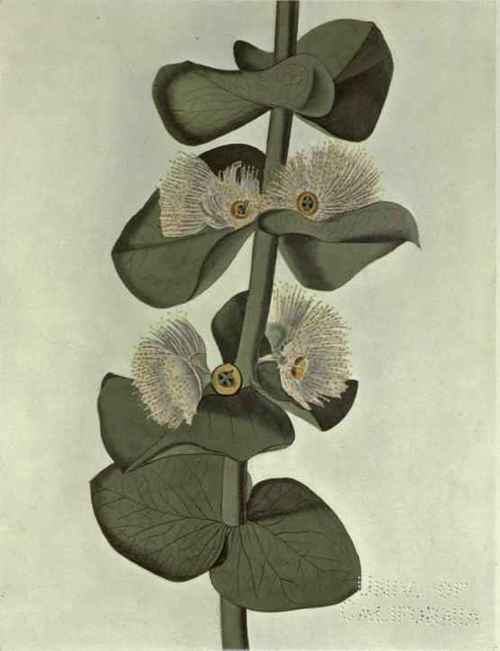
Eucalyptus Pulverulenta. Sims
Reproduced from the " Botanical Magazine," 1819. It will thus be seen that this rare Eucalyptus was grown in England from seed forwarded from Australia at that early period after the foundation of the Colony in 1788.
Plate XL.
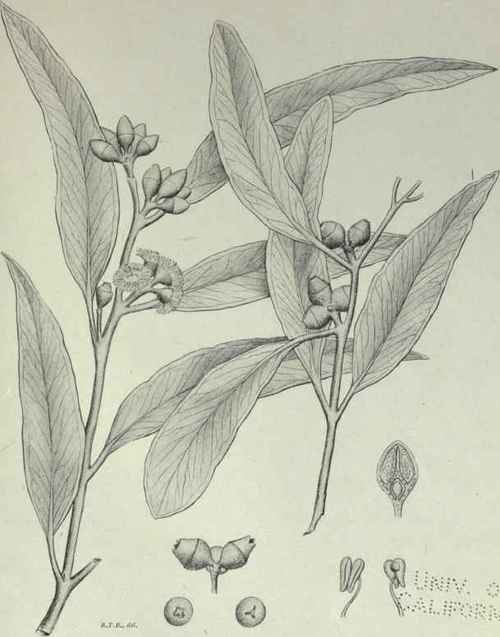
Eucalyptus Morrisii. R.T.B. Grey Mallee
Continue to:


My Books

