


74. Eucalyptus Bridgesiana
Description
This section is from the book "A Research On The Eucalypts Especially In Regard To Their Essential Oils", by Richard T. Baker, Henry G. Smith. Also available from Amazon: A Research On The Eucalypts And Their Essential Oils.
74. Eucalyptus Bridgesiana
(R.T.B., Proc. Linn. Soc, N.S.W., 1898, p. 164, t. V). Apple or Woolly-butt, Butt Butt of Gippsland (A. W. Howitt).
Systematic. - A tree of considerable size, grows to a great height, particularly in loamy soil. Bark whitish grey, wrinkled or tesselated, short and brittle in the grain, not fibrous, almost identical with that of the "Boxes," and when freshly cut exhales an aroma similar to the ordinary oil obtained from Eucalyptus leaves. Abnormal leaves in the early stage ovate-cordate, and then ovate-acuminate, petiolate or sessile, opposite or alternate. Normal leaves on rather long petioles, lanceolate, acuminate, often falcate, varying in length to over 1 foot, not shining, the southern form drying a light grey colour, the northern a darkish green; lateral veins either prominent or faint, spreading, the intramarginal one well removed from the edge. Umbels capitate, axillary, on flattened peduncles, bearing about seven flowers; pedicels from 1 to 3 or 4 lines long; tube of the calyx semi-ovate, rarely top-shaped; operculum hemispherical, obtuse or acuminate.
Fruit. - Hemispherical, rarely conical, on a short or long pedicel; rim mostly thickened with a ring below the edge; a specimen from Araluen has quite a flange; valves exserted; 3 to 4 lines in diameter.
The fruits are characteristic; they somewhat resemble E. resinifera or occasionally E. viminalis, but the rim is more domed.
Habitat. - Southern half of Dividing Range, New South Wales, into Gippsland, Victoria.
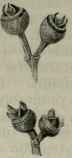
REMARKS. - Objections have been taken (vide Proc. Linn. Soc, New South Wales, 1899, Part IV, p. 628) to the specific rank of this species, and efforts made to show that it is identical with Baron Mueller's E. Stuartiana, the "Apple" of Victoria. We contend that E. Stuartiana, F.v.M., does not appear to occur in this State, as Mueller's description in the Eucdlyptngraphia applies to the "Apple tree" of Victoria, which has a red, almost Stringy-bark and a red-coloured timber. As stated by Mueller, "Argyle Apple" (E. cincrea, F.v.M ), is distinguished from E.
Stuartiana only in foliage.....The bark of E. Stuartiana and E. cincrea, F.v.M., are very much alike."
Such statements can only apply to the Victorian Eucalypt and the "Argyle Apple," as these characters do not apply to E. Bridgesiana. Dr. Howitt, F.G.S., a co-worker with Mueller on the Eucatypts, and one who collected the original E. Stuartiana material for him, holds that it was the "Victorian Apple" on which Mueller founded E. Stuartiana, and this is substantiated by all the writings and herbarium material of the late Baron, and by those who, along with him, were familiar with the tree in the field at the time of the publication of his work on Eucalypts. Dr. Howitt was quite in accord with our classification of these two species - E. Stuartiana and E. Bridgesiana. The figure (loc. cit.) somewhat resembles E. Bridgesiana, R.T.B., which species has been confounded with E. Stuartiana when working on dried material and some fancied nuances. The prevailing foliage of E. Stuartiana is lanceolate, sessile. Since publishing the first edition no new data have come to hand to alter our original classification. E. Bridgesiana has a pale-coloured, compact, persistent, oil-yielding, "Box "-like bark, and a pale coloured timber; characters entirely wanting in the "Apple" of Victoria (E. Stuartiana), as verified in the description given in the Eucalyplographia.
ESSENTIAL OIL. - Leaves and terminal branchlets for on distillation were obtained from Ilord, N.S.W., in February, 1898. The yield of oil was 0.57 per cent. The crude oil was of an orange-brown colour, and had an odour resembling those belonging to the cineol-pinene group. Pinene was present, but phellandrene was absent. The oil was rich in cineol. The higher boiling portion consisted largely of the sesquiterpene. The pinene was determined by its chemical reactions in the lower boiling portion. This Eucalypt gives one of the richest cineol oils of the group to which it belongs, but unfortunately the yield is not sufficiently large for it to be commercially profitable.
The crude oil had specific gravity at 150 C. = 0.9120; rotation aD + 3.35°; refractive index at 20° = 1.4666, and was soluble in 1 1/2 volumes 70 per cent, alcohol. The saponification number for the esters and free acid was 6.2.
On rectification 2 per cent. distilled below 1690 C. (corr.), in which portion the volatile aldehydes were pronounced. Between 169-1740, 27 per cent. distilled; between 174-1830, 57 per cent. came over; between 183-255°, 4 per cent. distilled, and two more between 255-2650. These fractions gave the following results: -
First fraction, sp. gr. at 15° C. | = | 0.9065; | rotation aD | + | 5.35°. | ||||
Second | " | " | " | = | 0.9128; | " aD | + | 2.70°. | |
Third | " | " | " | = | 0.9136; | " | not taken. | ||
Another sample of the same oil was separated at 183°. This had specific gravity at 15° = 0.911, and rotation aD + 3.4°.
The cineol, determined by the phosphoric acid method in the portion distilling below 183° was 65 per cent., indicating about 58 percent, in the crude oil (O.M.):
Plate XXXV.
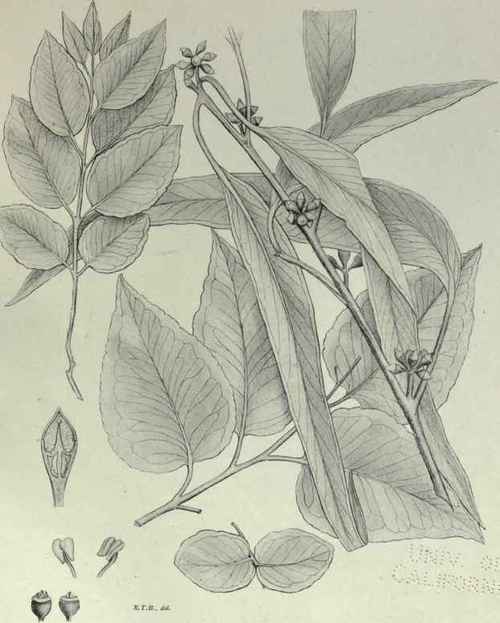
Eucalyptus Bridgesiana. R.T.B. Woolly Butt
The mixed oil of this species was preserved in the dark, and in September, 1919, twenty-one years afterwards, was again analysed. Not much alteration had taken place in the oil during that period, except that the cineol had apparently increased, and consequently the specific gravity also. go per cent. of the oil distilled below 190° C. The crude oil and the Targe fraction gave the following results: -
Crude oil, sp. gr. at 15° C. | = | 0.9383; rotation aD + 4.4°; refractive index at 200 = 1.4667. | ||
Large fraction | " | " | = | 0.9220; rotation aD + 3.5°; refractive index at .20° = 1.4599. |
The cineol was determined in the large fraction by the resorcinol method and calculated for the crude oil; the result was 81 per cent. By the phosphoric acid method it was 79 per cent. when calculated for the crude oil.
Material of this species was also obtained from Bungendore, N.S.W., in June, 1898. The oil differed but slightly from that obtained from Ilford, with the exception that the specific gravity was somewhat higher. Considering the difference in the time of year this was to be expected, as the present sample was distilled in midwinter. The yield of oil was 0.68 per cent. It was rich in cineol and free from phellandrene
Leaves of this species, the "Butt-butt," of Gippsland, Victoria, were received from Mr. A. W. Howitt, F.G.S., in July, 1898. The oil from this material differed in no respect from the above samples; was equally rich in cineol, contained pinene, and phellandrene was absent. The yield of oil was 0.58 per cent.
Later, in September, 1899, we received material of this species for distillation from Mr. J. F. Campbell, who obtained it at Walcha, N.S.W. It had been collected as would be done for commercial distillation. The crude oil was of an orange-yellow colour, and had an odour characteristic of oils belonging to the cineol-pinene class. Cineol was the principal constituent; it also contained some pinene, but phellandrene was absent. The higher boiling portion consisted largely of the sesquiterpene. The ester was small in amount, similar to the other oils of this species so far tested. The rectified oil was slightly tinged yellow, a character common with the rich cineol oils belonging to this class.
In April, 1908, material of this species was sent from Woolbrook, N.S.W., by the Museum collector. The oil distilled from this was identical with that from material sent from Walcha many years previously.
The following results were obtained with the crude oils from these two localities: -
Walcha. 18th September, 1899. | Woolbrook. 8th April, 1908. | |
Yield of oil, per cent. ... ...... ...... | = 0.73 | = 0.74 |
Specific gravity at 150 C............. ... | = 0.9223 | = 0.9246 |
Rotation aD... ... ...... | + 1.9o | + 1.8° |
Refractive index.at 200 C. ............ | =1.4655 | = 1.4672 |
Saponification number for ester and free acid ...... | = 8.7 | =7.6 |
Cineol determined by the phosphoric acid method in portion distilling below 183° C. | = 73 per cent. | = 78 per cent. |
On rectifying the Walcha sample the amount distilling between 172-1830 was 77 per cent.; between 183-.2450, 11 per cent.; and between 245-265°, 5 per cent. As seen above the first fractions consisted very largely of cineol, with some dextro-rotatory pinene.
Another portion of the crude oil of the Walcha sample was rectified by steam. The product was tinged yellow (a character common to the oils of this class), had a good odour and consisted largely of cineol. It had specific gravity at 150 C. = 0.9203; rotation aD + 3.1°; refractive index at 200 = 1.4606, and was soluble in 1.1 volumes 70 per cent. alcohol.
Oil from the Bark of this Species
This bark has an aromatic odour when fresh, so much so, that it was thought it might be possible to obtain an oil from it.
Material was obtained from Ilford, N.S.W., in June, 1898, and the bark finely chopped and then crushed. Two distillations were made of the chopped and crushed bark, each of 80 lb. weight, which was steam distilled. A small quantity of oil was obtained, about 2 drachms altogether; such a small quantity was difficult to collect, but about 1 drachm of clear and filtered oil was obtained. The oil was red in colour; was very mobile, and gave no reaction for cineol. Phellandrene was absent. The specific gravity at 15° C. = 0.898. The appearance, odour, etc, of the oil suggested that it might contain an ester in some quantity, but the specimen being required for Museum purposes, further determinations were not made. It is thus apparent that the odour of the bark of this species is due to the presence of a volatile oil, and that this is essentially different in composition from the leaf oil. Although oil rarely occurs in the barks of the Eucalypts, yet it has been noticed in a few cases, particularly with that of E. Macarthnri. (See under that species.)
Continue to:


My Books

