


75. Eucalyptus populifolia
Description
This section is from the book "A Research On The Eucalypts Especially In Regard To Their Essential Oils", by Richard T. Baker, Henry G. Smith. Also available from Amazon: A Research On The Eucalypts And Their Essential Oils.
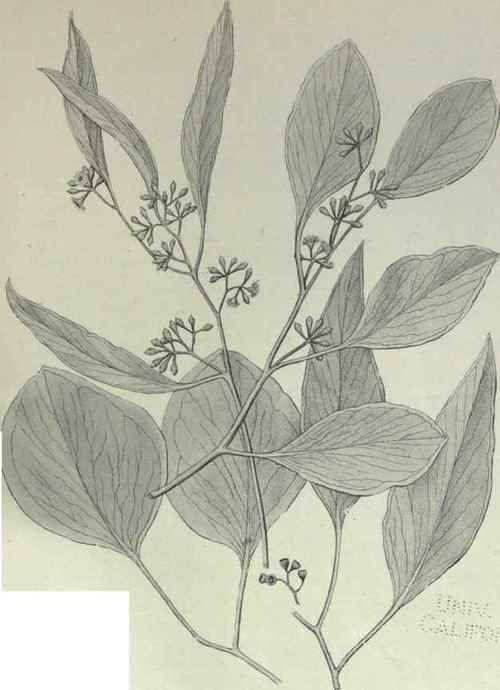
75. Eucalyptus populifolia
(Hook., in Ic. PL, t. 879, 1852.) Bimbil Box or Poplar-leaved Box.
Systematic. - A medium-sized tree; bark persistent on the stem and branches, rough, not deeply furrowed, sometimes whitish or khaki coloured between a "Box" and a "Woollybutt" in character. Abnormal leaves oval to ovate-acuminate, 2 inches long, shining on both sides'; venation distinct, lateral veins few, spreading, intramarginal vein removed from the edge. Normal leaves very variable in size and shape, from ovate-acuminate, ovate-lanceolate to narrow-lanceolate, under 6 inches long; venation and other features similar to that of abnormal leaves. Flowers numerous in axillary or terminal panicles, peduncles slender, under 6 lines long. Calyx turbinate, 1 line long and 1 line in diameter, also on a pedicel of about 1 line; operculum hemispherical, shortly acuminate.
Fruit. - Small, pear-shaped to slightly hemispherical; rim truncate; valves not exserted; under 2 lines long.
They very closely resemble those of E. crebra and E. polybractea in form.
Habitat. - The northern half of the Central Division of New South Wales; Queensland; North Australia.

Plate XXXVI.
R.T.B.. det. ad nal
Eucalyptus Populifolia. Hook. Poplar Leaf Box
REMARKS. - The shining "Poplar-leaved Box" was confounded by Bentham, B.F1., iii, p. 214, with E. polyanthcmos (probably including also E. Elctcheri, R.T.B., and E. ovalifolia, R.T.B.), but all these trees we regard as quite distinct, as they differ in the bark, timber, leaves, and chemical constituents. It occurs in the dry interior of the Continent, whilst the others above enumerated are confined to the Coast and tableland Mueller figures this species in his Eucalvptographia, but it is again here delineated in order to show the variability of its foliage, which is not illustrated by Mueller (loc. cit.), and also on account of its being a good cineol-yielding species. The timber is hard, interlocked, and reddish in colour.
ESSENTIAL OIL. - Leaves and terminal branchlets for distillation were obtained from Nyngan, N.S.W., in November, 1899. The yield of oil was 0.66 per cent. The crude oil was yellowish-brown in colour, and had an odour resembling those of the cineol-pinene class. Cineol was present in quantity, together with pinene, but phellandrene was absent. The higher boiling portion contained the sesquiterpene. The crude oil became turbid on keeping, and eventually deposited a sediment, as do many of the oils belonging to this class.
The crude oil had specific gravity at 150 C. = 0.9207; rotation aD + 0.4°; refractive index at 200 = 1.4652, and was soluble in 1 1/4 volumes 70 per cent. alcohol. The saponification number for the esters and free acid was 1.9.
On rectification, 2 per cent. distilled below 1700 C. (corr.). Between 170-1830, 90 per cent, distilled; between 183-2550, only a few drops came over; between 255-2650, 4 per cent. distilled. These fractions gave the following results: -
First fraction, sp. gr. at 150 C. | = | 0.9177; | rotation aD | + | 5.96°. | ||||
Second | " | " | " | = | 0.9259; | " | not taken. | ||
The cineol, determined by the phosphoric acid method m the crude oil, was 62 per cent. (O.M.)
The oil of this species is one of the best of the cineol-pinene group, but unfortunately the yield is not large.
Material from this species was received from Gunbar, N.S.W., in December, 1900. With the exception that the yield was rather larger, the oils were practically identical; both were heavy oils, rich in cineol, had slight rotation, showed the presence of pinene and absence of phellandrene. The yield of oil was 0.86 per cent. Specific gravity of the crude oil = 0.923; and optical rotation aD +1.2°. The cineol was determined by the phosphoric acid method in the crude oil; the result was 57 per cent. (O.M.). The crude oil formed a clear solution with 1 1/4 volumes 70 per cent. alcohol.
The above samples were mixed together and stored in the dark, and in August, 1919, the oil was again analysed. The alteration which had taken place in the oil during the nineteen years it had been kept, was in the direction of an increased cineol content; otherwise not much difference was observed. 86 per cent. distilled below 1900 C. The crude oil and the rectified portion gave the following results: -
Crude oil, sp. gr. at 150 C. | = | 0.9352; rotation aD + 0.4°; refractive index at 200 = 1.4656. | ||
Rectified portion | " | " | = | 0.9227; rotation aD + 1.4°; refractive index at 200 = 1.4602. |
The cineol was determined by the resorcmol method in the rectified portion and calculated for the crude oil; the result was 77 per cent. By the rapid phosphoric acid method it was 70 per cent. when calculated for the original oil. Terpineol was detected in the rectified portion.
Continue to:


My Books

