


91. Eucalyptus Australians. Part 3
Description
This section is from the book "A Research On The Eucalypts Especially In Regard To Their Essential Oils", by Richard T. Baker, Henry G. Smith. Also available from Amazon: A Research On The Eucalypts And Their Essential Oils.
91. Eucalyptus Australians. Part 3
Numerous analyses of this "first hour oil" have been made at the Technological Museum, beyond those enumerated in the table mentioned above. They were, however, all in agreement, so that it is unnecessary to tabulate them further. It may be stated, however, that the solubility in alcohol in no case exceeded 1.1 volumes 70 per cent. alcohol, and that they all contained about 70 per cent. of cineol, determined by the phosphoric acid method. (See also an analysis under the quantitative determination of cineol.)
Plate XLVIII.
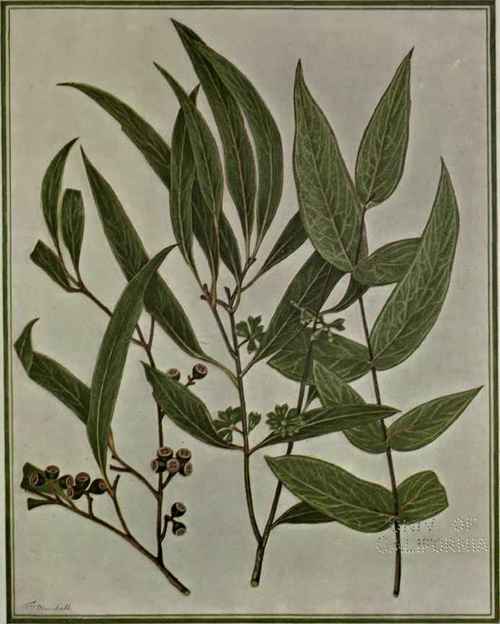
eucalyptus australiana. r.t.b. a h g s. Black Peppermint.
Plate XLIX.
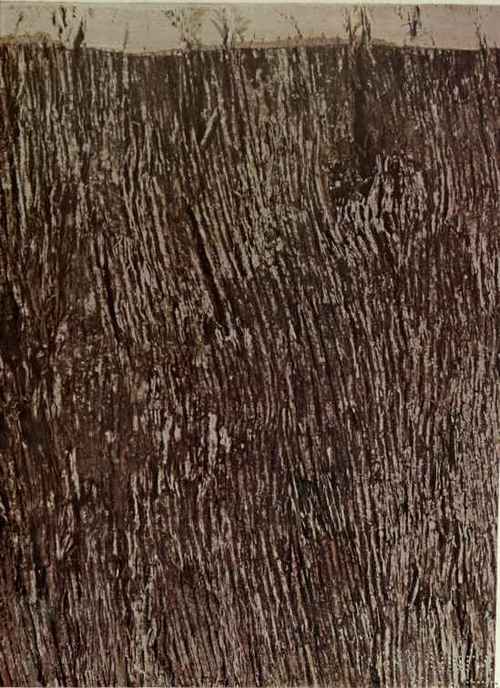
A Typical Peppermint Bark
Eucalyptus Australiana, R.T.B. & H.G.S
These barks might be described as a fine lattice pattern, and rather closer in texture than those of the " Stringy barks," but shorter in the fibre, and the colour more bordering on that of the " Boxes."
The chief constituents in the oils of Eucalypts with bark of this character are cineol, phellandrene and piperitone. These constituents vary in amount in the several species.
The " Peppermints " apparently represent the later species of the genus.
Plate L.

A cross section towards the leaf margin. The large yield of oil of this species is here indicated by the number and comparatively large oil glands in such a limited area. This leaf is of a rather delicate nature in the case of both the mesophyll and palisade parenchyma, the latter being more developed towards the upper surface. The strengthening tissue backing the outer edge of the leaf is not well developed. x 70.
Eucalyptus Australiana, R.T.B. a H.G.S
The resorcinol determinations for the cineol were always taken with the fractionated oil in the portion distilling below 1900 C, and calculated for the crude oil. The results would be altogether too high if taken with the commercial sample directly, because terpineol and other bodies are also absorbed; even in the portion distilling below 1900 C, substances other than cineol are absorbed by the resorcinol, and the results are consequently too high when determined in this way.
The specific gravities were in all cases corrected for 150 C, the factor 0.00075 being employed for that purpose.
"Second Hour Oil." - A sample of the "second hour oil" was forwarded to us by Mr. C. Gough, of Yourie, and was portion of the "second hour oil" he had commercially distilled. It was but little coloured, and had quite an aromatic odour. It had specific gravity at 150 C. = 0.9291; rotation aD + 2.20; refractive index at 200 = 1.4720; and was soluble in 1.1 volumes 70 per cent, alcohol. On distillation, 64 per cent, came over between 1720 and 1930 (corr.). This fraction had specific gravity at 150 = 0.9131; -rotation aD + 3.3°; refractive index at 200 = 1.4655, and contained 31 per cent. cineol by the phosphoric acid method, representing 20 per cent. in the "second hour oil." 25 per cent. came over as the second fraction, boiling between 1930 and 2270. This had a specific gravity at 150 = 0.9283; rotation aD - 0.2°; and refractive index at 200 = 1.4760.
The saponification number for the esters in the "second hour oil" was 11.4, while in the acetylated oil it was 95.1. This latter figure represents 33 per cent, of ester if calculated for a C10HI7OH alcohol, and if considered to consist wholly of terpineol, there was 23 per cent. of that substance, at least, in the free condition in the "second hour oil."
"Third Hour Oil." - A sample was also forwarded by Mr. Gough. It showed but slight chemical differences from the oil of the second hour, except that the alcohol was a little more pronounced. It had specific gravity at 150 C. as 0.9266; rotation aD + 2.6°; refractive index at 200 - 1.4747, and was soluble in 1.1 volumes 70 per cent, alcohol. Addition of more alcohol determined the presence of paraffin in both the second and third hour oils. The saponification number for the ester plus that of the free acid was 9.7; while with the acetylated oil it was 116.03; representing 29.4 per cent. of free terpineol in the "third hour oil."
On distillation, 55 per cent. came over below 1930 C, and 35 per cent. between 1930 and 2250. 26 per cent. of cineol was found to be present in the first fraction, determined by the phosphoric acid method. The specific gravity of the first fraction at 150 C. = 0.9145; and refractive index at 200 = 1.4669. The second fraction had specific gravity at 15° = 0.9267; rotation aD - 1.4°; refractive index at 200 - 1.4770. The saponification number for the ester plus that of the free acid was 9.4. A portion of the second fraction of the "third hour oil" was acetylated, when the saponification number had increased to 124.5. This represents an ester percentage of 43.6, indicating 31.7 per cent. of free terpineol at least in this portion. (For the determination of the Terpineol, see the article on that substance in this work.)
In February, 1930, through the kindness of Mr. R. H. McNeice, we received material of this species for distillation, from Black Springs, a locality about ten miles from Oberon, N.S.W. The yield of oil was 3.3 per cent. The crude oil was of a pale yellow colour, and had a pleasant odour with a secondary one of citral. Phellandrene was not detected.
The constitution of the oil was quite in accord with that distilled from the Yourie material above, although the distance separating the two localities is about 200 miles.
The crude oil, which was distilled right out, had specific gravity at 150 C. = 0.9141; rotation aD + 5.4°; refractive index at 200 = 1.4634, and was soluble in 1.2 volumes 70 per cent, alcohol. The saponification number for the esters and free acid was 10. After acetylation this had risen to 47.7; while in the cold with two hours' contact it was 15.8.
On rectification, 1 per cent. distilled below 1720 C. (corr.). Between 172-1930, 92 per cent. distilled, and between 193-2350, 6 per cent. distilled. These fractions gave the following results: -
First fraction, sp. gr. at 150 C. | = | 0.9106; rotation aD + 5.3°; refractive index at 20° = 1.4614. | |||
Second | " | " | " | = | 0.9170; rotation aD + 3.2°; refractive index at 200 = 1.4684. |
The cineol was determined by the resorcmol method in the first fraction; when calculated for the crude oil the result was 67 per cent. By the rapid phosphoric acid method it was 64 per cent. when calculated for the crude oil. The alcohols present were geraniol and terpineol, as in the oil from the Yourie material.
The Citral. - The secondary odour of the oil of the Black Springs sample was distinctly that of citral. To determine the identity of this aldehyde 1,000 c.c. of the crude oil were distilled, and all boiling below 1900 C. removed. The remainder was agitated with neutral sodium sulphite until the reaction was complete. The aqueous portion was washed with ether, decomposed with sodium hydrate, again extracted with ether, and on removal of this solvent 2.5 c.c. of an aldehyde remained, equal to 0.25 per cent. This had an odour of citral, and gave the following figures: - Specific gravity at 150 C. = 0.894, was inactive to light; had refractive index at 200 = 1.4875, and the B-naphthocinchoninic acid melted at 199-2000 C. These constants are those for citral. It was probably derived from the natural oxidation of the geraniol, which alcohol is a constant constituent in the oil of this species.
Eucalyptus Australiana, (R.T.B. & H.G.S.). var. latifolia (nobis).
Systematic. - This appears to be the most southern form of the species, and is distinguished from its type by the broad leaves and larger shining fruits. These two latter features greatly resemble those of E. dives, especially the fruits; the venation of the leaves easily shows it not to be that species. It is figured under E. amygdalina in the first edition. The abnormal leaves are large, cordate, sessile, acuminate; the venation well marked, the marginal vein being well removed from the edge. The normal leaves are long, up to 9 inches in length, broad lanceolate, intramarginal vein well distant from the edge.
Habitat. Officer, Victoria; Moruya, N.S.W.
ESSENTIAL OIL. - Materia' for distillation was received from Officer, Victoria, in 1900, but as the results could not be specifically placed at that time they were omitted in the first edition. On the discovery of E Australiana, however, they fall into line, and are now published. The yield of oil was 2 per cent. The crude oil was but little coloured, and had a secondary odour of citral. It was fairly rich in cineol and contained, at that time of the year, traces of phellandrene. It had specific gravity at 150 C. = 0.9155; rotation aD - 1.9°; refractive index at 200 = 1 4662 and was soluble in 1 1/2 volumes 70 per cent. alcohol. The saponification number for the esters and free acid was 8.
On rectification, 1 per cent. distilled below 1740 C. (corr.). Between 174-1830, 78 per cent distilled, and between 183-2250, 16 per cent, distilled. These fractions gave the following results: -
First fraction, sp. gr. at 15o C | = | 0.9097; | rotation aD | - | 2.5o | |||
Second | " | " | = | 0.0187: | " | - | 0.8°. | |
The cineol, determined in the crude oil by the phosphoric acid method, was 50 per cent. (O.M.).
In 1917 Mr. A. R. Penfold investigated the oil from this species growing near Moruya, N S.W. The analysis gave results quite in agreement with those recorded above.
Continue to:


My Books

