


99. Eucalyptus polybractea
Description
This section is from the book "A Research On The Eucalypts Especially In Regard To Their Essential Oils", by Richard T. Baker, Henry G. Smith. Also available from Amazon: A Research On The Eucalypts And Their Essential Oils.
99. Eucalyptus polybractea
(R.T.B., Proc. Linn. Soc, N.S.W., 1900, p. 692.) Blue Mallee.
Systematic. - A glaucous shrub, with quadrangular branchlets. Leaves lanceolate (those on the early shoots lanceolate to oblanceolate), erect, rarely falcate, not oblique, narrow, under 6 lines broad, mostly 3 inches long, acuminate, often with a recurved point, not shining; mid-rib raised on the under side, giving the leaf a strong resemblance to that of an Olea, intramarginal vein removed from the edge, lateral veins oblique, spreading, finely marked, only occasionally distinctly pronounced; petiole about 3 lines long. Peduncles axillary, short, 2 to 3 lines long, angled, with from eight to twelve flowers. Buds angular, 1 to 1 1/2 lines long, glaucous in the early stages of development, surrounded by numerous acuminate glabrous, ribbed, whitish bracts. Calyx conical, tapering into an exceedingly short pedicel; operculum obtuse, or only very slightly acuminate, hemispherical.
Fruit. - Hemispherical to pear-shaped, glaucous; rim thin, slightly contracted; valves deeply set, not exserted; 2 lines in diameter.
The fruits of E. Woollsiana and E. viridis are uncommonly like those of this species, so care is required in separating them.
Habitat. - Wyalong and large areas west of that district, New South Wales; also Bendigo district, north of Victoria,

REMARKS. -This Eucalypt is one of the "Mallees" occurring between the Lachlan and Murrum-bidgee Rivers, New South Wales, where it is known as "Blue Mallee," to distinguish it from its congeners. The dried herbarium material requires care in separating from that of E. viridis, R.T.B., and E. Woollsiana, R.T.B. The type specimen of E. fruticetorum is lost according to Mr. J. H. .Maiden (Crit. Rev. Gen. Enc, Vol. II. p. 40-41). His statement (Prcc. Roy. Soc. Vict., Vol. 26, p. 299)- -" Having found Mueller's fruticetorum (not type, for that is lost) but the next best thing a specimen certified by the describer," can have but little specific botanical weight. The specimen we have seen in the Melbourne Herbarium, under that name is a recent piece of E. polybractea. According to Mr.J H. Maiden, the original description of E. fruticetorum was in manuscript, and was published in type in Muefler's Fragmenta, ii., 57. One has only to compare this description and the localities given, with those of E. polybractca to realise that the two are quite distinct.
ESSENTIAL OIL. - It was in December, 1900, that we first obtained, from Wyalong, New South Wales, material for distillation of this "Mallee." At that time, practically nothing was known in this State of its possibilities as an oil producing species, and it was even scientifically undescribed The material we received was from old trees, no abnormal leaves being present, so that a minimum yield of oil was obtained at that time, and also an excess of aromadendral. During later years large quantities of oil have been distilled from this Eucalypt in the Wyalong district, so that the knowledge as to its capabilities for oil production is now extensive; the constitution and value of the oil are also well known. E. polybractea is a well defined species, and has long ago been stabilised, consequently the oil is constant in composition, and of a very definite character.
We give here the results of the first investigation on the oil of this species, as published in the first edition of this work, as it may well be of historic interest, Eucalyptus polybractea being one of the most important of all the species for the production of a rich cineol oil.
The leaves and' branchlets were collected as would be done for commercial purposes. The yield of oil was 1.35 per cent. The crude oil was but little coloured, being of a lemon tint. The odour was that of the better class of cineol-pinene Eucalyptus oils generally, and it gave a secondary one indicating aromadendral. The amount of volatile aldehydes, esters and free acid, was almost at a minimum. Pinene was present, but phellandrene was absent. The oil was very rich in cineol, and contained aromadendral, to the presence of which the lævo-rotation of the oil was due; this is also shown by the left rotation of the crude oil being greater than that of the rectified portion.
Plate LVI.
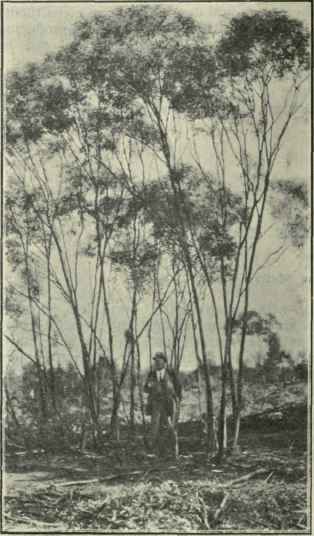
E. Polybractea. R.T.B. Blue Mallee
The crude oil had specific gravity at 150 C. = 0.9143; rotation aD - 1.95°; refractive index at 200 = 1.4679, and was soluble in 1 1/2 volumes 70 per cent.' alcohol. The saponification number for the esters and free acid was 4.5.
On rectification, 1 per cent. distilled below 1670 C. (corr.). Between 167.1830, 89 per cent. distilled; between 183.2240, 5 per cent distilled. These fractions gave the following results: -
First fraction, sp. gr. at 150 C. | = | 0.9109; | rotation aD | - | 1.2°. | ||
Second | " | " | = | 0.9236; | " | not taken | |
The cineol, determined by the phosphoric acid method in the first fraction and calculated for the crude oil, was 57 per cent. (O.M.).
The oil of this species has a strong resemblance to that obtained from E. cnovifolia of South Australia, although containing less aromadendral, and more cineol. (See also under "Quantitative determination of cineol.")
It was soon found that the new growth, or "suckers," as they are known vernacularly, contained a larger amount of oil than occurs in the old leaves, so that it was to the advantage of the distiller to obtain as much of this young material as possible. The oil from the young growth also contains a less amount of aromadendral, and other high-boiling constituents, than does that from old leaves, and the cineol is more pronounced in consequence. It. is customary also for the distiller not to treat the leaves for too long a time, as practically all the cineol comes over during the first two hours, much of the high-boiling constituents remaining in the leaf, consequently most commercial samples of the oil of this species, as now supplied, are slightly dextro-rotatory, and if the leaves are not distilled beyond 1 1/2 to 2 hours, the rotation may even exceed 1 degree to the right. This peculiarity is entirely due to the absence of sufficient aromadendral in the oil to overcome the slight dextro.rotation of the pinene.
A table giving the constants for numerous authentic samples of the oil of this species, commercially distilled, will be found later in the articles published in this work, where the question of constancy in the oil product, as well as methods for securing fresh growth of material are dealt with.
The rectified oil of E. polybractea is one of the best for the preparation of pure cineol by the freezing method. We have made numerous analyses on the oil of this species at various times, and have always found these to be in agreement.
In the following table are recorded the results we have obtained with commercial samples of the oil of this species, during the years 1918 and 1919, all of which were distilled at Wyalong: -
Data | Sp. gr. at 15oC | Optical rotation aD. | Ref. index at 20° C. | Solubility in 70 per cent, alcohol. | Cineol, per cent. |
Jan., 1918 ......... | 0.9250 | + 0.8° | 1.4599 | 1 vol. | 81 |
April, 1918 ......... | 0.9222 | + 1.1° | 1.4596 | 1 vol. | 83 |
April, 1918 ......... | 0.9275 | + 0.8° | 1.4594 | 1 vol. | 82 |
May, 1918 ......... | 0.9238 | + 1.1° | 1.4597 | 1 vol. | 82 |
Sept., 1918 ......... | 0.9229 | + 0.5° | 1.4609 | 1.1 vol. | 8l |
Oct., 1918 ......... | 0.9274 | + 0.8° | 1.4616 | 1.1 vol. | 79 |
Nov., 1918 ........ | 0.9264 | + 0.6° | 1.4600 | 1.1 vol. | 80 |
Nov., 1918 ......................... | 0.9239 | + 1.8° | 1.4601 | 1.1vol. | 81 |
June, 1919 ......................... | 0.9251 | + 1.3° | 1.4607 | 1.1 vol. | 80 |
Sept., 1919 ......... | 0.9273 | + -0° | 1.4596 | 1.1 vol. | 83 |
The yield of oil obtained commercially varies according to the time of year, and is also influenced by the amount of young leaf present. Statements made by the distillers vary much, these ranging from 12 lbs. of oil per 400 gallon tank, to 30 lbs. per tank. The yield is also largely governed by the way the leaf is cut, if cut too coarsely the loss is in two directions; (a) deficiency of leaf, and (b) the springy nature of the coarser stems preventing sufficient loading in the tank. In a letter we received from a correspondent who gave his results for three months (November, December, and January), this is brought out clearly. Taking the young leaf cut finely, the average yield during that period was 65 lbs. of oil per ton of material; but for old leaves, coarsely cut, the average yield was only 32 lbs. per ton. This works out at 2.9 per cent, for young leaf, and 1.43 per cent. for old leaf, practically the same as we obtained in the first investigation. Another distiller informs us that his digesters hold 15 cwt. of material, and that he obtains as an average 30 to 32 pounds of oil, or 1.8 to 1.9 per cent., but that at times he has obtained up to 40 lbs.
It appears, therefore, that the yield of oil from old leaf of E. polybractea, cut fairly, will be about 1.5 per cent., and from the young material about 2.5 per cent.
Plate LVII.
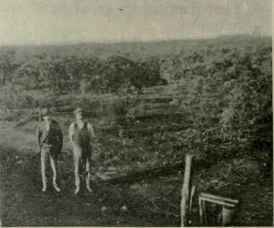
E. Polybractea, R.T.B. "Blue Mallee.
In this Plate the dense growth of this .\iallee is shown.
It will be seen that there is an absence of tall trees over the district.
Continue to:


My Books

