


98. Eucalyptus dumosa
Description
This section is from the book "A Research On The Eucalypts Especially In Regard To Their Essential Oils", by Richard T. Baker, Henry G. Smith. Also available from Amazon: A Research On The Eucalypts And Their Essential Oils.
98. Eucalyptus dumosa
(A. Cunn., Schau. in Walp. Rep., ii, 925.) Bull Mallee.
Systematic- Found only in the dry interior of the Continent, and rarely attains tree form. The bark is white and smooth. Leaves lanceolate, under 4 inches long, shortly acuminate, coriaceous, shining, of a dull yellow colour; venation fairly prominent, lateral veins distinct, intramarginal one removed from the edge. Oil glands quite obscured. Peduncles axillary, short, bearing a few flowers on short pedicels. Calyx tube cylindrical, occasionally angular, almost 3 lines long; operculum short, conical.
Fruit. - Shortly pedicellate or sessile, obovoid or oblong, slightly ribbed; rim narrow, sunken; valves slightly exserted; about 3 lines long.
The fruits might be mistaken for a small variety of E. costata.
Habitat. -Southern interior of New South Wales; South Australia; Victoria The Kangaroo Island species has a coarser fruit.

REMARKS.- -This species was considered by Baron von Mueller as a variety of E. incrassata, Labill., but Bentham records them as specifically distinct in the Flora Australiensis, and judging from the material in the National Herbarium, Melbourne, we think Bentham is correct in his classification. Labillardiere's species has a larger fruit than A. Cunningham's E. dumosa. The former species occurs so far west from this State that it was found impracticable to procure either leaves for distillation or specimens of limber. The fruit of R. dumosa often has the facies of E. oleosa, when the valves are exserted.
ESSENTIAL OIL. - Leaves and terminal branchlets for distillation were obtained from Coolabah, N.S.W., in October, 1900. The yield of oil was 1 per cent. The crude oil was amber coloured, and had an odour resembling those belonging to the cineol-pinene class, and a secondary one indicating the aldehyde aromadendral. The oil was not very rich in cineol; it contained pinene, but phellandrene was absent. Aromadendral was probably present, although the dextro-rotation of the higher boiling portion suggests the presence of the liquid form of eudesmol.
The crude oil had specific gravity at 150 C. = 0.9151; rotation aD + 5.8°; refractive index at 200 - 1.4703, and was soluble in 1 3/4 volumes 70 per cent. alcohol. The saponification number for the esters and free acid was 2.93.
On rectification the usual amount of volatile aldehydes came over below 1630 C. (corr.). Between 163-1830, 86 per cent. distilled; (24 per cent, below 171°); between 183-2370, 8 per cent, distilled. These fractions gave the following results: -
First fraction, sp. gr. at 15o C. | = | 0.9127; | rotation aD | + | 7.8°. | |||
Second | " | " | " | = | 0.9405; | " | + | 9.1°. |
The cineol, determined by the phosphoric acid in the large traction, was 50 per cent., indicating about 44 per cent, in the crude oil (O.M.).
Material for distillation was also obtained from Gunbar, N.S.W. in December, 1900. The yield of oil was 0.98 per cent. In appearance, odour, constituents, etc, this oil differed but little from the above sample, with the exception that it was less rich in cineol and contained more terpenes, and perhaps more aromadendral. The specific gravity of the crude oil = 0.9016, and optical rotation aD + 2.2°. The cineol in the crude oil, determined by the phosphoric acid method, was 33 per cent. (O.M.).
Plate Llll.
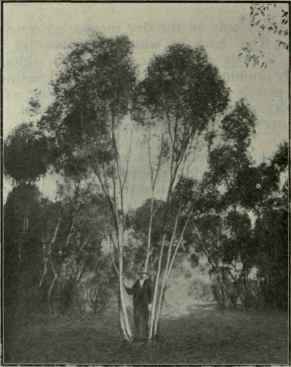
[Photo.] [R. H. Cambage].
Eucalyptus Dumosa, A. Cunn White" Or Bull Mallee."
In June, 1911, leaves and terminal branchlets for distillation were collected at the Kingscote end of Kangaroo Island, South Australia, where it is known as "Red Mallee." The leaves of this species were somewhat thick, and after steam distillation had become quite red in colour, particularly the young shoots at the end of the branchlets. This peculiar red colour of the steam-distilled leaves, was also observed with those of E. leucoxylon, but not with the leaves of the "White Mallee," or of any other species from Kangaroo Island.
The yield of oil was 0.96 per cent. The crude oil was reddish in colour, and in odour resembled the oils of the pinene-cineol group. Cineol was present in fair quantity, but phellandrene was absent. The low-boiling terpene was dextro-rotatory pinene, and the high-boiling fraction consisted principally of the sesquiterpene. A greater quantity of dextro-rotatory pinene was preent in this oil than in those of the New South Wales samples.
The crude oil had specific gravity at 150 C. = 0.9041; rotation aD + 16.4°: refractive index at 200 = 1.4667, and required 1 volume 80 per cent. alcohol to form a clear solution. The saponification number for the esters and free acid was 3.7.
Plate LIV.
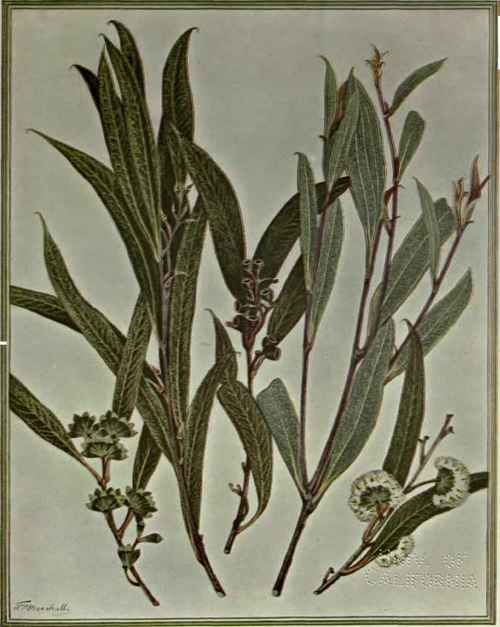
Eucalyptus Polybractea. R.T.B. Blue Mallei:
Plate LV.
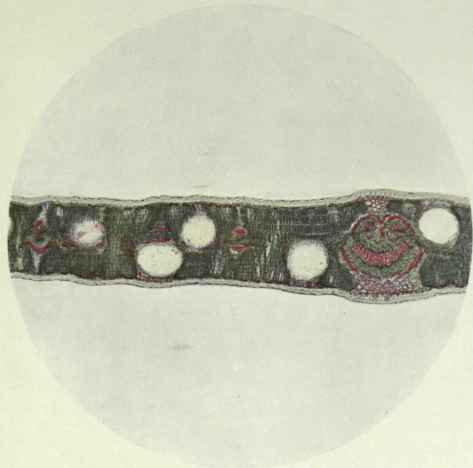
The transverse section near the mid-rib shows a very uniformly constructed texture almost entirely composed of small parenchymatous cells (palisade) typical of the "Mallees." The cuticle is slightly more strongly developed in the upper surface, stomata isogenous. The yield of oil is high and consequently oil glands are numerous. x 55.
Eucalyptus Polybractea R.T.B
On rectification a few drops of acid water with some aldehydes came over below 1630 C. (corr.). Between 163-167°, 32 per cent, distilled; between 167-198°, 53 per cent. came over; the temperature then rose to 245°, and between 245-272°, 10 per cent, distilled. These fractions gave the following results: -
First fraction, sp. gr. at 150 C. | = | 0.8854; rotation aD + 24.5°; refractive index at 200 = 1.4629. | |||
Second | " | " | " | = | 0.9022; rotation aD + 14.1°; refractive index at 200 = 1.4625. |
Third | " | " | " | = | 0.9289; rotation not taken; refractive index at 200 = 1.4920. |
The cineol was determined by the resorcinol method in the portion distilling below 198°; when calculated for the crude oil the result was 42 per cent.
The oil belongs to the pinene-cineol class, and does not contain constituents of a special character. The species is thus of little value as an oil-producing tree, particularly as others are available from which a superior oil can be obtained.
The chemical resemblance between this species and E. leucoxylon, shown by the formation of the red colouration of the leaves when steam-distilled, is further exemplified with their oils, which are in close chemical agreement.
Continue to:


My Books

