


97. Eucalyptus oleosa
Description
This section is from the book "A Research On The Eucalypts Especially In Regard To Their Essential Oils", by Richard T. Baker, Henry G. Smith. Also available from Amazon: A Research On The Eucalypts And Their Essential Oils.
97. Eucalyptus oleosa
(F.v.M., in Neder. Kruid. Arch., lv, 127.) Red or Water Mallee.*
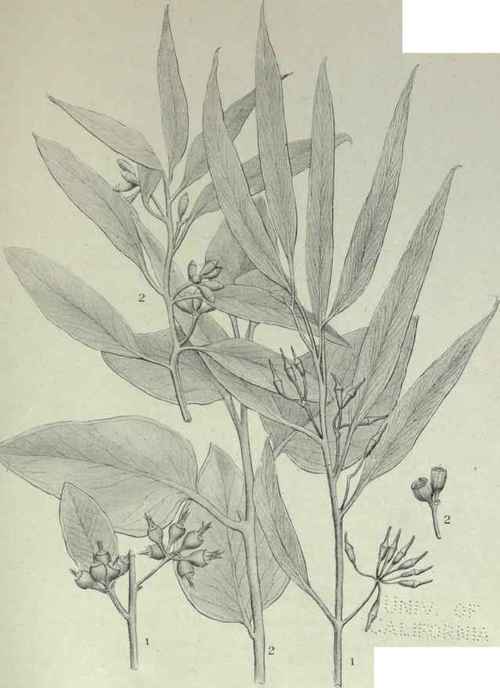
Systematic. - A small tree or shrub, under 20 feet, Bark rough and persistent (F.v.M. , branches smooth. Leaves scattered, narrow-lanceolate, acuminate, varying in length from 4 to 6 inches, coriaceous; venation indistinct, or obscured, oblique veins fine, numerous, intramarginal vein slightly removed from the edge. Oil glands very numerous, but hidden, owing to the thick cuticle. Peduncles axillary or lateral, each with about six to eleven pedicellate flowers on slender stalklets, slightly longer than the calyx. Calyx turbinate, a little over 2 lines long, and 2 lines in diameter; operculum conical, acuminate, rarely obtuse, usually exceeding the calyx tube, and sometimes much longer.
Fruit. - Globular, truncate; rim thin, contracted at the orifice; valves acute, long and slender, well exserted; under 3 lines in diameter.
The long slender exserted valves are a very marked feature of the fruit of this species, and make the herbarium material easy of determination.
Habitat. - Queensland; Victoria; South Australia; Western Australia; south and western interior of New South Wales.

REMARKS. - -In the field it is generally associated with E. viridis, R.T.B., E. gracilis, F.v.M., E. dumosa, A. Cunn., from which congeners it differs in fruits, nature of the bark, and timber. The bark of this tree is remarkably thin for a Kucalypt. It occurs chiefly as a "Mallee" in extended patches, sometimes covering miles of ground and is only occasionally found growing as a tree - when it attains a height of more than 30 feet, and a diameter up to 18 inches. The larger stems are generally hollow, and the timber pink, or reddish in colour, close-grained, hard, and interlocked.
ESSENTIAL OIL. - Leaves and terminal branchlets for distillation were obtained from Nyngan, N.S.W., in November, 1899. The yield of oil was 1.1 per cent. The crude oil was reddish-brown in colour, and had an odour resembling those of the cineol-pinene class. It was rich in cineol, contained pinene, but phellandrene was absent. Aromadendral was present, and it was to this constituent that the lævo-rotation of the crude oil, and the higher boiling fraction was due. After some time the crude oil deposited a powdery substance in considerable quantity. The high-boiling portion contained some sesquiterpene, but the amount of esters was small.
The crude oil had specific gravity at 150 C. = 0.925; rotation aD - 1.5°; refractive index at 200 = 1.4689, and was soluble in 1 1/4 volumes 70 per cent. alcohol. The saponification number for the esters and free acid was 4.9.
*The term "Mallee" is applied in Australia to those Eucalypts which differ in their mode of growth from other species, by sending out a number of small stems from an expanded root-stock, as shown in the plate.
On rectification, only a small amount came over below 1700 C. (corr.). Between 170-1830, 78 per cent, distilled; between 183-2500, 10 per cent. came over, and between 250--2600, 3 per cent, distilled. These fractions gave the following results: -
First fraction, sp. gr. at 150 C. | = | 0.919; | rotation aD | + | 0.85°. | |||
Second | " | " | " | = | 0.938; | " | - | 11.3°. |
Third | " | " | " | = | 0.942; | " | not taken. | |
Plate Lll

Eucalyptus Oleosa. F.V.M. "Red" Or "Water Mallee."
The figures for the optical rotations indicate the presence of aromadendral. The high specific gravity of the crude oil is partly due to the comparatively large amount of the sesquiterpene.
The cineol was determined by the phosphoric acid method in the first fraction; the result was 61 per cent., or about 52 per cent. in the crude oil (O.M.).
This sample of oil had been stored in the dark, and in September, 1919, was again analysed. 84 per cent, distilled below 1900 C. The specific gravity had increased a little, while the left rotation of the original oil had diminished. It was a little richer in cineol and had formed a deposit. The crude oil and the rectified portion gave the following results: -
Crude on, sp. gr. at 150 C. | = | 0.9400; rotation nil; refractive index at 20° = 1.4690. | |
Rectified portion | " | = | 0.9240; rotation aD +1°; refractive index at 20° = 1.4638. |
The cineol was determined by the resorcinol method in the rectified portion, and calculated for the crude oil; the result was 71 per cent. By the rapid phosphoric acid method it was 62 per cent., when calculated for the crude oil.
Plate LIIa.
R, T. Baker, del. ad nau
"Mallees." (1) Eucalyptus Oleosa. Fv.M, (2) Eucalyptus Dumosa. A. Cunn.
Continue to:


My Books

