


Eucalyptus Smithii
Description
This section is from the book "A Research On The Eucalypts Especially In Regard To Their Essential Oils", by Richard T. Baker, Henry G. Smith. Also available from Amazon: A Research On The Eucalypts And Their Essential Oils.
Eucalyptus Smithii
"The rapidity of growth shown by cultivated trees of some of the cineol oil-producing species is extraordinary, and this has often been pointed out, particularly with E. globulus. We have given some attention to this matter in connection with the excellent cineol oil-bearing species E. Smithii, and the results so far obtained are recorded herewith.
The natural habitat of this species is on the highlands, at an altitude of about 2000 to 3000 feet, and it might be thought perhaps that if planted at sea level, some differences in the rapidity of growth as well as in the composition of the oil might be observed. These changes, however, have not eventuated, as the results obtained with a cultivated tree, grown near. Sydney, practically at sea-level, gave evidence of great stability in both directions.
In January, 1912, a seedling of E. Smithii, a few inches high, was brought from Hill Top and planted in a garden at Marrickville, near Sydney. The plant grew rapidly and in January, 1915, only three years afterwards, was 22 feet high with a very foliaceous head. In the following June the leaf portion of the tree was removed and distilled for oil (No. 1 in the list of analyses below). The foliage grew again very rapidly from the lopped stem, and in December, 1917, the tree was 25 feet high, and was as shown in the accompanying photograph (Plate CII). It was then felled to within 1 foot from the ground, the foliage being distilled for oil (No. 2 in list of analyses). After three weeks numerous shoots appeared springing from the short remaining stem, and at the end of March, 1918, this
Plate CM.
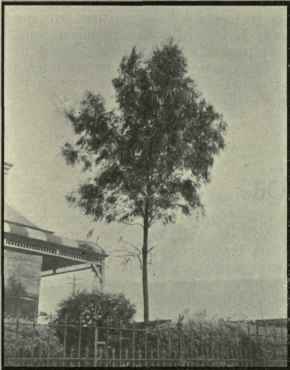
Cultivated tree of E. Smithii, at Marrickville Growth after being lopped. Seedling planted January, 1912. Photo, taken December, 1917.
This is the second head to the tree.
Plate CIII.
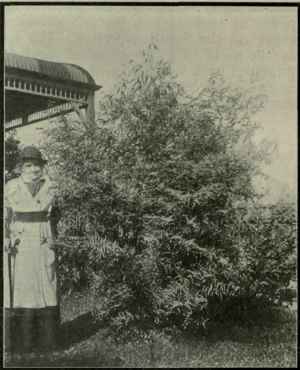
Same tree June, 1919, showing the fourth growth.
The bush was then trimmed and the leaves distilled for oil. No. 4 in list of analyses.
growth was over 6 feet high, while in the middle of July it was 12 feet, two of the shoots reaching that height; three of the stems were 3 1/2 inches in circum-ference at 3 inches above the attachment with the main stem; three more were 3 inches in circumference, and from twenty to thirty other shoots, all bearing leaves in profusion. On the 1st January, 1919, some of the shoots had stems up to 6 inches in circumference, and three of them had grown to 15 feet in height in the twelve months. The tree was then cut down to within 3 or 4 inches of the main stem, and the leaves distilled for oil (No. 3 in list of analyses). In about three weeks innumerable shoots again appeared, and by the beginning of June, 1919, some of these had reached a height of 9 feet. The tree at that time had the appearance shown in the illustration (Plate cm).
The tree was then trimmed into the form of a small bush under 6 feet high, the trimmings being distilled for oil (No. 4 in list of analyses). The bush again grew rapidly, and in the middle of October, 1919, had reached a height of 13 feet, having grown about 7 feet in height during the four months. The appearance at that time is shown in Plate CIV. It was again trimmed into bush form and the material removed distilled for oil (No. 5 in list of analyses). The results of these analyses are thus of interest, because of the varying ages of growth of the leaves, and the constancy of the oil products.
Plate CIV

Eucalyptus Smithii. Cultivated at Marrickvilli-, near Sydney. Photograph taken prior to trimming, October, 1919. No. 5 in list of analyses.
In the table (p. 444), No. 6 gives the analysis of the oil distilled from material taken from a tree cultivated at Ashfield, near Sydney, by Mr. E. Cheel, from seed collected by him at Mount Jellore, October, 1915. (See Proc. Roy. Soc, N.S.W., 1916, abstracts, p. 24.) It will be seen that the characters of the oil from this tree are in agreement with those from the tree grown at Marrickville.
The data given supplies fresh evidence as to the value of the oil of this species, as well as illustrating its rapid growth and vitality, and also its ready response to cultivation. The foliaceous nature of the tree, the somewhat large yield of oil, together with its high cineol content, all suggest the possibility of profitable returns from cultivated trees of E. Smithii.
One advantage to be derived from material so grown would be the uniformity in the character of the oil produced, as the mixing of leaves from other species would be avoided.
Continue to:


My Books

