


Bones Of The Face
Description
This section is from the book "Handbook Of Anatomy For Students Of Massage", by Margaret E. Bjorkegren. Also available from Amazon: Handbook Of Anatomy For Students Of Massage.
Bones Of The Face
The Maxillae unite to form the upper jaw; the body is pyramidal in form, and hollow, and has on it the infra-orbital foramen, through which part of the fifth nerve emerges. On the anterior border is a deep notch-the nasal notch; above the nasal notch the edge of the bone is rough to articulate with the nasal and frontal bones, below which it unites with its fellow of the opposite side. The inferior or alveolar border is ridged externally, and from it project the upper row of teeth; on the inner surface the palatal process, a flat plate of bone, projects horizontally inwards to form the roof of the mouth. The upper border is smooth and rounded, and forms the inner half of the lower border of the orbital margin, and ends in a rough process for articulation with the malar bone; the posterior border is smooth and rounded, and hangs free at the back of the mouth. The hollow space enclosed is called the antrum of Highmore.
The maxilla articulates with the nasal, frontal, and malar bones, and its fellow of the opposite side.
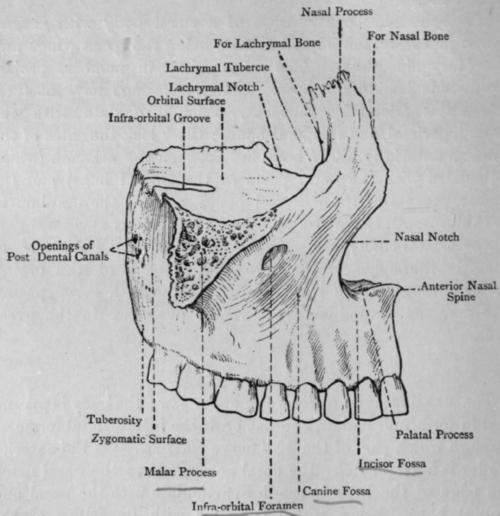
Fig. 43. - The Superior Maxilla.
Malar Bone
The Malar bone, or cheek-bone, forms the most prominent part of the cheek; the bone is convex outwardly and more or less square in shape, three of the angles being prominent. The superior angle articulates with the external angular process of the frontal bone, and the upper half of the inner side of the malar bone forms the outer half of the lower border of the orbital margin; the lower half of the inner border articulates with the maxilla: the fourth angle articulates with the zygomatic process of the temporal bone, completing the arch.
Continue to:


My Books

