


The Muscles of the Abdomen
Description
This section is from the book "Handbook Of Anatomy For Students Of Massage", by Margaret E. Bjorkegren. Also available from Amazon: Handbook Of Anatomy For Students Of Massage.
The Muscles of the Abdomen
The Muscles of the Abdomen are arranged in three directions -longitudinal, transverse, and oblique. The longitudinal ones straight up the front, flex the trunk, helped by the oblique ones when both sides act together. When the oblique muscles act singly, rotation of the trunk takes place. The longitudinal muscles on the posterior wall of the abdomen extend the spine when both act together. Acting singly, they flex the spine laterally. The transverse muscles of the abdominal wall are mainly used to keep the contents of the abdomen in place and to add to the strength of the wall, but help in flexion with the others.
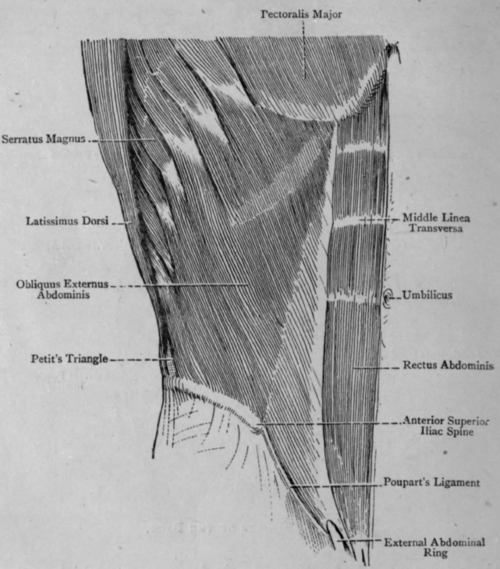
Fig. 36. - Muscles of the Abdomen.
Some of the muscles causing flexion and extension of the cervical part of the spine are situated in the neck and attached to the head; these must not be confused with the muscles that specially move the head on the spine.
(For Flexion and Extension of Spinal Column, see pp. 94 and 95.)
The movement of lateral flexion of the spinal column takes place by the muscles of flexion and extension acting together on one side. In the cervical region, however, there are a group of muscles which cause lateral flexion of that part.
Action . | Muscle. | Origin. | Insertion. | Nerve-supply. |
Lateral flexion | Scalenus anticus | From the transverse processes of the third, fourth, fifth, and sixth cervical vertebrae | The scalene tubercle and ridge'on the first rib | Anterior primary divisions of lower four or five cervical nerves |
Scalenus medius | From the transverse processes of the lower cervical vertebra (second to sixth inclusive) | On the first rib behind the groove for the subclavian artery | Same as above | |
Scalenus posticus | From the transverse processes of the fourth, fifth, and sixth cervical vertebrae | The outer surface of the second rib about the middle | Same above |
Continue to:


My Books

