


Bandaging: Arms
Description
This section is from the book "Lessons on Massage", by Margaret D. Palmer. Also available from Amazon: The Book Of Massage: The Complete Stepbystep Guide To Eastern And Western Technique.
Bandaging: Arms
To Bandage The Thumb in Case of Sprain. — A bandage 1 to 2 yards long and 0.75 inch wide. A couple of turns are first made round the wrist to fix the bandage. Take it up from the root of the thumb between the thumb and first finger to the nail, then round the thumb, then across the back of the hand and round the wrist, back again to the root of the thumb; then again round the thumb, covering two-thirds of the previous turn, then across the back of the hand, and repeat till the thumb is covered ; finish by a turn round the wrist, and secure with a safety-pin.
To Bandage the Fingers.—A bandage 3/4 inch wide, the length according to the number of fingers to be bandaged. Fix at the wrist as above, leaving 5 or 6 inches free ; take the bandage over the back of the hand to the outer side of the little finger, then up to the nail and round the finger ; make spiral turns or figure of eight down to the finger to the root, then take the bandage across the back of the hand, round the wrist, then again across the back of the hand to the root of the ring-finger, and proceed as before with this and each succeeding finger till all are covered, then tie with the loose end. One or two fingers are done in the same way.

Fig. 109.—Continuous Bandage for Fingers
To Bandage the Hand.—Bandage 1 inch wide. A couple of turns round the wrist to fix the bandage, then take it from the thumb side across the back of the hand to the base of the little finger, then across the palm at the root of fingers, then obliquely across the back of the hand to the little finger ; having covered two-thirds of preceding turn, then across the palm and over the back of the hand to the wrist ; repeat as often as necessary, and finish by a turn round the wrist, secure with a safety-pin. This is a figure of eight for the back of the hand.
To Bandage the Forearm.—Bandage 2.5 inches wide. Begin at the root of the thumb, make two or three circular and simple spiral turns to fix the bandage, then reverse over the thick part ; when the elbow is reached, make two or three circular turns, and secure with a safety-pin.

Fig. 110.—Reversed Spiral Bandage for Forearm

Fig. 111.—Reversed Spiral Bandage for Forearm and Arm, and Figure of Eight for Hand.
When necessary this bandage may be commenced on the hand with the figure of eight as described, but with the wider bandage, and continued over the elbow with the figure of eight and up the arm by reverse spirals, so that hand, forearm, and arm are done in one which would take 10 or 12 yards of bandage.
To Bandage a Shoulder.—Bandage 2.5 to 3 inches wide. A couple of circular turns round the upper third of arm, then reverse spirals to the shoulder. Place pad of cotton-wool in both armpits, take the bandage behind the shoulder across the back to the opposite side and under the unaffected arm, then across the front of the chest, well up to the top of the sternum; then across the shoulder in a line with the reverses on the arm, then round the arm, under the armpit, from behind to the front ; then across the back, and repeat. This is the ' ascending spica.'
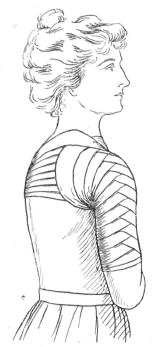
Fig. 112.—Ascending Spica for Shoulder (Side View).
The Descending Spica is commenced the same way on the arm. When the axilla is reached, the bandage is taken over the front of the shoulder and as high up the neck as possible ; then round the back to the opposite side, under that arm, and across the chest and front of the arm on the affected side; then through the axilla and over the shoulder again to the back, on a lower level than the preceding turn, and repeat till the shoulder is closed in.
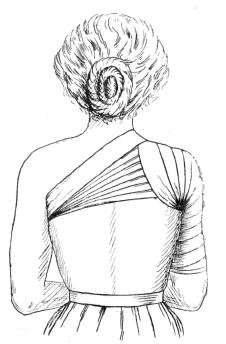
Fig. 113.—Ascending Spica for Shoulder (Back View).
Divergent Spica for Elbow.—Bandage 2.5 inches wide. Begin about the middle of the forearm ; fix with two or three circular turns, then reverse to the elbow; the forearm being flexed, place the middle of the bandage over the point of the elbow, take it from within forwards and outwards and over lower part of preceding turn, then to the inner side again, and outwards and over upper part of the first turn, and so on, closing in the elbow with figures of eight.
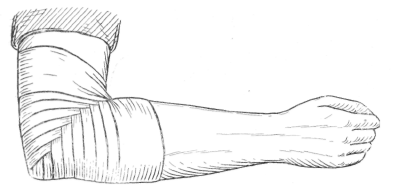
Fig. 114.—Divergent Spica for Elbow
A sling for the arm can be made of a square of calico or silk, or with a neckerchief. Fold the square corner-wise, making a triangular bandage ; place one end over the shoulder of the uninjured side, with the corner to the elbow, and the bandage hanging down in front ; take it up over the forearm, which is bent, and over the opposite shoulder, and tie the two ends at the side of the neck, then double back the corner over the elbow and pin. This supports the forearm. A narrow sling is made by folding the triangle on itself.

Fig. 115.—Triangular Bandage as Sling.
Sometimes an arm is ' put up ' with the fingers touching the opposite shoulder. In this case the elbow requires support. The same bandage is used, but the corner is placed on the opposite side—that is, beyond the hand—and the lower border or folded side of the triangle is at the elbow ; one end is placed, as before, over the shoulder of the injured side, the bandage is brought over the arm, and the two ends tied at the side of the neck ; the corner is folded up and over the forearm, and pinned to the bandage at the neck on the injured side.
Continue to:


My Books

