


(B) Clapping
Description
This section is from the book "Massage Its Principles And Practice", by James B. Mennell. Also available from Amazon: Massage It's Principles and Practice.
(B) Clapping
The hands are held so that the fingers and palm form a concave arch, and in this position they are brought sharply into contact with the body. The result is a rather deep-toned clapping sound. Applied to the chest, it aids the interchange of gases, stirs up the residual air, and assists in the loosening of mucus. This movement, like hacking, should be performed chiefly from the wrists (see Fig. 14).
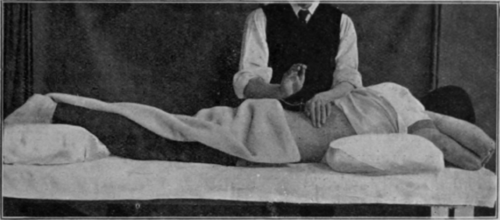
Fig. 14. - Clapping. Note the wrist action and the manner in which the pillows are arranged for the comfort of the patient.
Ordinary hacking is used over the chest in the treatment of heart cases, but requires great care. Its action on the heart (if any) is due to reflex; but, if vigorously performed, it might act directly on the heart muscle. The effect on the lungs is similar to that of clapping. Over the abdomen the application of hacking or clapping assists to tone up the abdominal muscles through the agency of the abdominal reflex, and can stimulate peristalsis by the mechanical stimulation of the unstriped muscle of the bowel. These movements should rarely, if ever, be used on the abdomen. If used, the performance must be very gentle.
Some students are actually taught to perform the hacking movement against the sharp edge of a marble mantelpiece. This may be a wise precaution when the individual attention given during training is inadequate to ensure the development of a satisfactory technique.
When efficiently performed the application of these movements is most pleasing and refreshing. For this reason it is sometimes a good plan to use either clapping or hacking as part of the treatment to be given between the performances of various exercises; but almost any other form of massage serves at least equally well.
Continue to:


My Books

