


(C) Beating. Part 4
Description
This section is from the book "Massage Its Principles And Practice", by James B. Mennell. Also available from Amazon: Massage It's Principles and Practice.
(C) Beating. Part 4
The second source of disappointment in the effect observed after massage treatment is to be found in misuse rather than in abuse; and, as a general rule, this is to be observed when massage has been called upon to "work up" the strength of a muscle or to re-educate it in the performance of its latent or forgotten function - in other words, in those cases in which massage has been expected to achieve results that can only be attained as the result of voluntary contraction or of skilled re-education.
It is not uncommon to find that a misconception of the word "stimulating" has arisen in the minds of some masseurs. They appear to believe that only the more or less vigorous or violent movements of massage have a stimulating effect. This is incorrect. Even the light surface-stroking massage aims at nothing save so to stimulate the sensory nerves that a reflex response may be secured. Deep-stroking and all forms of compression massage owe their reflex action either to a similar process of stimulation or to reflex response to a mechanical stimulus. All forms of massage are essentially stimulating, even if the effect of the stimulus is such that the patient is conscious only of a sedative effect. Just as morphia or heroin may serve as the best cardiac stimulant, so surface-stroking may be the best form of "stimulating" massage to administer to a patient. But the delusion is deep-rooted - and it will die hard - that "stimulation" in massage is impossible without the expenditure of muscle energy and vigour. A delusion, nevertheless, it is; and nothing will eradicate it until the time comes when the duration of training for the massage student is adequate to ensure a sufficiency of clinical experience. This, and this only, can impart a full appreciation of the use and abuse of massage.
Two movements remain to be described which, although they may be performed in a special manner, as separate movements of massage, can yet be imitated so closely under suitable circumstances by other movements that they hardly merit separate notice. They are vibration and shaking.
Let us return once more to our conception that a healthy limb, in which the muscles are relaxed, may be compared with a rubber hot-water bag filled with fluid. Thus almost the faintest touch can send, as it were, a wave of movement throughout the limb. This fact established, it is clear that any of the movements already described, with the exception of the superficial stroking, are able to impart in a greater or less degree a vibration or shaking movement throughout the area of the limb treated.
In disease, however, we must imagine that the water in the hot-water bottle is replaced by treacle, liquid glue or dough, according to the condition present; and, in addition, we must imagine that sometimes the bag is divided into compartments, each communicating with its neighbour by a comparatively small opening. Each phase would offer more resistance to the transmission of vibration, and hence we are bound to devise some effective means of overcoming the resistance when dealing with pathological conditions which have increased the "viscosity" of the "fluid" content of the "bag" of skin surrounding the limb.
For limb treatments particularly, and for special cases elsewhere, hand vibration is a poor substitute for many of the mechanical vibrators on the market. The best are those run from an electric motor contained in the apparatus. The rate at which the vibrations can be administered should be under control. Although the vibration is so "fine," it must be classed as a "stimulating" movement. Therefore these instruments should only be applied with caution, and never to the same spot for more than two or three moments at a time. For reducing cedema, stretching adhesions, loosening scars, and even for loosening joints, vibration is invaluable. The addition of vibration to deep stroking of the abdomen may assist the mechanical stimulation whereby we hope to secure the reflex contraction of the unstriped muscle. All massage movements intended to act on any organ under cover of the ribs by direct stimulation, do so only as the result of the vibration transmitted from the chest wall.
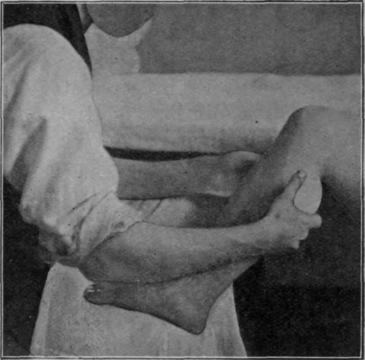
Fig. 15. - Shaking the calf-muscles. Note the loose grip, and that both hands can work simultaneously.
Nerve vibrations are much advocated: nothing need be added about them to what has already been said on the subject of nerve frictions.
Shaking is merely a coarse vibration. When dealing with a limb the most satisfactory method of administering shaking is to apply the hand to the surface as if preparing to perform the deep stroking movement, subsequently withdrawing the palm slightly, leaving the fingers in contact with one aspect of the limb, the heel of the hand or the extended thumb being in contact with an adjacent surface (see Fig. 15). The whole hand is then moved as if the deep stroking were to be performed, but, at the same time, a quick, firm, vibrating movement from side to side is added.
Although vibration and shaking, when performed as special movements, resemble percussion massage more closely than any other variety, it is essential that they should be performed with all the muscles in a state of complete relaxation. Care must be taken, therefore, that the movements are not sufficiently violent to excite a protective reflex contraction. This frequently occurs if great rapidity of vibration is employed with a mechanical vibrator, but usually it denotes that undue pressure is being exerted. When any shaking movement is applied to the abdomen care must be taken to ensure that the position of the patient is such that the abdominal muscles are completely relaxed, and that no surface irritation excites their reflex contraction.
Continue to:


My Books

