


(C) Petrissage
Description
This section is from the book "Massage Its Principles And Practice", by James B. Mennell. Also available from Amazon: Massage It's Principles and Practice.
(C) Petrissage
Petrissage and kneading are so similar in effect that distinction between the two is uncalled for. The term is usually applied to a movement that consists of "picking up," as it were, the tissues and submitting them to intermittent pressure. The technique varies slightly in different parts of the body.
It is used for the treatment of the skin and subcutaneous tissues, and serves a very useful purpose when we try to revitalise a dry, scaly skin which has lost its nutrition as a result of long splintage with, or sometimes without, sepsis. To attain this end it usually suffices to pick up the skin and subcutaneous tissues between fingers and thumb and to submit them to a gentle rolling movement. Not only are the tissues rolled between the digits, but the portion so grasped is slid about on the tissues immediately underlying them. It is well, but not essential, that the muscles should be held in a state of contraction. Both hands usually work together. No great pressure is called for, only enough, in fact, to ensure the raising up of the flesh between the manipulating fingers. Dry cupping is of great value in this respect. The technique is described in Chapter XXVI (The Treatment Of Constitutional Disorders).
For the reduction of adipose tissue, on the other hand, a soft though firm grip is required. A considerable amount of energy may be expended, as now we are attempting by our massage to perform a feat which must amount to little less than the emulsifying of the fat in the connective-tissue cells so that the fat globules may escape into the lymphatic system and be carried away from the part under treatment. It is possible that some of the fat may be "burnt up" by the local increase in temperature due to the local hyperaemia in the part manipulated. It is a claim frequently made, but on what evidence is not clear. Personally I am more than dubious as to the possibility of such a process taking place. At least it is safer to be sceptical until the possibility is established by definite scientific research. Until this has been done, the statement can only be made on inadequate grounds, and to put forward unfounded claims tends to bring the whole art of massage into disrepute. In treating this condition the fingers may be allowed to glide over the surface while the pressure is being gradually increased. The movement is not comfortable, but any pain which may be caused should be instantly relieved by a little gentle stroking.
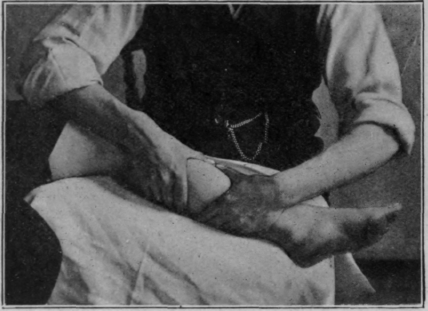
Fig. 12. - To illustrate "picking up" of the calf muscles. The flexion of knee combined with plantar flexion of ankle ensures relaxation. Adequate lateral support for the knee is essential in this position. If the masseur stands at the end of the bed, the foot should rest with its plantar surface upon it, the knee being flexed to nearly a right angle (cf. Fig. 15, p. 60).
Otherwise the movement of picking up is reserved for the treatment of muscle tissue and for the stretching of adhesions and scar tissue, whether these consist of definite bands or of a general matting together of the tissues.
The movement consists of grasping the muscle mass between the fingers and thumb of both hands and raising it away from the subjacent tissues. The tissues grasped are then compressed alternately between the thumb of one hand and the fingers of the other. The hands are made to slide gently over the surface till the whole region has been manipulated. Care should be taken to avoid an all too common error in technique, namely, the dragging of the fingers over the surface as if treating adipose tissue, instead of merely exerting an intermittent pressure. The grip should be soft, the whole hand relaxed. Sometimes, when the muscular tissue is sufficiently bulky, each picking-up movement is made to alternate with a kneading movement.
A third method, applicable chiefly to the calf, is performed by picking up the muscle in one or both hands and carrying it from side to side with an inclination to upward movement at the same time. The result is almost a semi-circular movement (see Fig. 12).
It will be seen that the last method of performing the movement amounts to little more than grasping a muscle group and shaking it. The same effect can be attained by kneading, by rapid deep stroking, or indeed by almost any manoeuvre of massage. By them all - provided there is complete relaxation - any soft tissue can be submitted to a "shaking-up" process, the severity of which must depend on the condition we are trying to remedy.
All that has been said under the heading of "kneading" applies with equal force to the picking-up movement, but it is well to emphasize the two cardinal points: first, that absolute relaxation is essential; and, second, that, given relaxation, no force or vigour is required to attain the fullest possible benefit. Any movement that calls forth a protective contraction can only defeat our aims, and should be regarded as an error in technique.
Continue to:


My Books

