


Massage Treatment In Neurasthenia. Part 4
Description
This section is from the book "Massage Its Principles And Practice", by James B. Mennell. Also available from Amazon: Massage It's Principles and Practice.
Massage Treatment In Neurasthenia. Part 4
1 Stroking is the only movement in which perfection of rhythm can be attained.
"So far I have spoken with the confidence bred of experience. When the question is raised as to the manner in which the massage or stroking can possibly act, we pass at once to the realm of speculation, that is, of uncertainty. One thing, nevertheless. I can assert without fear: that there is in it no element of mesmerism or any other more or less occult science. For my own part, I believe that the action of the massage is purely physical, and that the following explanation approaches to the truth. If we consider two of the impressions that reach the brain, vision and hearing, we find that the chief thing they possess in common is that they are transmitted thereto by rhythmical waves; and we know that, in the case of hearing, certain variations in the rhythm are apprehended and recognised by the brain. Such is the nature of our perception of music. It is probable that all other sensations are due to the arrival in the brain of rhythmical impulses by way of the various sensory nerves. In the same way, we know that, in all probability, the contraction of muscles during life is due to the sending out by the nerve-cells of rhythmical impulses along the nerves. An amplification of this is found in the proverb that habit is second nature, which means that by practice and repetition human life, its functions and actions, are subdued to a natural rhythm.
"Now, my interpretation of neurasthenia is that the rhythm of life is disturbed, and that the nerve-cells, which normally send out certain impulses in a rhythmical manner, lose their control when afflicted by this disease, and rhythm vanishes. The result is that, in response to a stimulus, there occurs a sort of explosion of nervous energy which continues until the cells are more or less exhausted according to the severity of the illness. Take, for example, a case of insomnia. The patient gets into bed 'dog-tired,' but the act of lying down or possibly of touching the bed-clothes constitutes a stimulus and causes an explosion of nervous energy which effectively prevents the patient from sleeping. Only when the explosion is more or less exhaustively complete, will the patient snatch a little fitful sleep.
"My attention was drawn to this point in a recent case in which the neurasthenia took the form of violent vaso-vagal attacks resembling angina. I think I may say that the explosions of nervous energy, on the part of some of the nerve-cells connected with the heart, completely puzzled the three highly competent observers whom I was able to consult. I have yet to see the case of neurasthenia that could not thus in some degree be accounted for: certainly this explanation of the symptoms is frequently tenable, if massage treatment is to be the main curative agent.
"If this is the nature of neurasthenia, then its cure is to be found in restoring to the nervous system the lost rhythm. I believe this may be done by sending up to the diseased cells rhythmical impulses, by means of massage of the variety I have described. Rest alone, mental and physical, will sometimes effect a cure by reducing the inimical stimuli in quantity and quality; and so potent is this remedy in suitable cases, that it can even counteract the injurious effects of the heavier forms of massage. But if, rest by itself failing to secure recovery, some curative agent is required, then our one hope rests in the massage treatment for the trial of which I plead.
"My theory is all speculation, but it covers clinical facts. However, I am no authority on the voluminous literature on the subject of neurasthenia, and some such theory may, for aught I know, have been propounded before. All I would suggest is that, should anyone be called upon to deal with an intractable case of neurasthenia of whatever nature, he should bear the three points to which I have drawn attention in mind when devising his treatment. I do not think he will regret having done so, nor will his patient."
It is possible to give a few general hints as to technique, but nothing more. Every care must be taken to render the conditions for treatment ideal. A part must be chosen for the start where no pain or discomfort has ever been felt, and then the hand should make two or three movements first upwards and then downwards. The expert will be able to tell at once which will prove most beneficial; failing experience, the patient must be asked to state which movement is preferable. As mentioned in Chapter IV (The Movements Of Massage. I. Stroking Movements)., surface stroking seems to be the most difficult of all manipulations to learn. Temerity, perhaps, plays a large part in ruining technique, and "trying hard" to do the right thing is also sure to wreck it. Natural movement, combined with a degree of firmness, which should slowly decrease as the masseur becomes more expert, is what the beginner should cultivate. (See also p. 31.)
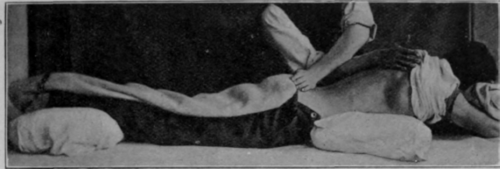
Fig. 126. - Stroking the back. The left hand is finishing one stroke while the right is preparing to begin. This is a very difficult movement, and requires great skill to attain perfection of rhythm.
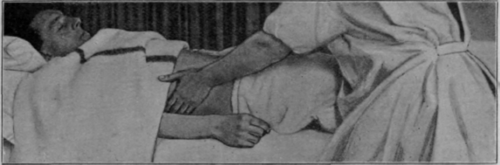
Fig. 127. - Stroking the abdomen with both hands. The beginning of the stroke.
No stimulating movement is to be given, so exposure must be reduced to the minimum, especially when dealing with the legs. One hand can support the bed-clothes while the other does the massage. In this way no part of the limb need be exposed during the treatment. It is well to have a hot-water bottle at hand, as cold feet and sleep are incompatible.
Continue to:


My Books

