


Pessaries
Description
This section is from the book "Intra-Pelvic Technic OR Manipulative Surgery of the Pelvic Organs", by Percy H. Woodall, M. D., D.O.. Also available from Amazon: Intra-Pelvic Technic OR Manipulative Surgery of the Pelvic Organs.
Pessaries
A pessary is to the displaced uterus merely a crutch, an artificial support to be discarded as soon as the natural ones can function. Should the various agencies supporting the uterus fail to resume their functions, then the pessary must be retained until something better can be provided. Pessaries do not correct displacements and the use of a pessary is rarely advisable until replacement has been accomplished.
In recent years the trend toward surgery has been so great, surgeons have become so skillful and daring that many cases formerly treated by the use of pessaries are now referred to the surgeon, consequently the use of pessaries is less common than it once was. The fact remains however that many patients can be relieved or cured of displacements by proper intra-pelvic technic supplemented, when necessary, by the use of pessaries. Besides there are many cases in which the hazard of surgery is either out of proportion to its possible benefits or is contraindicated altogether.
Pessaries remain most useful devices in the treatment of many common displacements and to discard their use is to limit one's ability to properly care for many troublesome conditions. A study of their application will amply repay anyone.
Pessaries are usually made of hard or soft rubber, occasionally of metal, glass or some other material. Besides the purpose of supporting the uterus and the vaginal walls they are sometimes used to straighten or dilate the cervical canal. They are arbitrarily divided according to form into (1) ring pessaries, (2) modified ring pessaries, (3) ball pessaries, (4) cup pessaries, (5) stem pessaries, (6) belt supported pessaries. (Figs. 47, 67.)
The ring pessaries need no special description. They may be made of hard rubber, or of a spiral spring covered with rubber, or a copper ring covered with rubber or of soft rubber and inflated with air. The inflated ring is perhaps most frequently used.
The modified ring pessaries are rings so modi fied as to be somewhat quadrilateral in form, having two lateral and an anterior and a posterior bar with the angles rounded. They have a slight S curve from behind forward, the posterior end looking upward, the anterior end downward. This curve is to conform to the curve of the vagina and is to prevent the pessary slipping out too readily. Of this form the most frequently used are the Hodge, (Fig 47), the Smith, (Fig. 48), the Thomas, (Fig. 49), and the Gehrung pessary, (Fig. 51).

Fig. 47. Hodge Pessary.

Fig. 48. Smith Pessary.

Fig. 49. Thomas Pessary.

Fig. 50. Thomas-Hodge Pessary.

Fig. 51. Gehrung Pessary.

Fig. 52. Byford-Smith.

Fig. 53. Inflated Rubber Ring Pessary.

Pig. 54. Rubber Covered Spring Wire Pessary.

Fig. 55. "Anatomical" Pessary.
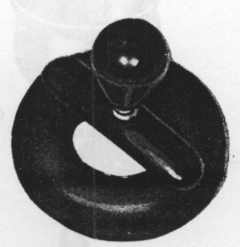
Fig. 56. Menge or Vienna Pessary.
The ball and the cup pessaries are not frequently used. (Figs. 57, 58.)

Fig. 57. Glass Ball Pessary.

Fig. 58. Aluminum Cup Pessary
Stem pessaries are so called because they are provided with a stem which projects into, and sometimes through, the cervical canal. (Figs. 59-66.)

Fig. 59. Aluminum Stem Pessary.

Fig. 60. Hard Rubber Stem Pessary.

Fig. 61. Glass Stem Pessary.

Fig. 62. Ferguson's Draining Pessary.

Fig. 63. Chamber's Stem Pessary.

Fig. 64. Soft Rubber Stem Pessary.

Fig. 65. Gold Stem Pessary. Closed with gelatine capsule for introduction and opened after introduction.

Introducer for Soft Rubber Stem Pessary.

Fig. 66. Wire Stem Pessary.
Belt supported pessaries are fastened to a belt which fits around the waist. From it rubber bands pass beneath the thighs and they in turn support hard rubber stems of various designs. These rubber stems pass into the vagina and are fitted at their upper ends with a cup, or a ring, to receive the cervix. (Fig. 67.)

Fig. 67. Belt Pessary.
Continue to:


My Books

