


1. Tubercular Tumour Of The Brain (Scrofulous Tubercle Of The Brain)
Description
This section is from the book "A Manual Of Pathology", by Joseph Coats, Lewis K. Sutherland. Also available from Amazon: A Manual Of Pathology.
1. Tubercular Tumour Of The Brain (Scrofulous Tubercle Of The Brain)
As already indicated, this is a very common lesion, being the most frequent form of tumour of the brain. It is a pure local tuberculosis, and may occur without any other tubercular manifestation. The symptoms are chiefly those of tumour of the brain, and the diagnosis of the kind of tumour is sometimes difficult.
The tubercular tumour occurs most frequently in young persons, and is often multiple. We have seen that tubercles are minute round bodies, but here in the brain substance we have solid tumours of a size increasing up to that of a hen's egg and larger. These massive tumours are composed of myriads of tubercles, along with the. products of their degeneration. The greater part of the tumour is made up of a firm yellow caseous mass, which resembles very closely in appearance a scrofulous gland (see Fig. 332). Sometimes the cheesy mass is directly continuous with the brain substance, but usually there is a transparent grey zone outside it, and this gradually merges in the brain substance around. This grey zone, when it exists, indicates that the tumour has been growing up till death, and it often contains tubercles of characteristic form. Sometimes there are no rounded tubercles in it.
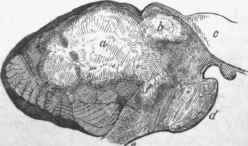
Fig. 332. - Tubercular growth in cerebellum. a, Main mass of tumour; b, part involving corpora quadrigemina; f, part projecting into fourth ventricle; c, third ventricle; d, pons.
And it forms simply a cellular zone. The grey tissue gradually merges in the brain substance, and both it and the brain substance show inflammatory conditions characterized by the presence of multitudes of round cells. The solitary tubercles are met with in all parts of the brain and spinal cord, but are most frequent in the cerebellum and pons, and next to that in the cerebrum.
The tumours in the cerebrum or cerebellum are almost always near the surface, and they sometimes lead to a local or general tubercular meningitis. In the cerebellum they may be so large as to replace almost the entire substance of a lobe (see Fig. 332).
Continue to:


My Books

