


2. Lateral Curvature, Rotatory Curvature, Scoliosis
Description
This section is from the book "A Manual Of Pathology", by Joseph Coats, Lewis K. Sutherland. Also available from Amazon: A Manual Of Pathology.
2. Lateral Curvature, Rotatory Curvature, Scoliosis
In the introduction to this subject we have seen that the mechanism of the spine allows of exceedingly limited lateral deviation. But it often happens that from habitual faulty positions at work or otherwise there is a frequently repeated tendency to lateral deviation. In that case, as a direct displacement is not possible, there may be, especially in persons constitutionally weak, a deviation with partial Rotation of the vertebrae. The faulty position may be merely the result of a bad habit, of standing on one leg for instance, so as to cause obliquity of the pelvis; or it may be from sitting in a constrained position at study or manual labour, so that either the pelvis is oblique or the arms are used particularly in one direction so as to displace the centre of gravity to one side; or there may be a hysterical contraction of the muscles of the scapula lasting for a long period and altering the centre of gravity; or there may be an obliquity of the pelvis from one leg being shorter than the other, as sometimes in rickets. There is also softening of the bones in rickets, and very considerable curvature may occur when this is associated with obliquity of the pelvis.
The mechanism of this rotation will be understood from the accompanying diagram (Fig. 286). The dark outline indicates the natural position of the vertebra, the dark straight lines indicating the natural axis and the direction of the transverse processes. When rotation occurs the bodies of the vertebrae move round so as to present to one side in the direction of the lines a a and a a, while the spinous process deviates very little. In the figure the centre of rotation is just behind the tip of the spine, and there is a slight deviation of it; but the centre of rotation may be at the tip of the spine, and with very marked rotation of the vertebrae there may be no deviation of the spines.
Lateral rotatory curvature is met with chiefly in the dorsal and lumbar regions, being, as a rule, much more extreme in the former, probably from' the greater mobility there (see Fig. 287). There is usually curvature in both these regions, the two curves being in opposite directions, and one of them in a certain sense secondary. It is not possible, however, to distinguish rigidly between primary and secondary curves, as the two form nearly pari passu; a slight deviation to one side will result in a similar curve to the opposite side, and they will increase together.
We have seen above in connection with Fig. 286 that the plane of the transverse processes is altered by the rotation of the vertebra?. An examination of that figure will show that the transverse process on the side of the convexity is considerably displaced backwards, and in actual cases it may be felt projecting under the skin. If the curve be in the dorsal region the ribs will be similarly displaced, and their angles will project. As shown in Figs. 287 and 288, the rib in that case commonly makes a sharp curve at its angle, so that it is greatly flattened laterally. The figure also shows that, in such a case, the capacity of the corresponding side of the chest is greatly diminished. The vertebras are rotated into that side of the chest, and the ribs are flattened towards the vertebrae these conditions sometimes attaining to such a degree that the bodies of the vertebrae approach the internal surface of the ribs. There is consequently great reduction in the capacity of this side of the chest, the lung being correspondingly compressed and curtailed in its movements. It will be seen also that posteriorly there is prominence of the angles of the ribs on the side corresponding with the convexity of the curve, while anteriorly the breast on the opposite side is prominent.
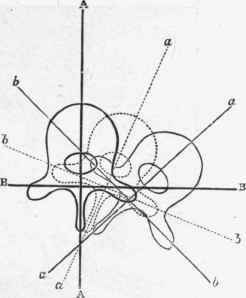
Fig. 286. - Diagram showing rotation of vertebra in lateral or rotatory curvature. The various lines show the positions of the body and transverse processes in the different degrees of rotation. The axis of rotation is behind the tip of the spinous process, where the three lines meet. (Adams).

Fig. 2S7. - Extreme rotatory curvature affecting chiefly the dorsal vertebra;.
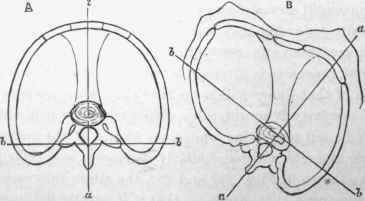
Fig. 288. - Diagrammatic section of normal chest and that with rotatory curvature. In the latter it is seen that the body of the vertebra is rotated into the right side of the chest, the rib on this side turning at an unduly sharp angle. The prominence of the transverse process on this side and of the breast on the opposite side is shown. (Adams.) This.illustration may be compared with preceding one.
The term Spondylolisthesis has been recently introduced to designate a rare condition in which, as a result of injury or inflammation, the fifth lumbar vertebra is displaced forwards so as to overhang the base of the sacrum. The vertebra carries with it the whole spinal column above it and projects into the pelvis and narrows it.
Literature
Pott, Remarks on that kind of Palsy which is often found to accompany curvature of the spine, 1779; Further remarks, etc., 1782; Ward, Prac. obs. on distortions of spine, etc., 1822; Shaw, in Holmes' Syst. of Surg., 1883; Adams, Lectures on curvature of spine, 2nd ed., 1882; Little, in Holmes' Syst. of Surg., 1883; Neugebauer, Zur Entwickelung d. Spondylolisthesis des Beckens, 1882; also New Syd. Soc. transl., 1888; Swedlin, Arch. f. Gynaek. xxii., 1883; Krukenberg, ibid., xxv., 1884; Chiari, Prag. Zeit. f. Heilk. xiii., 1892 (literature).
Continue to:


My Books

