


Erosions Of The Stomach. Part 2
Description
This section is from the book "Diseases Of The Stomach", by Max Einhorn. Also available from Amazon: Diseases of the Stomach.
Erosions Of The Stomach. Part 2
Emaciation
Most cases lose in flesh during the first period of their sickness, but thereafter keep up their weight quite constantly. They look rather thin in the face (the jaws protrude, the cheeks are thin and somewhat hollow), but do not present that cachectic color we are accustomed to meet in carcinoma and other grave chronic troubles.
Feeling Of Weakness
All patients complain of a feeling of lassitude, weakness, lack of ambition, and inability to work, and of a decrease of bodily strength. These symptoms appear most markedly right after meals, and decrease somewhat a little while afterward (one-half to one hour). In one of ray patients (G.
B------) there usually appeared, once in a week or in a fortnight, an exacerhation of these symptoms associated with complete anorexia, which lasted for about two days. During this period of deterioration the patieut was hardly able to walk.
Objectively the following point is of the greatest importance: in washing the stomach, when the patient is in the fasting condition, one to four small pieces of gastric mucous membrane are found. They are about 0.8 to 0.4 em. long and nearly as wide, and present a blood-red color. Under the microscope one caused by the tube, for while, on the one hand, this sign is present even if the lavage is performed without any aspiration and by means of a soft tube, on the other hand, one could not observe in a casual lesion that constancy which is found here.
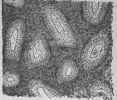
Fig 60. - A Piece of Gastric Mucosa (patient M. G.), showing the glands mostly vertically cut, and accumulations of red blood.corpuscles on the lower right-hand sees well-preserved glands and accumulations of red blood corpuscles (see Fig. 60). These pieces of gastric mucosa are constantly found if the stomach of the patient is washed out in the fasting condition. We have not to deal here with an incidental lesion.
In most cases blood is never found in the wash-water carrying the small pieces of mucous membrane. Only rarely has the wash-water a very faint red color; this occurs especially if coughing spells frequently appear during lavage. Besides containing the pieces of gastric mucosa, the water is then stained slightly red.
The pieces of gastric mucosa which are found in the wash-water of these patients probably partly or wholly peel off from the mucous membrane of the stomach some time previous to the washing. This would explain why there is no bleeding during the lavage. The spots on which the exfoliations take place and which thus present "erosions," may explain the soreness met with in these patients. One can also easily understand the appearance of blood from the sore spots caused by violent contractions of the stomach during a coughing spell.
It is very difficult at present to decide whether the exfoliations always take place at the same spots - the mucous membrane constantly becoming replaced and peeling off - or whether the whole (or a great part) of the inner surface of the stomach is affected to such an extent that small pieces of mucosa easily peel off here and there. This question can only be answered after a long study of vast clinical and pa-thologico-anatomical material. These exfoliations take place (whether always on the same or on different spots) day by day in the stomach of our patients, and effect temporary erosions.
Continue to:


My Books

