


Other Methods Of Testing The Gastric Secretion
Description
This section is from the book "Diseases Of The Stomach", by Max Einhorn. Also available from Amazon: Diseases of the Stomach.
Other Methods Of Testing The Gastric Secretion
Notwithstanding the great importance of the results derived from chemical analysis of the stomach contents obtained by means of the soft-rubber tube, this com-paratively new method has not as yet been generally adopted by the medical profession, for the reason that the examination by means of the tube is often unpleasant and repugnant to the patient. Moreover, some patients absolutely refuse to undergo this method of examination. To obviate these difficulties several other methods have been devised:
1. Gunzburg's1 Method
Patient swallows 0.2 gm. potassium iodide enclosed in a small rubber bag fastened with fibrin threads. After the disintegration of the fibrin by digestion, the rubber bag opens and the potassium iodide is now set free and ready for absorption. As soon as iodine is detected in the saliva, we are sure that the fibrin has been digested and from this Gunzburg concluded the presence of hydrochloric acid. This method, though ingenius, is not adapted for practical purposes, for while, on the one hand, it necessitates examining the saliva for quite a period of time (one to two hours), on the other hand the appearance of iodine in the saliva does not conclusively prove that the fibrin has been digested in the stomach. The rubber bag may have escaped into the intestines, the fibrin may have been digested there, and the potassium iodide absorbed. Thus we cannot reach any decisive conclusion as to the condition of gastric secretion by this method. The same remarks apply to Sahli's method, which corresponds in most respects to the one just described.
1 Gunzburg: Deutsche med. Wochenschr., 1889, No. 41.
2. Spallanzani And Edinger's Sponge Method
Edinger1 fastened a small sponge to a silk thread which he caused his patient to swallow. After several minutes he withdrew the sponge from the stomach, and examined the contents squeezed out for hydrochloric acid. This method, which had been practised before by Spallanzani, is deficient in the following particulars: 1. The sponge is partly squeezed out during its withdrawal through the narrow passages (cardia and introitus oesophagi), and thus much of the gastric contents obtained is lost. 2. It absorbs some of the secretions of the oesophagus and pharynx. Thus the few remaining drops of gastric contents in the sponge are impure (that is, mixed with other fluids) and sometimes are altered in their chemical state.
3. Stomach Bucket (Einhorn2)
The bucket consists of a small capsule-shaped vessel (1 3/4 cm. long, 3/4 em. wide) made of silver; on the top there is a large opening surmounted by an arch to which a silk thread is tied, and a knot made at a distance of sixteen inches from the attachment.
1 Edinger: "Zur Physiologie und Pathologie desMagens," Deutsch. Arch. f. klin. Medicin, vol. 28, 1881.
2 Max Einhorn: "A New Method of Obtaining Small Quantities of Gastric Contents for Diagnostic Purposes." Medical Record, July, 1890.
Method: In order In obtain a sample of the stomach contents, proceed as follows: The bucket is dipped into lukewarm water, tilled and emptied. (This serves to make the inside of the vessel moist, so that it will more easily take up the contents of the stomach.) Then the patient is asked to open his mouth widely, and the bucket is placed on the root of the tongue (almost in the pharynx); the patient should now swallow once or twice.
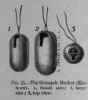
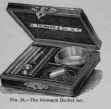
The vessel after a short time (one to two minutes) enters the stomach. Assoonas the knot of the thread is at the lips the bucket is in the stomach, for the distance from the teeth to the cardia is usually sixteen inches. The vessel is left there for about five minutes and then withdrawn. During the withdrawal of the apparatus a resistance is usually felt at the introitus oesophagi. To overcome this difficulty, when the apparatus is at that narrow point the patient should swallow.
By the act of swallowing the larynx is pushed forward and upward, and thus the passage is free and the bucket can be withdrawn easily. If the stomach is not empty, the bucket returns filled and the amount is sufficient for making various important tests. In people suffering from an abundant secretion of the mucous membranes the bucket might become filled with mucus before entering the stomach, and then in emptying the vessel one would find clear mucus instead of chyme. In such cases it is necessary to make the trial again and to cover the opening with a thin gelatinous capsule, which keeps away the mucus from the vessel on its way to the stomach; there the capsule is dissolved and the stomach contents can now enter the apparatus. On its return from the stomach, the bucket being filled, the mucus cannot to any extent enter it. The best time for obtaining a sample of the stomach contents is one hour after Ewald's test breakfast.
This way of obtaining a small quantity of gastric contents for examination does not give any trouble, nor does it cause any exertion to the patient. Even in ulcer of the stomach there is no danger whatever from hemorrhage as a consequence of the examination. For this reason the method seems to be especially adapted to all cases where there is suspicion of an ulcer in the stomach, and where we desire to avoid the tube. It is also suitable for the general practitioner who does not intend to make an exact analysis of the gastric contents, but who desires to determine whether there exists free hydrochloric acid or not. The gastric contents withdrawn in the bucket are examined directly without being filtered, in the following way:
1. By means of blue litmus paper it can be determined whether the contents are acid; if so, the paper turns red.
2. With Congo paper whether there are free acids or only acid salts. The presence of free acids turns Congo paper blue, otherwise the Congo color is not changed.
3. If there are free acids it is necessary to find out whether there is hydrochloric acid present or not. For this purpose take one drop of the contents and one drop of Giinzburg's solution and mix them thoroughly in a white porcelain dish. This dish is now heated over an alcohol lamp; when the fluid evaporates, a cherry-red color appears in the same spot whenever hydrochloric acid is present even in a very small amount.
4. The amount of hydrochloric acid, or the acidity, can be approximately determined by gradually diluting one drop of the contents with water until the above-mentioned Gunzburg's reaction for hydrochloric acid begins to disappear in the diluted fluid. Normally the stomach contents can be diluted from eight to ten times and yet will give the Gunzburg reaction. In this way cases in which we are able to dilute only five times, or even less, must be considered as cases of subacidity (too small amount of acidity), and cases in which we are able to dilute more than twelve times as cases of hyperacidity or superacidity (too large amount of acidity. In cases in which no acidity whatever is found, we have to deal with anacidity.
Recently 11 gauged the amount of hydrochloric acid and also that of the total acidity approximately by means of a strip of paper saturated with a one-half -per-cent dimethylamido-azo-benzol solution and dilution. The method is as follows: A minute quantity of stomach contents is placed by means of a glass rod upon a strip of dimethylamido-azo-benzol paper (0.5 by 8 cm.). If the paper turns red, one drop of the contents is diluted with two drops of water in a small porcelain dish. A glass rod is dipped into the mixture and the test paper again touched. If it still turns red, one or two more drops of water are added and the procedure is repeated as before. This is done until only a slightly red or almost no red color is produced by the mixture upon the test paper. In this way the amount of dilution required for a trace reaction with the test paper is determined. It is clear that the more hydrochloric acid there is in the stomach contents the more they can be diluted, still giving a trace reaction with the dimethylamido-azo-benzol paper.
A dilution of from 3 to 6 corresponds to a normal, under 3 to a subnormal acidity, and over 0 to hyperacidity.
The numbers given refer to the examination one to one and one-half hours after Ewald's test breakfast. If we have to test after other more complicated meals (test dinner, etc.) hyperacidity would be indicated by somewhat smaller amounts of dilution (from about six times on), since we estimate approximately only the free hydrochloric acid, and the amount of the latter is relatively small after meals containing much albumin.
1 Max Einhorn: " A New Method of Determining Approximately the Amount of Hydrochloric Acid in the Gastric Contents." Medical News, July 20th, 1901.
5. Pepsin and rennet, the two ferments of the stomach, generally accompany each other, and we can deduce the presence of one from that of the other. We prove the presence of the ferments by making the following test for the rennet ferment: Two drops of the stomach contents are mixed with about 2 c.c. of milk and kept either in a warm place or in a glass with warm water. The presence of rennet curdles the milk in from ten to twenty minutes.
Dr. Dickinson,1 of Erie, Pa., has made a comparative study of the results obtained after an examination by means of the tube and a minute analysis of the filtered gastric contents, and the result gained after examination with a stomach bucket and the coarse method of analysis just described. He examined thirteen persons by means of both methods, and found that the results harmonized pretty closely. The degree of acidity corresponded quite accurately to the figure obtained by dilution.
The examination with the tube is as a rule preferable to that with the stomach bucket, as the quantity of gastric contents obtained with the former is certainly larger, and permits a more detailed examination. Wherever, however, the examination with the tube is either contraindicated, or where the patients refuse its introduction, the examination with the bucket will certainly be able to replace the tube and afford us more thorough information as to the secretory functions of the stomach.
1Dickinson: "A Comparative Study between the Results Obtained by Examination of the Stomach Contents by Means of a Stomach Tube and Einhorn's Stomach Buckct." Medical Record, September loth, 1894.
Continue to:


My Books

