


Animal Hypnotism. Continued
Description
This section is from the book "Hypnotism And Hypnotic Suggestion", by E. Virgil Neal, Charles S. Clark. Also available from Amazon: Hypnotism And Hypnotic Suggestion.
Animal Hypnotism. Continued
It is a matter of popular knowledge that a sitting hen may readily be changed from nest to nest, if her head be tucked under one wing and her body rocked to and fro slightly. An animal thus treated will continue sitting on any nest in which she has been placed. Children often amuse themselves by turning a chicken's head back under its wing and then laying it on the ground. Sometimes in such cases the animal lies as if dead for several minutes.
The earlier experimenters made use of strings, chalk lines and other objects in the hypnotizing of hens. Kircher's method was as follows: ,he tied a hen's legs together, to prevent escape, laid it on a table and after struggling had ceased, drew a chalk line across the table parallel to a line passing through the animal's eyes. The legs were then freed, but usually the subject would lie still for five or even thirty minutes.
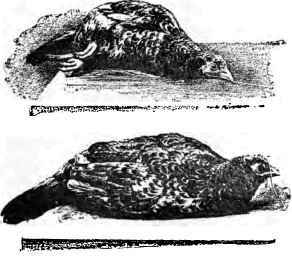
Further experimentation showed that the string or chalk line to which Kircher had ascribed great power was entirely unnecessary. Merely holding a hen in one position for a time ordinarily sufficed to bring on the hypnotic condition. Because of this some authors concluded that the lines were without effect. But pigeons, it was discovered, could not be made quiescent by holding alone; however long one restrained their movements they would fly away as soon as released. They could easily be hypnotized, however, by holding a finger or any small motionless object in front of their eyes and in line with the bill. In this case the bird's eyes became fixed upon the object and there apparently resulted something similar to what we call concentration of the attention.
Methods, in principle the same as this, are extensively used in the production of human hypnotism. By Braid's method, for example, the subject is influenced through gazing intently at some object; so in Luy's method the attention is fixed on a rapidly rotating mirror, and likewise in the Nancy method the subject looks at some object while the operator suggests drowsiness or sleep.
Czermak says in this connection, "With hens I often brought a piece of twine or a small piece of wood directly over their crests, so that the end fell before their eyes. The hens remained motionless, closed their eyes and slept, sinking to the table." From this it seems pretty certain that the lines do influence the hen, although the state may be induced without them.
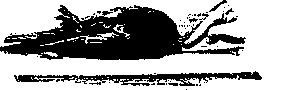
The condition of a hypnotized hen, as now known, may be described thus: the body is motionless in any given, stable position, the eyelids move occasionally, the eyes may be closed, though usually open. I have noticed that Florida chameleons and frogs during the early stages of hypnosis open and close their eyes irregularly and slowly. The hen's legs and wings may move slightly; usually they are held in one place, but without rigidity, and any position given them is maintained. Trembling of the extremities has been noticed. The heart beat, and respiration are at first increasingly rapid, later they become slow. It is said that the temperature does not change. From five to ten minutes is the common duration of the state in hens, although it has been known to last half an hour. The spell seems to be broken suddenly, the animal coming back to normal activity with a start or jump.
For frogs, as for the other animals considered, no elaborate method is required to bring on the hypnotic state. Under ordinary conditions a frog rendered motionless by restraint of movement will remain so for several minutes, and if precautions be taken to prevent stimulation by light, sound, contact or other strong irritants it may be kept so for hours.
A frog in process of hypnotization at first struggles violently to escape, but finally quiets down and becomes motionless except for trembling of its legs, eyelid movements and occasionally body motions. The breathing is at first rapid and irregular, it may sometimes be inhibited; in later stages it becomes slow. Preyer says it may sink from 96 or 100 to 28 or 36 times a minute. The heart beat is also more rapid at first.
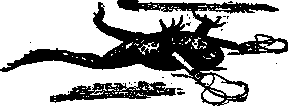
Preyer mentions the following interesting differences between sleep and the state which he terms "Kataplexie" for the benefit of those who think them identical.
1. Sleep is not easily induced in new or unnatural positions as is Kataplexie.
2. Excitement and violent movements tend to prevent sleep, but are not unfavorable to Kataplexie.
3. A sleeping animal takes the relaxed position indicative of fatigue; a kataplectic subject is commonly in a state of muscular tension.
4. After being forcibly held or restrained from motion animals do not sleep well, but they readily become kataplectic
5. In sleep the toes are not widely spread nor the extremities raised as in Kataplexie.
6. The eyes usually closed during sleep are often open in the kataplectic state.
7. The respiration in sleep is deepened and prolonged, always regular; in Kataplexie it is markedly irregular.
8. During sleep the heart beat is regular and somewhat slow; in the artificially produced quiescent condition it is now rapid, now slow, often very irregular.
9. Kataplectic appearances are not normally present in sleep.
10. Chewing movements are seldom seen during sleep, although common in Kataplexie.
11. Sleeping animals do not tremble as kataplectic subjects do.
12. Defecation is rare during sleep and common in Kataplexie.
13. In the presence of strong stimuli, such as noises, heat, cold* etc., sleep is almost impossible, whereas Kataplexie is easily induced.
14. For the induction of sleep the removal of strong stimuli acts favorably, but a very strong stimulus, on the contrary, is necessary to produce Kataplexie.
15. Sleep tends to last longer than a few seconds; Kataplexie on the other hand never lasts very long. 1
We have now to ask the cause of this peculiar phenomenon called by different authors Sleep, Kataplexie, or Hypnotism. That it is not precisely the same as human hypnosis is certain; that it is not as much like the human state as the animal's structure and mental development justifies us in expecting, is far from clear. Verworn says, "With human hypnosis, which is purely a phenomenon of suggestion, this state (Animal Hypnosis) stands only in an external relation, in so far as inhibition of action is characteristic of both. But not every inhibition phenomenon is to be characterized as hypnosis. The essential thing in the condition is the tonic reflex which gives the animal hypnotic state its strikingly odd appearance."" 2 Granting Verworn's assumption, that human hypnosis is essentially a suggestion phenomenon, it is by no means certain that the so-called animal hypnosis, although caused by methods which seem different from the suggestion methods, is entirely unlike hypnotism in man. It would in all probability be just as true to say that man's mind is entirely different from a dog's. Just because of the vast difference in mental development between man and the brute, these similar states must be produced by different method,.
1. The above is a free and somewhat abbreviated translation from Wm. Preyer's "Die Kataplexie und der thierische Hypnotismus," p. 77-78.
2. Verworn, "Die segenannte Hypnose der Thiere," p. 92.
Fear has been taken by some as the sufficient cause of animal hypnosis; and, inasmuch as it is known to cause, at times, loss of movement or paralysis in men and animals, this is not strange. Wild animals we are told are most susceptible, therefore fright is important; but on the other hand this is denied, and ability to concentrate the attention is said to be the chief determining factor in susceptibility to hypnotization. Whatever part fear may play, it is now clear that it is not an important cause, for even the tamest animals may easily be influenced.
Evidently in this phenomenon the restraining of natural movements so effects the central nervous system as to cause the temporary inhibition of both voluntary and reflex movements. Normal excitability and mobility are lost; why or how we are at present unable to say. In both human and animal hypnosis the important thing: undoubtedly is inhibition, and if it could be shown that the states differed only in manner of production, their close relationship would be indisputable.
The figures are from Wm. Preyer's, Die Kataplexie und der thierische Hypnotismus. Preyer In turn credits them to Czermak.
Czermak, J. N., Nachweis echter hypnotischer Erscheinungen bei Thiere. In Sitzungber. d. Akad d. Wiss in Wein. Bd. LXVl Abt. 3,1872.
An English translation of this article by Ciara Hammond in Popular Science Monthly. Vol. Ill, 1873.
Danilewsky, B., Ueber die Hemmungen der Reflex - und Willkurbewegungen. Beitrage zur Lehre vom thierischen Hypnotismus. In Pfluger's Archive, Bd. XXIV, 1881.
Heubel, Emil, Ueber die Abhanglgkeit des wachen Gehirnzustandes von ausseren Erregungen. Ein Beitrag zur Physiology des Schlafes und zur Wiirdigung des Kircher'schen Experimentum mirabile. In Pfluger's Archive. Bd. XIV, 1877.
Preyer, Wm., Die Kataplexie und der thierische Hypnotismus. Jena, 1878, pp. 100.
Verworn, Max, Die sogenannte Hypnose der Thiere. Jena, 1898, pp. 92.
Continue to:


My Books

