


Chapter XIII. Animal Magnetism - Magnetic Healing
Description
This section is from the book "Practical Lessons In Hypnotism", by Wm. Wesley Cook. Also available from Amazon: Practical Lessons In Hypnotism.
Chapter XIII. Animal Magnetism - Magnetic Healing
Long recognized by physicians - Dr. Alva Curtis - Philosophy of animal magnetism - Neuraura - Impressibles - Distinguishing mental power - How to recognize impressibles - Metal rod - Organs not equally impressible - Harmonious and antagonistic organs - Restoring mental balance - Diagnosing disease - Relief of pain - Curing headache - Relieving toothache and neuralgia - Relieving inward pains - Producing sleep in insomnia - Suppressing respiration - Regions of the brain - Perceptive faculties - Intellectual faculties - Propelling faculties - Unbalanced and well balanced brains - Doctrines of magnetic healing - Precautions to be observed - How to magnetize a person - Mesmeric passes - Experiments in animal magnetism - Examining diseased persons - Magnetic healers - Magnetic influence exerted by physicians.
The employment of animal magnetism in the treatment of disease has constituted an important part hi the general practice of a number of prominent physicians for many years. These physicians have not, as a rule, made a conspicuous display of their knowledge of the subject, realizing that the public in general were not prepared to sufficiently differentiate between their methods and those employed by ignorant charlatans. Nevertheless the great success that attended their efforts to relieve suffering through what we now call hypnotic influence, led them to impress upon their professional brethren the importance of a more thorough study of this valuable branch of medicine.
Among the first in America to employ "animal magnetism" in medical practice, was Alva Curtis, A. M., M. D., a highly educated and talented physician, who died in 1881. He attributed his remarkable success in practice to the scientific use of non-poisonous remedies and the mental influence he was able to exert over his patients. While not claiming to be a "magnetic healer," he nevertheless practiced and taught to his classes the art of "magnetizing," and as early as 1846, he published the formulated principles of animal magnetism that have ever since formed the basis of the practice of magnetic healing. The author, like many others, is greatly indebted to the genius and erudition of this remarkable teacher who devoted his life to the amelioration of his fellow men.
Philosophy And Method Of Dr. Curtis
The brain is a compound organ, to the distinct portions of which is assigned the performance of special mental functions. These separate portions, or organs, can be readily excited by the touch of the hand, and can be made to perform not only the peculiar functions of the brain, but of those of all the other portions of the body, increasing or depressing them at pleasure.
Magnetism (neuraura) may be made to proceed at will from every organ of the brain of every person, and to affect to some extent the organs of any other brain to which the fingers of the operator may be applied. Of course, the more of this magnetism a person has, the more effectually he can operate upon others; and the less he possesses, the more distinctly he perceives the influence of those who have the most, Thoss who have the least magnetism are termed impressibles. So sensitive are some of these to the influence of the magnetism of others, that whenever they touch an organ of the head or face of another, they feel, in themselves, the influence of the action of that organ, as strong or weak, healthy. or unhealthy, and are consequently capable of determining the relative power of different brains, or of the different organs of the same brain.
How To Determine Impressibles
To ascertain whether or not a person is impressible, take a smooth, metallic rod, about half an inch in diameter and a foot long. Put one end of this rod into the left hand of the subject and request him to hold it loosely; while with your own hand you grasp firmly the other end for some five to thirty minutes. If he is impressible and if you are a good operator, he will feel a diminution of sensibility, or a numbness (much like that of the limb going to sleep) creeping up his wrist, arm and shoulder and perhaps into his body. Some have described it as resembling a charge of electricity when insulated. If no impression should be made, either the subject is not very impressible or you are not a good operator. But if impressible at all, his organs are not all equally so. Those organs are the most impressible which have been the most frequently and powerfully irritated and inflamed. If the irritation and inflammation have become chronic, the effect is of a depressing character and in proportion to the recovery of a healthy tone this impressibility wears away.
In other words, the subject acquires more power to resist the impressions of the operators.
Every organ in the brain, as well as the body, has its anatgonistic organ, which is known through the study of phrenology. All these organs are constantly working in opposition to one another, so that a man's character is not decided by the strength or activity of either one of these, but by the balance of power between them.
The impressible subject feels very manifestly, whether pleasantly or painfully, the influence of the organ with which he is brought in contact. To prevent this influence from being disagreeable, he should always keep one hand near the antagonist of an organ when examining it with the other, so that if a disagreeable impression is about to be established, he can so touch the antagonist and restore his balance.
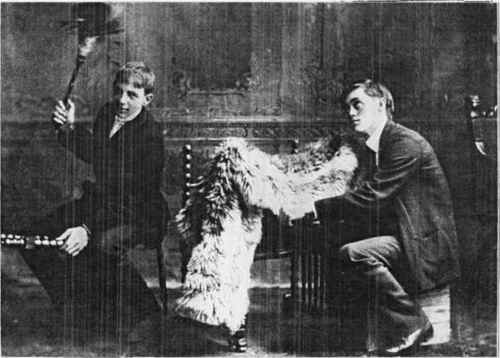
One of these subjects believes he is milking a cow, while the other thinks he is a jockey at a horse race.

These children are entranced by the sight of angels in the skies.
Having found a suitable, that is, a very impressible subject, he can determine by feeling on other heads, the locality of all those organs that are very active or much depressed, and thus ascertain the extremes of character or of disease, much better than he can their middle ground. Impressibles can operate on themselves, so as to relieve their own pains and aches.
Continue to:


My Books

