


Condition Of The Body
Description
This section is from the book "Practical Lessons In Hypnotism", by Wm. Wesley Cook. Also available from Amazon: Practical Lessons In Hypnotism.
Condition Of The Body
The operator as well as the subject should not be in a state of fatigue, if the best success is desired. It is true that deep hypnosis may be secured in a person who is completely "tired out" - exhaustion being really an aid in such cases. But deep hypnosis is not always desirable, and it is often very disappointing to realize that a subject shows no disposition to respond to any other suggestion than that of sleep.
For an operator to be physically tired is frequently disastrous. His subject soon realizes the fact and may fail to succumb to the most ardent efforts to hypnotize him. Worse than this, when the operator is fatigued and the subject full of energy and vigor, the operator may actually hypnotize himself while endeavoring to get his subject under control, and may by such an act forever lose control over the subject.
Pain may render hypnosis difficult by keeping the subject's mind constantly upon himself. But when pain has produced exhaustion, the sufferer usually yields without much difficulty. Fever is another unfavorable condition, although much good can be accomplished placing feverish patients under control. In the low grades of fever hypnosis is more readily induced.
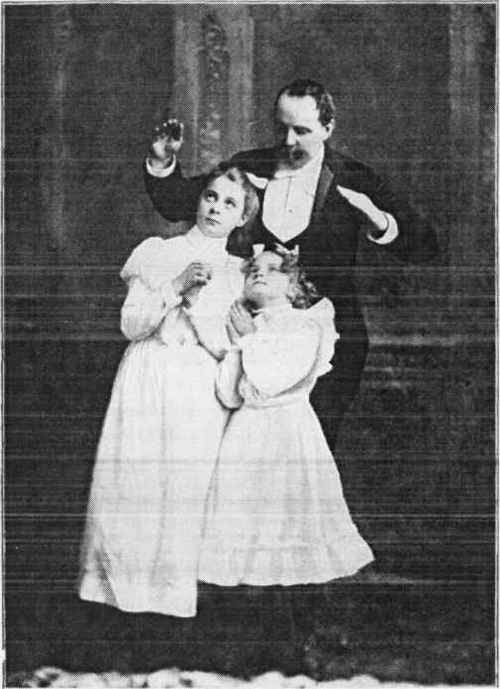
These children are entranced by the sight of angels in the skies.

Producing hypnosis by passes.
The condition of the skin is important. A moderately warm and dry skin is best for both operator and subject. Should either be bathed in perspiration, the result is liable to be unsatisfactory. During an exhibition the operator should have in his pockets several handkerchiefs and occasionally wipe his hands. Silk handkerchiefs arc best. A cold, clammy skin may prevent all action. Some persons habitually have their hands in such a condition, and they make poor subjects. Cold feet are also detrimental.
Influence Of Time
The time of day is not important, except as it concerns the condition of the body. Early morning finds an empty stomach, which is not good, and directly after meals finds the act of digestion at its height, which is not desirable. Late in the evening, the inclination to sleep may render hypnosis comparatively easy, but then it may be difficult to get a satisfactory response to any suggestions besides those of sleep. From an hour to two hours after meals is usually the most favorable time for operating upon a subject. This applies to both the subject and the operator. An expert hypnotist can successfully use a trained subject at any time of day.
Continue to:


My Books

